
RTG Neuromodulation (RTG 2783)
RTG Neuromodulation (RTG 2783)
P4 Sensor-based tracking of upper limb use in domestic environments
Motivation & Objectives
This project is part of the RTG ‘Neuromodulation of motor and cognitive functions in the healthy and diseased brain’ (GRK 2783): https://uol.de/neuromodulation
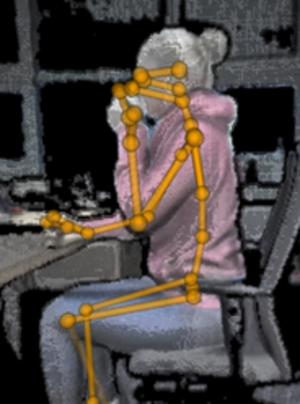
Around 50 per cent of stroke survivors experience impairments in activities of daily living (ADLs). ADLs are an important outcome measure for interventions aimed at improving upper limb function, although the assessment tools commonly used regularly fail to show significant improvements. Project 4 of the Research Training Group therefore aims to utilise body-worn inertial measurement units (IMUs) and depth-sensing cameras to, on the one hand, detect changes in arm movements whilst performing ADLs and, on the other hand, to classify different ADLs in stroke patients.
Approach
To achieve these objectives, the project will conduct two studies:
In the first study, IMU data as well as colour and depth images of stroke patients will be recorded before, during and after neurofeedback training. Activities of daily living, such as drinking or making a sandwich, will be performed as part of this. The data will be recorded both in a university laboratory setting and in the patients’ own homes. From this data, the arm movements of the stroke patients will then be extracted and changes over the course of the training period analysed.
In the second study, IMU and camera data are also recorded from healthy individuals and stroke patients in a simulated home environment. Here, participants are asked to perform simple arm movements, natural arm movements following a standardised procedure, and completely natural arm movements. This data will then be used to classify ADLs. Furthermore, an assessment will be made of how the quality of the movements is reflected in the data and the classification results.
Publications
Büker, L., Hellmers, S. and Hein, A. (2025). A Pre-Study on Tremor Classification During Activities of Daily Living. In Proceedings of the 18th International Joint Conference on Biomedical Engineering Systems and Technologies – HEALTHINF; ISBN 978-989-758-731-3; ISSN 2184-4305, SciTePress, pages 805–812. DOI: 10.5220/0013307400003911