
Ocean Sampling Day 2015
Ocean Sampling Day 2015
Ocean Sampling Day 2015 - Worldwide sampling of the microbial diversity of the oceans on the summer solstice
Oldenburg/Wilhelmshaven. The Institute of Chemistry and Biology of the Sea (ICBM) took part in Ocean Sampling Day (OSD) again this year with its Marine Sensor Systems Research Group (AG MSYS). Initiated by the EU project ‘Marine Microbial Biodiversity, Bioinformatics and Biotechnology’ (Micro B3), OSD 2015 took place worldwide for the second time (www.microb3.eu). The aim of the campaign is to sample the genetic diversity of microorganisms in the ocean. The activity of these tiny marine organisms is particularly high on the brightest day of the northern hemisphere, the summer solstice on 21 June. Around the globe, some 191 marine research institutions took surface samples on this day – whether in the Arctic, on Heligoland or along the coasts of New Zealand and the USA. This year’s OSD was also supplemented by measurements for the EU project ‘Citizens’ Observatory for Coast and Ocean Optical Monitoring’ (Citclops) (www.citclops.eu). The ICBM is a partner in this project, which focuses on investigating marine water quality.
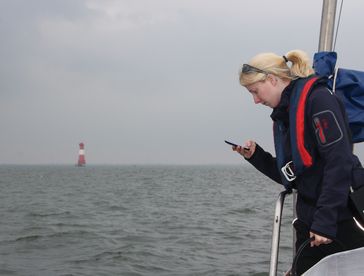
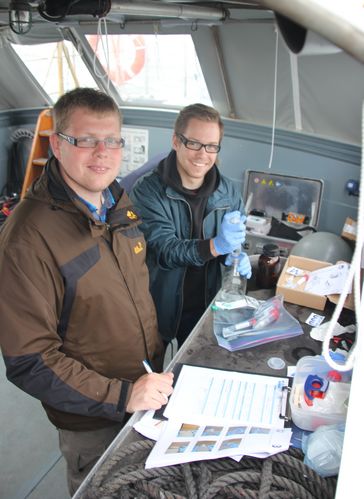
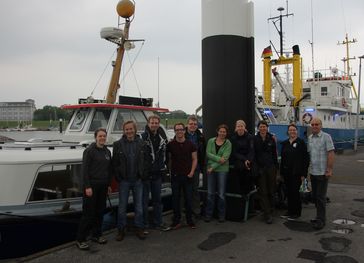
A small group of scientists and students, coordinated by Dr Julia Busch, a research associate at the ICBM, set out onto the Jadebusen in the research vessel OTZUM and took water samples at two locations there. Students on the Marine Engineering degree programme at Jade University of Applied Sciences in Wilhelmshaven used various sensors and a small CTD (Conductivity, Temperature, Depth) probe to record different environmental parameters, such as the pH value, temperature, salinity and oxygen content of the water. The measured parameters not only provide important information on the samples collected for the OSD, but also give scientists an insight into the condition of the North Sea in the Jadebusen area. The students also had the opportunity to gain practical experience in handling the measuring equipment. Dipl. Ing. Daniela Meier, a member of the MSYS research group, supported the OSD from the North Frisian island of Spiekeroog. Following routine investigations on artificial islands as part of the ‘Biodiversity – Ecosystem Functioning across marine and terrestrial ecosystems’ (BEFmate) project, she collected samples. The Max Planck Institute for Marine Microbiology in Bremen (MPI) is responsible for the subsequent analysis of the biodiversity samples collected worldwide. As soon as the DNA extraction and sequencing of the microorganisms have been completed and the first qualitative results are available, these will be published so that further research can be carried out collaboratively.
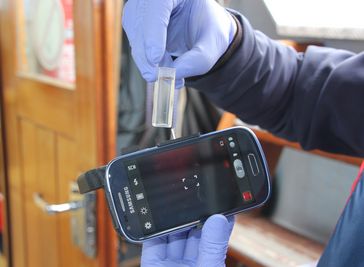
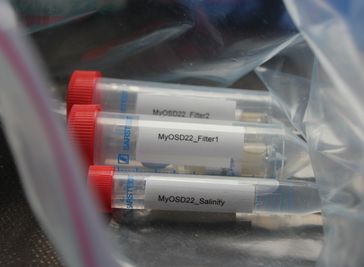
Although in science today everything is still often noted down with pen and paper, new methods of data collection, such as smartphone apps, are also being used. Easy-to-use apps that get the job done in just a few clicks make participation in marine research attractive to members of the public. During the OSD, interested members of the public were able to contact so-called OSD hubs – points of contact at marine research institutions – and receive the MyOSD sampling kit from them. This kit contains all the necessary materials, from gloves to thermometers and sample vials, so that sampling could be carried out using the OSD app. Dr J. Busch also acted as an OSD hub this year and distributed MyOSD sampling kits to interested members of the public. “The combination of Micro B3 and Citclops, with the aim of covering a wide geographical area with measurements in a single day, is ideal,” says Dr J. Busch, the Citclops contact at the ICBM, adding, “The statistics for the measurements taken using the Citclops app show us a high level of participation by both scientists and members of the public in this year’s OSD, which I am particularly pleased about.” This is because Citclops also enables the public to get involved in marine observation. As part of the project, apps are being developed for various measurements of water conditions. For example, by taking a photo of the water’s surface where the water colour is clearly visible, anyone can contribute important data to research in just a short space of time. During the OSD 2015 expedition, doctoral candidate Anna Friedrichs (MSYS research group) also had the opportunity to test the fluorescence adapter for smartphones that she had developed for Citclops.