
On contemporary Russian philosophy

On contemporary Russian philosophy
On contemporary Russian cultural philosophy
by Rainer Grübel
The twentieth century dealt a fatal blow to immanent eschatologies. Only die-hard proponents of progress still expect philosophical discourse to achieve self-enlightenment. In the West, a fear of catastrophe is spreading in the form of secular apocalypticism, which – as a negative counterpart to the progress-oriented Adventism of the 1960s and 1970s – focuses on the ominous forces of the times.
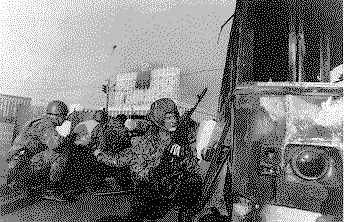
Russia in upheaval: the battle for the ‘White House’ during the old guard’s attempted coup in 1993
The collapse of the Soviet Union has unleashed far stronger centrifugal forces in Russia’s intellectual life, which, after decades of pressure on the centre, have allowed the periphery to become a source of insight. As a result of this released pressure, the Soviet Union – a bloc that seemed erratic even a decade ago – has been torn into an as yet indeterminate number of parts, without the Commonwealth of Independent States or even Russia in the narrower sense being regarded as equivalent successors. Just as after a moulting process that unexpectedly gave way to a division, the end of the body can no longer be felt from within. Suddenly, as with the nesting matryoshka dolls, there are several bodies of varying sizes. The east-west expanse, stretching from Vladivostok in Siberia to the Polish or Belarusian border, seems more fixed and tangible than the north-western and southern borders. Is it any wonder that, following the departure from Marxism ( 1992), Russian books with titles such as *The Russian Idea* or *On Russia and Russian Philosophical Culture* are in high demand?
The advocacy of Russia’s kinship with Asia, which is currently most influential in less educated Russian circles, can be traced back to the philosopher and linguist Trubetskoy, as well as to the geographer, economist and philosopher Savitsky, and was continued by the historian and geographer Lev Gumilev. Gumilev countered the ‘Eurocentric legend’ of the Tatar-Mongol yoke (1240–1480) with the view of a culturally fruitful symbiosis between the Mongol nomads and the East Slavic forest-dwellers. His thesis on the ‘passionarity’ of the steppe dwellers, which bases ethnogenesis on climate and landscape, is all too reminiscent of the foundations of Hippolyte Taine’s positivist cultural model, rooted in climate, landscape and race. (Gumilev uses the term ‘passionarity’ to describe the biochemical energy that a person has absorbed from their natural environment. It varies from individual to individual and, taken as a whole, determines the ‘passionarity’ of an ethnic group.)
Certainly, the Eastern Slavs were able to learn a great deal from the Turkic peoples and the Mongols about administration and warfare, and also some things about urban planning, but not about philosophising. Like the Orthodox religion, their written language, their literature and their modes of thought also originate from Byzantium. As a result of this Byzantine heritage, the East Slavic Middle Ages, right up into the 16th century, knew of no philosophy independent of religion: Aristotle was scarcely known, and the Arabic influences—which challenged Western European thought and were transmitted via Spain—failed to take hold here.
The Russian Orthodox Church resisted any teaching of philosophy at universities, with varying degrees of success, well into the 19th century, and from the 1920s onwards, Marxism-Leninism hindered academic philosophical education. Less than five years after the October Revolution, Lenin had philosophers and independent thinkers who had not yet emigrated put on two ships and sent to Western Europe. Russia, which had enriched Western European intellectual life with such eminent figures as Berdyaev and Frank, Lossky and Shestov, became a philosophical wasteland. The Bolsheviks executed the remaining philosophers, such as Pavel Florensky (1937) and Gustav Špet (1940).
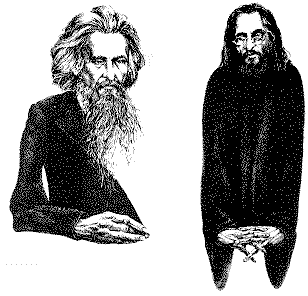 | Pavel Florensky and Vladimir Soloviev |
Skovoroda, the earliest East Slavic thinker, promoted the secularisation of thought from a religious standpoint through his gnoseological dualism of the visible (creaturely) and invisible (divine) worlds, as well as through his pragmatic ontology. The flip side is that immanence of the religious which continues to characterise philosophical thought in Russia to this day. Outside religion, yet always in dialogue with it, 18th- and 19th-century Russian literature—from Lomonosov through Pushkin to Chekhov—continued the secularisation of thought in the direction of a literary philosophy. We encounter this in Gogol’s religious writings as well as in Turgenev’s secular speeches and essays.
Russian Symbolism brought together, at the turn of the century, the two traditions – that of the philosophy of religion and that of the philosophy of literature – which, according to Western conception, were peripheral. And it was precisely during this period that Russian philosophy first flourished. It was shaped in equal measure by the lively influence of Hegel and by the lack of engagement with Descartes and Leibniz. Until very recently, Russian philosophers have read Spinoza more than the Enlightenment thinkers. Kant only found his way to Russia in the 20th century via the Marburg School.
Until a few years ago, the role of literature as a guide through the world of thought was significantly promoted by Russian and Soviet censorship, which was particularly strict on philosophical matters. Even today in Russia, those seeking guidance in matters of thought still read the works of Pushkin and Gogol, of Dostoevsky and Tolstoy, and also of Bulgakov and Platonov. What, in German, despite or because of Nietzsche, many find jarring about Benjamin’s style has characterised the tone of Russian thought from the very beginning: since Solov’ev and Rozanov, it has kept a ‘literary philosophy’ in motion.
This perspective offers an illuminating view of the cultural present: postmodernism and deconstructionism take preceding processes of consciousness to be events of being. Conversely, from a standpoint external to postmodernism, postmodern being is here unmasked as pure (linguistic) thought. Mamardašvili and Pjatigorskij herald the end of the linguistic era by rejecting not only the postmodern critique of logocentrism but also the premises of Derrida’s *Grammatology*. Their metatheory of consciousness may trigger an avalanche-like shift in the humanities; those who follow it will shift the focus from textual studies to research into concrete processes of consciousness.
We also observe this shift from a focus on norms and rules to a pragmatic consideration of concrete individual cases in Russian logic. Yuri Levin titles his propositional-logical investigation of the question of truth *Truth in Discourse*, which, with regard to the singularity or plurality of truth in everyday sentences, grants only limited validity to the law of the excluded middle.
By contravening the convention of treatises on the logic of truth and considering statements with dubious, unclear or relative, conditional or subjective, as well as irrelevant truth values, he is able to identify the unambiguity of truth-value in utterances of real discourse as an exception. In the vast majority of cases characterised by ambivalence, undecidability and irrelevance, he arrives at remarkable insights. Totalitarian discourse, through ritualised language use, replaces the open-ended contrast between ‘true’ and ‘false’ – which must always first be established – with the normative, pre-determined alternatives of ‘right’ or ‘wrong’, ‘permissible’ or ‘impermissible’. Incidentally, this applies no less to discourse characterised by ‘political correctness’: without the risk of error—which ideologues and academic administrators shun—truth cannot bear fruit. Levin therefore argues that philosophy must abandon its claim to truth.
In Podoroga’s ‘Metaphysics of Landscape’, a novel philosophy of space elevates the philosopher’s location to the very object of philosophical inquiry. It individualises the ecological passion of Lev Gumilev’s landscape-determined ethnogenesis. For Podoroga, landscape is, first and foremost, a cultural landscape. This distinction from Gumilev stems from the fact that, unlike the steppe of the nomadic Mongols, the land of Modia, the Engadin and the Black Forest are not fateful places of birth, but rather spiritual spaces which Podoroga’s ‘heroes’—Kierkegaard, Nietzsche and Heidegger first sought out and then visited. The Russian philosopher is concerned with the congruence between fundamental principles in the strategies of philosophising and experiences of a physical landscape, which find their way into figures of thought and styles of representation. In doing so, he succumbs to the pull of the mythical communion postulated by Gumilev between the earthly body and the (national) body, between landscape and mentality. The unwelcome memory of Josef Nadler’s literary history of German tribes and landscapes comes to mind. Mikhail Ryklin’s philosophy, by contrast, exposes the tradition of Russian culturology to the intellectual impulses of early French postmodernism. His ‘logics of terror’ confront those terrorist practices which, in this century, took their most horrific form in Soviet Stalinism and German National Socialism. Whilst he views the practice of state terror as invariably directed at a collective body, within which the body of the individual—rendered faceless—is dissolved, the ‘logics of terror’, as a reflexive cultural experience of horror, are directed at the individual body itself.
Ryklin contrasts the Western (terrorological-sadistic) tradition of confession with an Eastern tradition that renders gender autonomous, elevates it to a cosmic phenomenon and manifests itself above all in literature. The fundamental premise of his cultural model is the contrast between, on the one hand, the singularity of the human body in both reflexive and metareflexive culture and, on the other, the collective and unreflexive character of the ‘corpus of words’ in modern, industrialised urban verbal communication.
The juxtaposition of historical terror, with its focus on causes, on the one hand, and ahistorical logics of terror—akin to natural laws—with their focus on effects, on the other, makes it possible to step outside the mediating nature of time, of which thanatology is an indispensable component. Thus, the transition from the ‘discourse of gender’ of the October Revolution to the ‘natural, cosmic terror’ of the 1930s becomes comprehensible as Stalinism’s departure from history, which found its belated symbol in the Chernobyl nuclear disaster.
By highlighting the capacity of ecstatic-rational terror to defeat the logocentric mind and target the body directly, Ryklin expresses a desire for immediacy that is as alien to postmodernism as the cosmological dimension of Russian philosophy. Here, too, a recurring motif in Russian history is given literary and philosophical honour: the motif of the pretender to the throne, whose role is assigned to God in de Sade’s work, thereby shattering the norms of rational atheism.
With the rallying cry ‘Yes, Apocalypse, yes now’, Boris Groys negates Derrida’s cry of ‘No Apocalypse, not now’. From a cultural-economic perspective – which, in good Russian tradition, pragmatically examines the proclaimed truth with an eye to the question ‘cui bono?’ – he also frames this apocalyptic mood, drawing on Derrida’s critique of logocentrism, as a form of postmodern self-criticism. Groys identifies the nuclear war as the concrete instance of Derrida’s meta-apocalypse, which threatens to wipe out all (literary) fictions – the ‘archive’. In that poststructuralism, unlike its predecessor, does not set the realisation of meaning – nor the hitting of targets by missiles – as the norm, but rather the error of determination, the apocalypse of the apocalypse soars towards the hope of salvation, with Derrida, the guarantor of salvation, as its leader.
Igor Smirnov’s essay *The Primordially Repressed* finds its place within the context of his *Psychodiachronology*, which has just been published in Moscow. This volume, which unfolds the development of Russian culture since the Romantic period as a subject of stages of psychological maturation, brings together works from the last fifteen years and, following Vygotsky’s psychology of art and Grifcov’s psychology of the writer from the 1920s, constitutes the third major contribution to Russian cultural psychology. It offers a psychological theory—indeed, a psychophilosophy—of the origins of culture in a nutshell.
The Russian works that pose the greatest challenge to the Western philosophical reader are those which, in the spirit of a ‘non-classical philosophy’, seek to overcome the Cartesian separation of subject and object. Contemporary Russian philosophers may claim their place on the fringes of classical philosophy, but they are at the very heart of life.
The author
 Prof. Dr Rainer Grübel, a professor of Slavic philology in the Department of Linguistics and Literary Studies, studied Slavic studies, German studies and philosophy in Göttingen, Frankfurt and Leningrad. After completing his doctorate, he first became a full professor at Utrecht University and then at Leiden University. In 1986, he accepted a post at the University of Oldenburg.