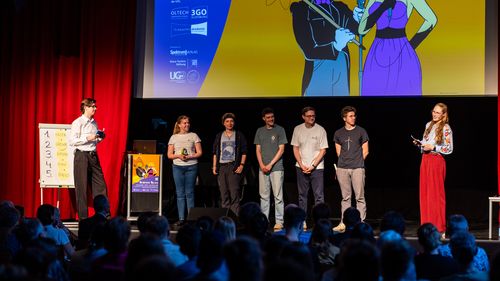
The University of Oldenburg and the Oldenburg University Society (UGO) held a ceremony to mark the start of the new academic year in the university’s main lecture theatre. The traditional ‘Auftakt’ event brought together around 500 invited guests from the worlds of academia, politics, business, public administration and culture. The keynote speaker was the journalist and author Hasnain Kazim.
“We have come through a highly dynamic period and a real feat of strength. With our ‘Northwest Alliance’ consortium, we were in the running right up to the end to become a centre of excellence alongside the University of Bremen. Today is a day for reflection, for expressing gratitude to the countless incredibly dedicated people, and for looking confidently to the future.” With these words, University President Prof. Dr Ralph Bruder, together with UGO Chair Dr Stefanie Abke, set the tone for the programme.
Lower Saxony’s Minister for Science, Falko Mohrs, addressed the audience via a video message: “The University of Oldenburg has every reason to look back on the past few years with pride. You have established yourselves as a research-intensive, internationally networked and socially engaged university.” Excellence is demonstrated in the quality of academic work, in the ability to collaborate, in the courage to embrace new ideas and in the willingness to take responsibility for the major issues of the future. “All of this, I believe, characterises the University of Oldenburg to a very special degree,” explained Mohrs.
Lord Mayor Jürgen Krogmann was represented by Mayor Christine Wolff. She conveyed Krogmann’s message to the guests: “The Carl von Ossietzky University is a key driving force behind our city’s future viability. It carries out outstanding work both nationally and internationally and is a major source of inspiration for our entire region. Following the disappointment over the decision regarding the allocation of the new centres of excellence, it is now all the more important that we continue along the path we have chosen together, seize new opportunities and resolutely build on the strengths of our academic hub. The city stands firmly by its university in this endeavour.”
Parallels between academia and journalism
The highlight of the evening was the lecture by Hasnain Kazim. The journalist, who writes for publications including *Die Zeit*, *taz*, *Süddeutsche Zeitung*, *Der Spiegel* and *Deutschlandfunk*, spoke on the topic ‘Saying what is? Investigating what is? A critique of society’. Kazim said: “Science – like the press, the arts and democratic society in general, for that matter – thrives not on consensus, but on the freedom to say even what is false, uncomfortable and contradictory, and then to be able to examine it. Universities and publishers have this in common: they demonstrate their strength not by silencing uncomfortable voices, but by tolerating them and, where necessary, refuting them.” In his lecture, he also called for a clear distinction to be drawn between politics and science: “Once evidence and arguments for something are sought only after a decision on the matter has long since been made, science ends and politics begins. Then it is no longer research, but the pursuit of subjective interests. That is legitimate, but it should then be called activism, lobbying or, indeed, politics – not science, nor journalism.”
Kazim will also be focusing on substantive discussions next spring, particularly regarding the role of universities, their dialogue with society and current societal challenges. At the university’s invitation, he will spend three months in his hometown of Oldenburg as a so-called fellow, engaging in dialogue with university staff and the wider community.
Research excellence and social responsibility
In his speech, University President Prof. Dr Ralph Bruder emphasised the enormous leap forward the university has made, partly through its participation in the Excellence Competition: “When people in Germany talk about cutting-edge research today, we are part of that conversation. We have significantly increased our national and international visibility. In doing so, we are strengthening not only the university but the entire north-west.” The close collaboration with the University of Bremen and the University of Groningen forms the strong foundation of the Northwest Alliance. “Together, we are committed to linking research excellence even more closely with social responsibility. Now and in the future!”
Awards for outstanding female researchers
The university’s research strength was also evident at the presentation of the UGO Awards. The Chair, Dr Stefanie Abke, presented the ‘Prize for Excellent Research’, each worth 5,000 euros, to healthcare researcher Dr Milena von Kutzleben and sociologist of technology Dr Ricarda Schmidt-Scheele. Dr Lina L. Blank from the Institute of Dutch Studies received the PhD Prize, which carries a prize of 2,000 euros. Social scientist Prof. Dr Jannika Mattes was awarded the Prize for Outstanding Doctoral Supervision. This prize also carries a sum of 2,000 euros.
Nils Prior, a research associate at the University of Oldenburg, hosted the evening. He also gave the audience a very special insight into the Excellence Competition and dedicated a poetry slam to the achievements of the Universities of Oldenburg and Bremen.
The evening was accompanied by music from members of the Institute of Music. Drummer and student Martain-Louis Seidel set the mood for the ceremony with an acoustic performance. On stage, the University of Oldenburg Big Band, conducted by Christian Kappe, ensured a lively evening.