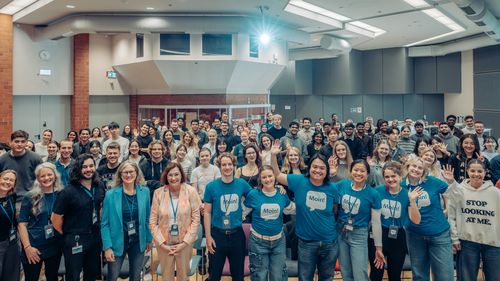
Shin Wee Chong and Sonja Bozic, Master’s students in Neurocognitive Psychology at the University, bring international students together with Oldenburg residents – bridging divides between languages, cultures and generations.
It’s an early evening in September, and as the late summer sun bathes the almost deserted Haarentor Campus in a warm glow, the Intercultural Meeting Place (Room 0-002) fills with people of all different ages and backgrounds. They chat, laugh and take their seats at the tables that have been laid out for them. The smell of coffee fills the room. It’s time to “Meet & Speak”.
The participants often start chatting with each other straight away, says Shin Wee Chong with a smile. Shin is a tutor at the university’s International Office. She and her colleague Sonja Bozic invite international students and Oldenburg residents –in particular members of the city’s Best-Ager generation, meaning those aged 50 and above – to come to the meetings on the last Wednesday of every month, chat with others in German or English in a relaxed atmosphere, and get to know one another and each other’s cultures.
“For us, it’s just about coming together and talking,” explains Shin, who initiated the meetings and organises them together with fellow student Sonja. But in fact, there’s more to it than that: “I’m interested in the topic of better ageing and would like to contribute to making the world more age-friendly,” says the Master’s student, who earned her Bachelor’s degree in Malaysia and is now studying Neurocognitive Psychology in Oldenburg.
Breaking down prejudices
In her work as a tutor, Shin has found that many international students are also eager to speak German outside of their courses and meet people from Oldenburg beyond the university campus. At the same time, she is convinced that settling in and feeling at home in a place depends not just on where you are, but above all on the people you meet. “I myself have lived and worked in several countries; Germany is my fourth,” she explains.
This is why she came up with the idea for Meet & Speak: regular meet-ups where for some the goal is to improve their language skills, while others want to experience the university’s international environment. And where both sides can break down prejudices and reservations about people of different cultures and generations.
To put her plan into action, Shin contacted inForum, an organisation she had come across while searching online.. Run by the City of Oldenburg, inForum organises volunteer-led events and activities that promote the participation of people aged 50 and over, also known as 'Best Agers', in public life and encourage intergenerational exchange. With the support of inForum and the university’s International Office, Shin has now been bringing residents of Oldenburg and international students together for just over a year.
This evening’s on-campus meeting is proof that her concept works. Little cards and sheets of paper listing topics for discussion are spread out on the tables, and at one of them, Shin’s colleague Sonja encourages those sitting around it to join in the conversation. But even without prompting, the participants engage in lively conversations about topics such as where the students come from, the city of Oldenburg, or German customs. Sometimes they switch from German to English and back again. Sometimes they speak a completely different language – which both tutors expressly encourage: “We want everyone to talk freely without feeling pressured,” says Shin.
Conversations across generations
The relaxed atmosphere is one of the reasons why Tina Zohouri feels so at home at the Meet & Speaks. “I’m often nervous about starting a conversation in German with native speakers,” she says. But at the Meet & Speaks, talking in German doesn’t feel at all strange, she explains. Tina, who is from Iran and in her second semester of the Master’s programme in Engineering of Socio-Technical Systems, attends the events as often as she can.
Trudy Morgan, one of the Oldenburg residents, is also a regular at the Meet & Speaks, whether they take place on campus or, every other month, at Oldenburg’s PFL Cultural Centre. Although the PFL is closer to where she lives, she enjoys coming to the Intercultural Meeting Place just as much because she loves “the mix of different people and nationalities” that she encounters here, and enjoys chatting with the young people and helping them learn about the German language and culture.
Talking to people like Trudy Morgan is “different to what you experience in everyday life at the university,” says Shoaib Atta from Pakistan. “I love talking to older people who have had more experiences than I have.” He also likes the way Wee Chong runs the meetings, which is why he has come to this evening’s event for the first time in a while.
An idea to be copied?
And what about the organiser? She likes observing how international students pluck up the courage to speak German and how people who would otherwise never meet connect with one another – bridging cultural, linguistic and generational divides. She also likes to see how some Oldenburg residents keep coming back and form closer bonds with the students.
She hopes that her idea will be copied elsewhere, too: in June this year, she and Sonja presented the concept at an international conference held by the World Health Organisation (WHO) in Spain, and networked with members of the Global Network for Age-friendly Cities and Communities.
At the same time, Shin wants to underpin her concept with a scientific basis in her Master’s thesis. She plans to carry out a study in collaboration with the Ambulatory Assessment in Psychology Lab led by Professor Mandy Roheger to this end. The study will examine which aspects of Meet & Speak influence the participants’ sense of connection and psychosocial well-being. The student has already identified one key factor for success: “Some just come for the biscuits,” she says with a wink.