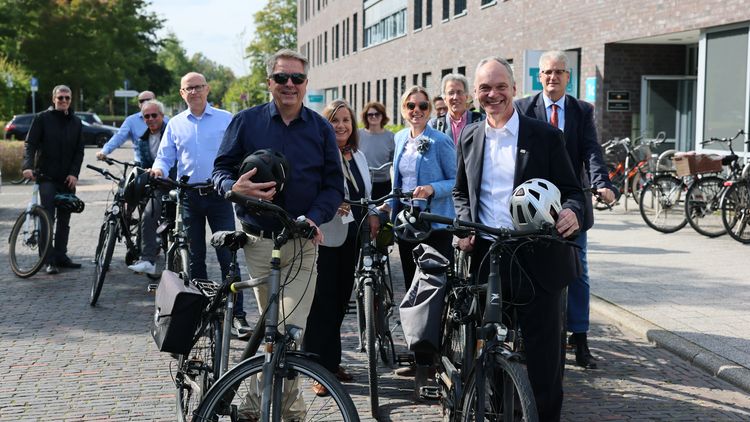

This week, the heads of the city administration and the university continued their regular exchange whilst cycling. Their route took them past key academic sites and joint future projects, including, not least, several research centres in Wechloy.
This was already the second meeting of its kind this year, bringing together Lord Mayor Jürgen Krogmann, University President Prof. Dr Ralph Bruder and other representatives from the city's and the university's administrations. Their cycle tour took them through Wechloy and ended at the previous Fliegerhorst air base.
“Direct dialogue is of great importance for good cooperation between the city and the university. During our joint cycle tour, we were able to experience first-hand at several locations exactly how science, urban development and innovation interact in Oldenburg,” said Lord Mayor Jürgen Krogmann.
Start at the IQON innovation quarter
The tour began at the Economic Development Agency on Industriestraße. There, Thorsten Schröder, a representative of the OFFIS Institute for Computer Science, first gave a brief overview of the current status of the Oldenburg Innovation Quarter (IQON). The group then cycled on towards the university’s research sites.
Excellent research at NeSSy
The first stop was the NeSSy Research Centre – Neurosensory Science and Safety-Critical Systems. On the way there, the route also passed the IQON open space on Industriestraße. At NeSSy, the focus was on the three clusters of excellence: Ocean Floor, NaviSense and Hearing4all. The researchers are working on a variety of forward-looking topics: from the importance of the seabed for biodiversity and material cycles, through the mechanisms of animal navigation, to new solutions for the diagnosis and treatment of hearing loss. The short presentations demonstrated the wide range of internationally oriented research taking place at the University of Oldenburg.
From the Medical Campus to marine research
The tour continued towards the Technology Park. A brief stop was made at the construction site of the new Medical Campus. Following the ground-breaking ceremony in August this year, a dedicated campus for medical training is gradually taking shape there, with a total of around 12,400 square metres of usable floor space. Plans include teaching, laboratory and office spaces, as well as, at a later stage, research facilities, a teaching block and a cafeteria.
We then proceeded to the neighbouring Helmholtz Institute for Functional Marine Biodiversity at the University of Oldenburg (HIFMB). Here, across some 2,000 square metres of modern laboratory and research facilities, research is carried out into marine biodiversity and its significance for the functioning of ecosystems and for humankind.
Conclusion at the Fliegerhorst
The final stop on the joint cycle tour was the air base. Axel Müller, project manager for the air base project, welcomed the group and, during several stops, provided information on the development of the new neighbourhood, which is set to be home to around 3,000 people in future. The Helleheide smart city quarter and the Hallensichel commercial area, covering around 15 hectares, are also part of the development.
“Highlights of the Collaboration”
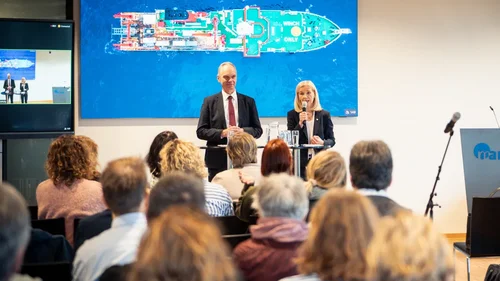
To conclude the annual meeting, Lord Mayor Krogmann and University President Bruder addressed the participants. Under the heading “Highlights of the Collaboration”, they reflected on the diverse links between the city and the university and on shared prospects for Oldenburg’s future development.
Source: Press release from the City of Oldenburg (in German)