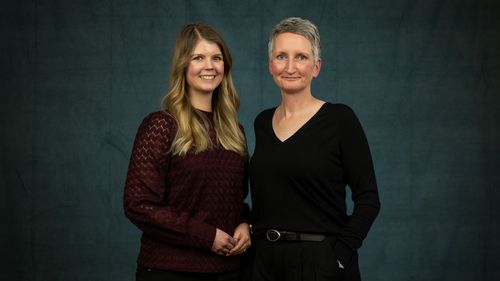
A new electrochemical 3D printing process for precise metal joints at the nanometre scale: this is what earned the start-up team NanoXion the Lower Saxony Innovation Prize. The technology makes it possible to produce extremely small, conductive structures.
A little thought experiment: as an astronaut on the International Space Station (ISS), you are floating some 400 kilometres above the Earth’s surface. “And now you’re supposed to work on a hazelnut lying on a table in Oldenburg from up there using a tool,” explains Simon Sprengel. That, says the chemist, is roughly how one might imagine the task that he and his colleague Karuna Kanes regularly face. The two doctoral candidates from Prof. Dr Dmitry Momotenko’s Electrochemical Nanotechnology research group are specialists in miniature 3D printing: They produce objects measuring just a few millionths or even billionths of a metre, ranging from simple columns and wire connections to tiny 3D models.
The printed structures are made of metal, so they are electrically conductive and suitable for many applications, such as in microelectronics, nanorobotics or sensor technology. However, producing them is significantly more complicated than printing similarly tiny plastic objects. In recent years, Momotenko’s team has made great strides in producing high-purity metal objects on the nanoscale. In 2021, for example, they succeeded in printing copper columns with a diameter of just 25 nanometres – around 4,000 times finer than those produced by conventional 3D printing using metal powder.
To produce nanometre-scale objects, Momotenko and his research group rely on electroplating, a branch of electrochemistry. The researchers use salt solutions containing positively charged metal ions, such as copper, gold or platinum, as their raw material. The respective solution is fed through a tiny nozzle onto a surface, where it comes into contact with a negatively charged electrode. There, the positively charged ions combine with electrons to form neutral metal atoms and deposit as a solid layer on the electrode.
Water droplets unleash forces like a tsunami
Sprengel and Kanes, who are both nearing the end of their PhDs, have further developed the printing technique over the past few years. They optimised the control of the print nozzle, programmed new software and tested various materials. “There were many problems to solve,” explains Sprengel. This is because, at the minute scales the researchers are working at, seemingly minor physical effects often become major obstacles: due to their surface tension, water droplets exert forces akin to a tsunami and can destroy the tiny printed structures. Surfaces that appear as smooth as glass are, at the nanoscale, akin to a landscape of mountains and valleys; the print nozzles must be controlled with great precision to prevent them from being damaged or becoming blocked.
They have made good progress in this regard: they are now able to produce even more complex structures with potential applications in the laboratory. The number of self-built printers in the research group’s laboratory has increased from three to seven over the past three years. “However, further development work is still needed before this becomes a market-ready device that operates reliably outside the specialist laboratory,” says Kanes. This is precisely what the team aims to achieve in the coming year: together with two other co-founders and supported by the University’s Start-up and Innovation Centre (GIZ), Kanes and Sprengel are preparing to launch a spin-off company to turn 3D metal printing into a business. Their project, NanoXion, has now won the Lower Saxony Innovation Prize in the ‘Knowledge and Technology Transfer’ category: the researchers were honoured at the award ceremony on 3 November in Hanover. They will receive prize money of 20,000 euros.
The budding entrepreneurs see several potential areas of application for the nano-3D metal printers, such as in medical technology or quantum research. But first, they want to further develop the printing process “so that it can be used as a tool in chip development”, explains Kanes. According to the team, the process could significantly speed up development stages in this field and make them much more cost-effective.
Printing metal connections exactly where they are needed
This is because when manufacturers develop new chips, they need to test their functionality. However, the methods currently in use are reaching their physical limits – primarily because electronic components are becoming ever smaller. In future, tiny, printed metal connections could help to determine whether certain areas of a chip are electrically connected to one another. “We can print connections made of pure metal precisely where they are needed. The task now is to prepare this process for industrial use,” explains Sprengel. It could be used quickly and easily, as it operates under normal environmental conditions and requires neither a cleanroom nor a vacuum nor high temperatures. “This can save a lot of time and money in certain processes,” Sprengel is convinced.
The two doctoral candidates were enthusiastic about the technology right from the start – but the idea of setting up their own company was not on their minds. “We are scientists and are passionate about our technology. However, we hadn’t had anything to do with business models for a long time,” says Sprengel. “Planning to set up our own business was a real hurdle for us at first.” Ultimately, it was enquiries from outside that tipped the balance: following scientific publications, companies and research groups in need of such conductive nanostructures for their own work got in touch. “Potential customers approached us and asked whether the 3D printers were available to buy anywhere,” reports Kanes. The pair have since received support: the founding team now includes a business administration specialist and an expert in software and real-time hardware control.
They were encouraged in their plan by their supervisor, Dmitry Momotenko. “He continues to support us as a mentor,” says Sprengel. For further development, the team has access to the research group’s laboratories and the equipment of the ‘Electron and Light Microscopy’ service unit.
GIZ offers a wide range of support
The guidance and support provided by GIZ is also hugely important for the start-up – for example, in developing the business model, filing patent applications, applying for funding or producing a promotional video. “We are very pleased to have this support and that it gives us access to a large network,” says Sprengel.
There is also great enthusiasm at GIZ. Franziska Gloeden, Head of GIZ, emphasises: “We have been supporting this dedicated start-up team for a long time and are delighted that the great potential of their project is being recognised and appreciated even beyond the boundaries of science.”