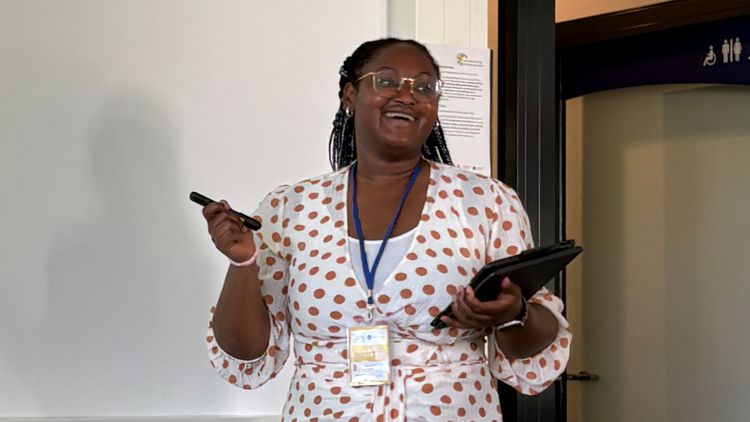

How do depictions in school textbooks influence our understanding of culture and racism? And what can teachers do to change this? Jessica Adaobi Nnamani, a student in teacher education, has been exploring these questions.
While she was still at secondary school, Jessica Adaobi Nnamani noticed the stereotypical depictions of people in the books used by young learners of English. “I was born in Nigeria and English is my mother tongue,” she says. However, the people and situations depicted in the textbooks simply looked 'very English' and had nothing to do with her.
During her 18-week teaching placement at a secondary school, the trainee teacher also came across a portrayal of the story of Rosa Parks, an icon of the Black civil rights movement in the US. The Year 8 English textbook introduced the topic "merely as an exciting story", and the main focus of the learning unit was grammar rather than the content, she explains. „I found that insensitive,” she says.
Schoolbooks should not only teach grammar and vocabulary, but also prepare children and young people for intercultural encounters in Europe and around the world, says Dr Sylke Bakker, an English pedagogy lecturer at the university who has supervised Master's students on teaching placements for years.
Questioning representations
The core curriculum for the lower secondary level at Hauptschulen, for example, stipulates that pupils should learn to perceive, reflect on and shape intercultural encounters by shifting their perspectives in language lessons. However, the success of this depends on the representations in the books, says Nnamani. „These can either broaden or limit young people’s cultural understanding,” she explains, for example, by relying on stereotypical portrayals and oversimplifying complex issues.
For the Master's student, her personal experiences were reason enough to explore how depictions in English textbooks promote stereotypical notions and racism, both in practice and in theory. She also wanted to find out what teachers can do to challenge these notions and promote cultural diversity.
In practical terms, this meant setting aside the set task for the lesson and focusing on the story of Rosa Parks instead. She encouraged the Year 8 class to consider why the story of the civil rights activist remains important today. The pupils explained that mutual respect is important and that skin colour and religion should not affect how we treat one another. Nnamani feels vindicated: „The pupils understood the complexity of the topic and drew on their own experiences.”
Redesigning lessons
Inspired by postcolonial theories, she analysed how the stories of Rosa Parks and the Black community are portrayed in this English textbook. “The comic strip in question is rendered in sepia tones, so you cannot see differences in skin colour,” says the student. This could influence how the story is perceived. She therefore believes that teacher education students should acquire the necessary theoretical knowledge during their studies to enable them to question and contextualise such representations, and adapt their teaching accordingly.
Bakker, an expert in subject didactics, considers this approach to be exemplary. While teaching materials are being redesigned and curricula are being adapted accordingly, she says that, in future, intercultural learning should also include raising awareness of the diversity within a language. The dominance of the so-called native speaker ideal, such as British or North American English, is being critically examined, for example. However, teachers are also expected to engage critically with teaching materials and redesign their lessons accordingly. "Jessica Nnamani has demonstrated the importance of this approach when addressing issues such as racism."