
OER from the UOL
OER from the UOL
Projects at the UOL introduce themselves
Below, we would like to give our university’s OER projects the opportunity to introduce themselves briefly and, at the same time, showcase specific resources to those who are interested.
Can’t see your project listed? We’d be delighted to include it – please email us at:
Support for teaching in inclusive settings: "Action strategies for heterogeneous classes - OER for teacher training"
To get a taste – go straight to a selected resource:
 | On having and needing. A podcast from the ‘Learners’ Needs’ package |
 | Feedback – supporting learning constructively. A presentation video from the ‘Inclusive Education’ package |
 | What exactly is classroom management? (Part 1 of 2). A screencast from the ‘Good Teaching’ package. |
What is it about?
Inclusion and heterogeneity in learning groups is a topic relevant to all teaching degree programmes. The project ‘Strategies for managing heterogeneous classes – OER for teacher training’ has taken this as an opportunity to create videos, podcasts and texts in the ‘Open Educational Resources’ (OER) so that (future) teachers can improve their qualifications and approach the topics of ‘heterogeneous learning groups’ and ‘inclusive education’ with greater confidence. The materials focus on the quality of teaching, the possibilities for inclusive lesson planning and school development, and the specific needs of learners. They also take into account learning difficulties and challenges relating to social and emotional development.
The materials were recognised by twillo.de as ‘OER of the Month’ (Feb. 2023).
How can the OERs be used?
The project has developed scientifically grounded videos, podcasts and texts (‘products’) on various key topics (‘packages’). They were originally intended to support university lecturers in working with trainee teachers in an interdisciplinary manner to explore how to successfully navigate the complexities of teaching.
As the project progression occurred, further possible applications emerged, including:
- As self-study material for teachers, both during their training and in their school practice
- For use in subject and school staff meetings as stimulus material within the framework of inclusive school development
- As information material for local education authorities to pass on to interested schools
Where can it be found?
All materials can be found in a collection comprising three sub-collections on twillo.de via this link.
Project name
Action strategies for mixed-ability classes – OER for teacher training. Licensed under CC BY 4.0.
Contact – Clemens Hillenbrand /
Project website – https://uol.de/oer-lkb
Project duration – 1 January 2021 – 31 October 2022
SOUVER@N - Digital teaching and learning in Lower Saxony
For a taster:
 | Here you can find all OER provided by the partners of the joint project SOUVER@N at twillo . |
What is it about?
The SOUVER@N project was a joint project involving 8 universities in Lower Saxony and Elan e.V., which tackled the diverse challenges in the field of digital teaching and developed strategies and approaches for the partner universities and beyond. The project ended in December 2025.
The (dynamic) link above provides anoverview of all OER materials that have been created in the network to date at twillo for further use (updated daily) and thus impressively documents the OER activities of the partners even beyond the end of project. The compilation contains a colourful variety of offers that these universities and especially their teaching staff make available to the public.
How can the OER be used?
Due to the wide range of materials, "everything" can be found here: concrete working materials, courses, didactic instructions, handouts, guidelines, etc.; video, audio, texts, worksheets, textbooks, scripts, presentations and much more from a wide variety of subject areas.
As of May 2026, there are already over 1900 materials from the network. Accordingly, there are a wide variety of possible uses, as self-study material, to supplement your own teaching, as a basis for your own teaching, etc.
Where to find it:
Under the above link at "Zum Reinschnuppern" and on the SOUVER@N website.
Project name
SOUVER@N - digital teaching and learning in Lower Saxony
Project website -www.souveraenes-digitales-lehren-und-lernen.de/home/
Project duration - 2021-31.07.2024, extended until 31.12.2025
OER in the "Methods file: Teaching methods from A to Z"
For a taster - directly to selected material:
| |
 |
What is it about?
The method file is an extensive collection of different teaching methods that can be used in pre-school education, in a school context and in adult education. The methods can support teachers in preparing lessons . There are also options for differentiating and varying the methods.
The site also contains student-created OER that have been developed as part of courses focusing on education, training and socialisation .
How can the OER be used?
The OER can be used in a variety of ways in the classroom and beyond. The content is particularly, but not exclusively, relevant for teachers and student teachers . For example, the radio plays invite you to take a closer look at multilingualism, language situations and basic concepts of (political) education. The existing content can also serve as inspiration and help you to create and develop your own works .
Where to find them?
All OER materials are available on the Methodology Catalogue website.
Project name:
Methodenkartei - a co-operation project at the Universities of Oldenburg and Vechta.
Contact -
Project website - www.methodenkartei.uni-oldenburg.de
Project duration - since 2016 (open-ended)
Learning snacks around OER creation
For a taster - directly to a selected material:
 | Using images & texts in a legally compliant way (OER). A learning snack about legally compliant re-use. |
What is it about?
Learning Snacks are "knowledge snacks" that impart knowledge in small portions in a playful way via a chat format. The following self-learning modules were developed for a course in teacher training to support students in creating their own OER . The Learning Snacks provide a quick overview of the use and creation of OER.
How can the OER be used?
The Learning Snacks can be used to support the creation and quality control of OER.
Where to find them:
Anja's Learning Snacks on the pages of https://www.learningsnacks.de. These OER are licenced under CC BY-SA 4.0.
If you have any further ideas or suggestions for improvement, please do not hesitate to contact us for re-registering students:
OER at the C3L
OER at C3L Open educational resources are also created and used at C3L. One project in particular develops, revises, digitises and distributes OER for the management of education and science. Teachers who want to design and create free teaching and learning materials can also seek support there.
participate@UOL
To get a taste of it:
Click here to see all the OERs produced as part of the project. The project ended in December 2025.
 | What is it about? As part of the project, lecturers and students had the opportunity and the freedom to work together in a participatory manner to identify the teaching and learning formats best suited to them, to trial them and to implement them sustainably in practice. In addition, a separate sub-project developed OER designed to support students before, during or after their studies. |
How can the OERs be used?
The OERs created as part of the project are primarily aimed at students, but also at anyone else who is interested, and provide an introduction to a wide variety of topics.
Where can they be found?
The materials can be found both on the project website and at twillo.de.
Project name
participate@UOL
Project website – https://uol.de/participate
Project duration – 08/21–07/24 , extended until 31 December 2025
C3L - Quality management in educational organisations
To get a taste of it – go straight to a selected resource:
 | Quality Management in Educational Organisations: An Organisational Theory Perspective |
 | Exercises relating to the study materials ‘Quality Management in Educational Organisations’ – meso level |
 | Quality management in educational organisations: Case study: the higher education sector – is competence-based evaluation possible? |
What is it about?
Over the past few decades, quality management has become a core task for educational organisations. This collection is intended not so much as a detailed analysis of the circumstances at individual levels of education, but rather as a comprehensive introduction to the subject. The subject of ‘Quality management in educational institutions’ is examined at various levels – thereby laying the foundations that are relevant across all sectors of education.
How can the OERs be used?
The collection contains educational videos, case studies, teaching texts and exercises that can be used as self-study materials. Detailed information on the content, as well as examples of how it can be used, is compiled in the document “Teaching Guide for the Use of Open Educational Resources (link)” and the learning pathway. In principle, all materials are designed so that they can be freely combined.
Where to find them?
All materials can be found in a collection comprising four sub-collections on twillo.de via this link:
Further information
The C3L also creates and utilises other open educational resources. For example, OER have been created for the management of education and science, research data management, energy informatics and business administration topics such as human resource management, organisation, and investment and financing . Furthermore, the C3L has an OER strategy, which can be found via this link.
Contact – Uda Lübben –
Website – C3L – Centre for Lifelong Learning
Teaching-learning platform school
To get a taste of it – go straight to a selected resource:
 | |
 | |
 | School Teaching and Learning Platform
|
What is it about?
The School Teaching and Learning Platform is a platform for school-related Open Educational Resources (OER). A filter allows you to perform a selection of available OER by target group (teachers, pupils, teaching staff, trainee teachers), by school subject and by resource type (guides, podcasts, videos, self-study resources, experiments, worksheets).
The platform was developed as part of the OLE+ project under the Teacher Training Quality Initiative and is maintained by the secretariat of the Centre for Teacher Training – Didactic Centre. The submitted materials were developed as part of various projects and in study modules; they are subject to quality management. The platform is open to further OER.
How can the OERs be used?
The OERs can be used in a variety of ways across different subjects, during degree programmes, during teacher training placements, and by teachers in schools. Pupils can use them for self-study. The subject matter and types of resources (guides, podcasts, videos, self-study programmes, experiments, worksheets, etc.) cover a wide range.
Where can they be found?
All OER materials are available on the website of the ‘Schule’ Teaching and Learning Platform.
Project name
Teaching and Learning Platform ‘Schule’ at the University of Oldenburg
Contact –
Website – https://uol.de/lehr-lern-plattform-schule
Wadden Sea Learning Lab
OER collection by Anja Wübben
To get a taste – go straight to a selected topic:
What is it about?
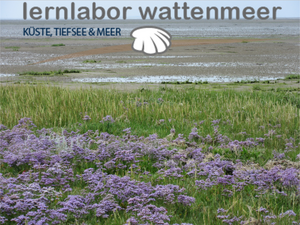
This collection contains learning resources on the topics of the Wadden Sea habitat , the coast and the ocean. It consists mainly of 90-minute lesson plans featuring illustrative small-scale experiments, digital learning components and elements of Education for Sustainable Development (ESD).
The collection is still under development; new key topics are regularly selected in consultation with researchers from the University of Oldenburg, adapted into learning units for school lessons, and tested and optimised in collaboration with various schools in the region.
Topics include:
- Noise in the North Sea – Suffering for porpoises (The materials were provided by twillo.de as ‘OER of the Month’.)
- Microplastics in the sea – formation and distribution
- Phytoplankton – Small but mighty
- Fishing in the North Sea – and its dangers
- Salt marshes on the North Sea coast
- Oil pollution in the Wadden Sea
- Ocean acidification
- The freshwater lens
- Light pollution in coastal areas
How can the OERs be used?
The learning units (or individual components thereof) can be easily integrated into school science lessons or into environmental education at out-of-school learning venues , as, in addition to the workbooks , sample answers, subject-specific background information in the form of factual analysis, complete lists of materials for the experiments and tabular lesson plans – including suggested classroom discussions – are provided.
The teaching units were developed under the guidance of Anja Wübben for participate@UOL at the ‘Wadden Sea Learning Laboratory’ (http://www.lernlabor-wattenmeer.de/) in collaboration with students on various biology teaching methodology courses, and have been tested in practice with pupils on several occasions and optimised.
Where to find them?
All materials can be found in a collection comprising several sub-collections on twillo.de via this link.
Project – OER for teacher training from the ‘Wadden Sea Learning Lab’.
Contact – Anja Wübben
Wadden Sea Learning Lab website – http://www.lernlabor-wattenmeer.de/
Learning snacks around OER creation
For a taster - directly to a selected material:
| Using images & texts in a legally compliant way (OER). A learning snack about legally compliant re-use. |
What is it about?
Learning Snacks are "knowledge snacks" that convey knowledge in small portions in a playful way via a chat format. The following self-learning modules were developed for a course in teacher training to support students in creating their own OER . The Learning Snacks provide a quick overview of the use and creation of OER.
How can the OER be used?
The Learning Snacks can be used to support the creation and quality control of OER.
Where to find them:
Anja's Learning Snacks on the pages of https://www.learningsnacks.de. These OER are licenced under CC BY-SA 4.0.
If you have any further ideas or suggestions for improvement, please do not hesitate to contact us for re-registering students:
Thermodynamics in the Bachelor's degree programme in Chemistry
The materials consist of two sub-collections. The first sub-collection contains lecture videos on thermodynamics, and the second sub-collection consists of instructional videos for the thermodynamics practical.
To get a taste of the lecture:
 |
To get a taste of the practical session tutorials:
 |
What’s it all about?
Even before the pandemic, work had begun on breaking down the thermodynamics required for a chemistry degree into small, easily digestible chunks. This led to the creation of the ‘Lecture’ sub-collection. And to help students prepare for the Thermodynamics practical, a series of videos has been produced to guide them through the experiments and explain some of the techniques used during the practical.
Both are available to students as a supplement to the regular lecture or as preparation for the practical course.
How can the OERs be used?
The videos can be used as support and as self-study material during the course. They are licensed under CC BY-SA 4.0.
Where can they be found?
The thermodynamics materials can be found on twillo.de via this link.
Contact – ,
Website – https://uol.de/en/chemistry/physical-chemistry-al-shamery
Learning map with self-learning materials for Office applications by W. Müskens
- by Dr Wolfgang Müskens for participate@UOL
- licensed under CC BY 4.0
- published in December 2023
Click here to view the learning map
Description:
Are you actually familiar with the software you need to use during your studies?
This learning map provides an overview of helpful self-study resources that explain how to use Office software during your studies. The linked resources contain introductions as well as useful tips and tricks for the following programmes: Word, Excel, LaTeX, PowerPoint and Citavi. Navigate through the map and select the topics that interest you.
Note: The software names mentioned in this learning map may be subject to trademark, brand or patent protection even if not specifically marked as such.
Target audience:
First-year students and anyone else interested
Language:
German
Credits – we welcome the use of this OER provided the following details are included:
Learning Map: Office Applications by W. Müskens for participate@UOL, licensed under CC BY 4.0.
For re-users:
All OER files available for download (in a ZIP folder)
"Game-based learning and virtual reality medicine and natural sciences" - a padlet compilation of freely available offers for use in teaching by Susanne Quintes
- by Dr Susanne Ouintes for participate@UOL
- licensed under CC BY 4.0 – all templates, graphics or other elements generated by Padlet itself are excluded from the licence.
- Published in March 2024
Description:
This Padlet provides an overview of teaching and learning resources that present and convey content using game elements (also known as game-based learning or edutainment). The focus is on free, widely accessible resources that can be easily integrated into one’s own teaching.
Target audience:
Teachers, students and anyone else interested
Language:
German
Credits – we welcome the use of this Padlet provided the following details are included:
‘Game-based learning and virtual reality in medicine and the natural sciences’by Susanne Quintes, licensed under CC BY 4.0 – the licence does not apply to any templates, graphics or other elements generated by Padlet itself.