Michael Hölling
Michael Hölling
Generation of turbulent wind fields in a large wind tunnel
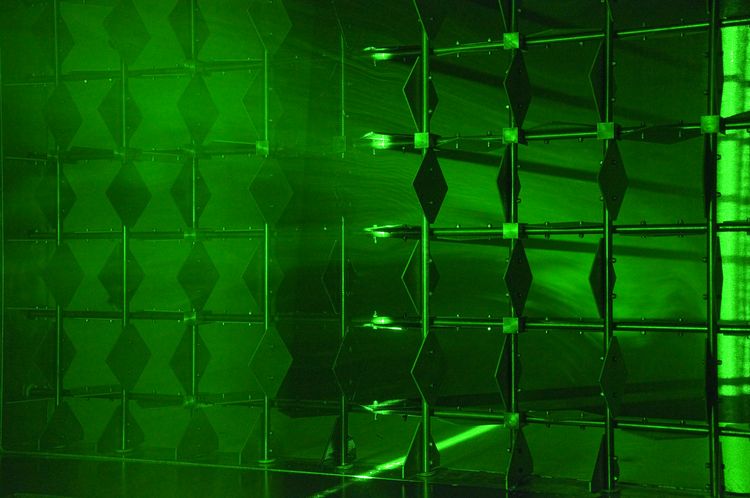
The so-called active grille enables a wide variety of different turbulent wind fields to be generated in the large Oldenburg wind tunnel. A total of just under 1,000 diamond-shaped aluminium blades are mounted on 80 individually controllable waves. This allows specific, limited areas of the wind tunnel nozzle to be blocked off and turbulence to be generated. Thanks to its aluminium frame construction, the 3 x 3 metre grid can be easily installed and removed from the wind tunnel. The combination of an active grid with a wind tunnel of this size makes the ForWind tunnel unique. With the aid of the grid, ForWind researchers can downscale features of complex atmospheric wind fields to the dimensions of the wind tunnel, thereby replicating characteristic properties of a real wind field within the wind tunnel, such as various types of turbulent flows, wind shear and gusts. Their aim is to gain a better understanding of turbulent flows and their effects on wind turbine components. They are also developing and testing innovative control concepts to better compensate for turbulence effects.
Optimisation of wind farms: wind tunnel experiments with model wind turbines
By 2030, 15 GW of offshore wind energy is to be generated in the North Sea and the Baltic Sea.
Fossil fuels are to be increasingly replaced by renewable energy sources.
Wind energy plays a major role in this transition. Due to various economic and environmental factors, wind turbines are being installed in wind farms. These are increasingly being built offshore. There remains a very high demand for reliable forecasts of wind behaviour and fluctuations, as the prevailing wind is not only the source of energy but also, at the same time, a source of increased loads on wind turbines. Understanding how the wind behaves (e.g. direction and speed) within a wind farm is essential for utilising the available energy efficiently whilst avoiding turbine failures. Forecasts are usually generated using numerical simulations which, due to the complexity of the flow, attempt to describe various situations within the farm using simplified models.
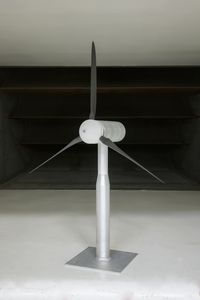
These models need to be verified; however, conducting open-field tests within the wind farm is technically challenging and very expensive, as it is not possible to control the inflow conditions or measure all parameters. For this reason, wind tunnel experiments using model wind turbines are carried out at the University of Oldenburg. In the wind tunnel, defined flow conditions can be replicated under reproducible conditions, offering highly flexible and cost-effective opportunities to gain a deeper understanding, thereby enabling the improvement of numerical models and, ultimately, of real-world wind farms.
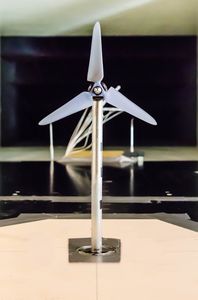
The focus here is on the influence of turbulent inflow on the power output behaviour of wind turbines and their wake flow. The model wind turbines developed in Oldenburg are as realistic as possible replicas of large wind turbines and enable research into the effects of various inflow conditions and control parameters on the turbines and their power output, as well as the influence of additional dynamics in turbines installed on floating platforms.
Wind tunnel tests / Dynamic stall
As many fluid dynamics problems cannot be calculated – or can only be calculated approximately – even with the most advanced computers available today, many questions must be answered by taking measurements on models. With a jet cross-section of 1.0 m × 0.8 m, the University’s wind tunnel provides the basis for a wide range of measurements, such as cylinder wake, wind turbine and wind farm models, or novel anemometers. A range of standard measurement methods are available, such as pressure-measuring probes, one- and multi-dimensional hot-wire anemometers, and laser Doppler anemometers.
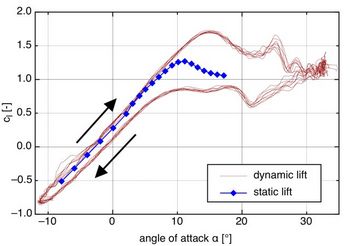
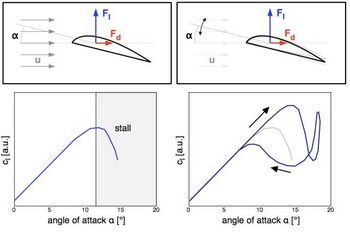
Of particular interest is also the possibility of closing the measurement loop for force measurements on blades. In this process, lift and drag forces are measured non-contact via the pressure distributions behind the blade and on the wind tunnel walls. This also enables measurements to be taken at rapidly changing wing angles of attack, as strong, short-lived lift forces can occur in such cases (dynamic stall). These must be well understood for suitable models.