
How turbulence arises
How turbulence arises
How turbulence arises
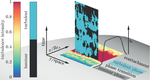
Physicists in Oldenburg test 30-year-old theory in an experiment
Oldenburg. Describing turbulence mathematically is one of the great unsolved problems in physics. Nor has it yet been conclusively established how it arises. A team of scientists led by the Oldenburg-based physicist Prof. Dr Joachim Peinke and the Osnabrück-based mathematician Dr Pedro G. Lind has now succeeded in experimentally recreating how turbulence forms on an airfoil. These findings could help, for example, to further optimise the rotor blades of wind turbines. The scientists recently published their results in the journal *Physical Review X*.
Turbulence is defined as a flow characterised by disorder. This contrasts with smooth, so-called laminar flows. The exact point at which a laminar flow transitions to a turbulent one can be determined by the so-called Reynolds number. This physical parameter describes the ratio of the turbulence-generating factors to the smoothing frictional forces acting on the object being flowed around. However, the transition from laminar to turbulent flow does not always occur abruptly. Rather, there is often a kind of transition zone: within this zone, laminar and turbulent flow coexist. The vortices, which initially occur sporadically, become increasingly frequent – until they cross a critical threshold and develop into full-blown turbulence.
As early as 1986, the French turbulence and chaos researcher Yves Pomeau put forward the theory that vortices arise in accordance with the model of so-called direct percolation. Percolation theory describes how complex, interconnected structures – known as clusters – emerge from what were originally local events. Random spreading plays an important role in this process. Using a percolation model, it is possible, for example, to describe how epidemics spread from individual people to an entire region.
Although Pomeau’s theory was largely ignored for many years, scientists have in recent years been able to verify it experimentally in relation to fluid flows in pipes. The wind energy experts in Oldenburg have now, for the first time, tested the theory with regard to its practical application to aerodynamic problems: Using modern optical measurement methods, the scientists were able to record the flow along a blade in the wind tunnel with high temporal and spatial resolution. Analysis of the data showed that the results of the experiment could be clearly attributed to the theoretical model of direct percolation. “With this work, we have provided the first experimental evidence that percolation models have practical relevance for the aerodynamics of wings,” says Dominik Traphan, a doctoral candidate in Peinke’s team and lead author of the study. This now makes it possible to precisely determine the point at which laminar flow transitions to turbulence.
“The results of our fundamental research are highly relevant to the development of rotor blade profiles,” says Peinke. This is because: when the airflow around the blade becomes turbulent, a so-called laminar separation bubble forms – and this exerts forces on the blade which, over time, contribute to material fatigue. “Based on these new findings, existing engineering models can, for example, be adapted and wind turbines further optimised,” says Lind, summarising the potential applications.
“Aerodynamics and Percolation: Unfolding Laminar Separation Bubble on Airfoils” by Dominik Traphan, Tom T. B. Wester, Gerd Gülker, Joachim Peinke and Pedro G. Lind (2018) in *Physical Review X*, Volume 8, Number 2, Page 021015.
Web links
contact
Prof. Dr Joachim Peinke, Tel.: 0441/798-5050, email: peinke@uol.de