We (all) are the people 2017/2025 Hans Haacke
We (all) are the people 2017/2025 Hans Haacke


We (all) are the people at the University of Oldenburg
Since autumn 2025, two banners from the series *We (all) are the people* by the artist Hans Haacke have been on display on the bridge between buildings A1 and A14. On panels measuring 10 x 1.5 metres each, the title of the work is written in a total of twelve languages, each framed on the left and right by blocks of colour with a rainbow gradient. The languages – Arabic, Bulgarian, German, English, Farsi, French, Polish, Russian, Croatian, Kurdish, Tigrinya and Turkish – represent the countries of origin from which the majority of migrants in Germany came at the time of the work’s first presentation at documenta 14 (2017).[i] On the banners, the individual translations are arranged in three blocks and – without judgement – in alphabetical order.
Haacke’s engagement with the eponymous slogan ‘Wir sind das Volk’ began as early as 2003. One of his proposals involved projecting the slogan ‘Wir sind das Volk’ – which was already being used by xenophobic groups at the time – onto St Nicholas’ Church in Leipzig, with the addition of ‘(alle)’. In the 2010s, the slogan – which originated with demonstrators in the final phase of the GDR – experienced a resurgence in right-wing populist circles as a result of the Pegida demonstrations. In 2017, Haacke revisited his never-realised proposal from Leipzig in a work created for documenta 14, which took place in Kassel and Athens. The resulting work, *We (all) are the people*, was displayed there on sites such as the Rotes Palais in Kassel, at bus stops and at the Museum of Contemporary Art in Athens. The choice of languages was adapted to the respective country. Thus, the version on display in Athens featured translations of the phrase into Albanian, Greek and Romanian, rather than German, Polish and Tigrinya.[ii] The work was later exhibited at various other venues: in 2018/2019, it was shown at art colleges and universities in the eastern German Federal States, including the Bauhaus University Weimar, the Academy of Visual Arts and Book Design in Leipzig and the Burg Giebichenstein University of Art and Design in Halle. In 2020, the work was a prominent feature of Berlin Art Week, where it was presented at venues such as the Volksbühne Berlin, the Haus der Kulturen der Welt and the Academy of Arts. The work has also been exhibited abroad on numerous occasions, with the languages displayed always tailored to the respective country, such as in 2018 at the Khalil Sakakini Cultural Centre in Ramallah, in 2018 at the Town Hall in Brussels-Molenbeek, and in 2019 at the New Museum in New York. In a press release from the Academy of Visual Arts in Leipzig, Haacke explains the history of the work as follows:
“‘We are the people’ was the slogan used to overthrow the commanders of the so-called People’s Police in 1989. In 2003, I was invited to take part in a competition to commemorate these events with a permanent installation in Leipzig. By then, xenophobic groups had already re-interpreted the liberation slogan for their smear campaign against immigrants and refugees. Against this backdrop, I proposed projecting the proclamation ‘We (all) are the people’ onto St Nicholas’ Church in Leipzig at night – the very place where the victorious Monday demonstrations had taken place in 1989. The competition jury opted for another artist’s proposal. The banner ‘We (all) are the people’ reaffirms our solidarity with all migrants and refugees who are currently exposed to virulent xenophobia, racism and life-threatening religious conflicts in many countries around the world.”[iii]
The work also forms part of a series of other works by the artist in which he explores the concept of ‘the people’ and notions of belonging. His design *Calligraphie* ( 1989) envisaged, amongst other things, depicting the slogan of the French Revolution in Arabic and gold lettering on a pyramid of stones in the courtyard of the French National Assembly. Far better known is the work *DER BEVÖLKERUNG* ( 2000) in the German Bundestag, which is celebrating its 25th anniversary this year. Here, Haacke engages in a critical examination of the inscription on the portal of the Reichstag building, ‘To the German People’, and relies on the participation of the Members of Parliament, who are to bring soil from their constituencies to Berlin and pour it into a wooden frame. This anniversary is also one of the reasons why *Wir (alle) sind das Volk* is now on display in Oldenburg. In co-operation with the initiative ‘Werkstatt DER BEVÖLKERUNG’, which develops projects at the intersection of art and politics and was founded to mark the anniversary of DER BEVÖLKERUNG, Timo Merten and Friederike Nastold curated the presentation of the banners, which can be seen on the bridge between the A1 and A14 motorways, at the entrance to the Haarentor campus.
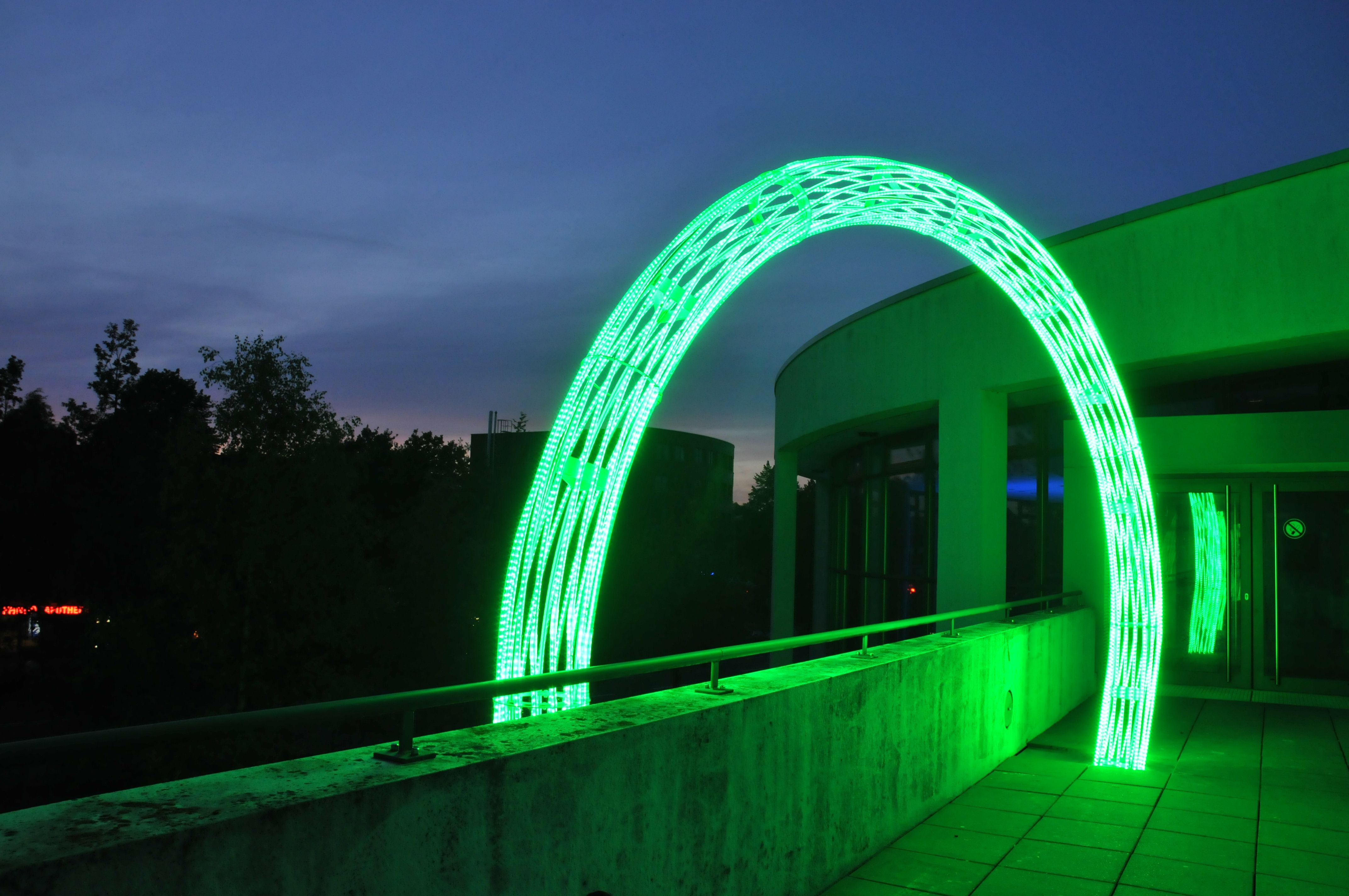
The use of the bridge for artistic works – particularly those addressing social coexistence and politics – is not entirely new. As part of an exhibition marking the 125th anniversary of the philosopher Karl Jaspers in 2008, Peter Weibel and Ólafur Elíasson designed the work *Rainbow Democracy*, a ring that glowed in the colours of the political spectrum. Peter Weibel wrote in the exhibition catalogue: “The colour circle around the bridge between two university buildings alludes to the bridging function of parliament and to a democracy in which all interest groups are fairly represented – that is, all republican parties loyal to the constitution.”[iv] On a lawn on the Haarentor campus, Weibel and Elíasson also installed a sprinkler that watered a ring-shaped strip of grass. In this work, the artists addressed the necessity of participation in political processes: “That is why a sprinkler has been installed on a lawn some distance away, which also sprays water in a circle. Where the water falls, the lawn is green. Where the water does not fall, the lawn is brown. Democracy must be practised and activated. Democracy is green. Where there is no democracy, where no water is activated, the brown of dictatorship prevails.”[v]
Just as the bridge itself, on which both works were or are mounted, connects the comparatively new lecture centre with the original university complex A1–A4, thereby alluding to the further development of the reform university founded from the College of Education, Weibel, Elíasson and Haacke, too, take up the bridge’s function as a connecting element in their works. *Rainbow Democracy* emphasises the interplay of different political positions and participation in political processes as a means of preventing fascism. We (all) are the people, on the other hand, alludes to the slogan of the peaceful revolution in the GDR—which has since been appropriated by the right-wing populists—and creates an inclusive counterpart to it by adding the word ‘(all)’ and translating it into twelve further languages. As the banner shows, all these languages stand side by side on an equal footing. Particularly at a university whose student body and staff comprise people from diverse backgrounds and with varied migration histories, and at a time when right-wing narratives are increasingly shaping political decisions, the work serves to unite and build bridges: Everyone belongs, everyone stands together on an equal footing, and every person – regardless of their background – is an important part of the community.
Text: Timo Merten
Concept and organisation: Timo Merten and Friederike Nastold, Institute of Art and Visual Culture
In co-operation with the workshop DER BEVÖLKERUNG (Berlin)
[i] Cf. Alberti, Sarah: ‘We (all) are the people’ – Hans Haacke’s contribution to documenta 14, kunsttexte.de, No. 4, 2017, here: p. 6.
[ii] Ibid., p. 6.
[iii] Academy of Fine Arts Leipzig: Press release: “We (all) are the people – We (all) are the people” Documenta banners by Hans Haacke in Leipzig, Chemnitz and Dresden, 2018, www.hgb-leipzig.de/hochschule/presse/35, last accessed: 29 October 2025.
[iv] Weibel, Peter: Rainbow Democracy. A project for Karl Jaspers by Ólafur Elíasson and Peter Weibel, in: Meyer-Bohlen, Monika (ed.): Truth is what unites us. Philosophy, Art, Illness, exhibition catalogue, University of Oldenburg, 22 May – 12 July 2008, Bremen: Hauschild 2008, pp. 164–169, here: p. 169.
[v] Ibid.