
events
events
Corals Are Us
Lecture by Petra Löffler

5 November 2026, Barcelona, Spain
9th International Symposium on Deep-Sea Corals – An Event for Science, Art and Society
Reef-building corals are often referred to as the architects of the ocean. More than that, they are marine world-builders, sharing our world with humans. Humans and corals are intertwined in many ways: reefs act as protective shields and are a source of life and biodiversity. However, corals can adapt to a wide range of environments, from shallow waters to the deep sea, and live in colonies or as individuals. They have survived mass extinction events and serve as a model of evolution on our planet. This talk explores corals as a vivid example of co-habitation and cooperation between species, from which humans have much to learn.
Further information here
Situating AI: Politics, Aesthetics, Futures
series of lectures

Room A06 0-001, 6.00–8.00 pm sharp
Where? When? How many? These are (just) three questions that help to situate artificial intelligence in today’s world: In her latest book, *Medium Hot: Images in the Age of Heat* (2025), media artist Hito Steyerl has described AI technologies as a ‘hot medium’ in two senses: As an industry that accelerates climate change and is dominated by tech giants, all vying for markets and consumers. So we need to find out: where do AI technologies source their energy, and where are the mega-data centres and server farms located? When did the race for the most powerful AI begin, and who stands to benefit from it? How many forms of artificial intelligence exist, and how do they differ? And finally: how are media studies and the arts positioning themselves in relation to the AI hype, and what futures can be imagined both with and against the promises of AI? This lecture series explores these pressing questions and the entanglements of AI with extractivism, authoritarianism and climate change.
Concept & Organisation: Petra Löffler
Further information here
Media constellations
Retreat organised by the Theory and History of Contemporary Media Research Group

24–27 August 2026
Lehnin Institute for Art and Culture e.V., Lehnin Monastery
Following on from the 2025 retreat on the theme of ‘Remediation’, this year’s retreat focused on discussingthe department’s current research projects under the overarching theme of ‘Media Constellations’. A key focus was on the media practices of colonial scholarship, and in particular colonial photographs and colonial archives. Using specific archival materials and photographic objects, Louise Adams and Jakob Claus highlighted the historically sensitive staging and interpretation of documents relating to colonial history, which are heavily dependent on context and perspective. This media constellation possesses a particular temporal dimension: the reconstruction of the origins and use of colonial-racist photographs is linked to their current decolonial reappropriation.
Further information here.
Work - love - cinema in times of excessive demands. An approach to Alfonso Ruizpalacio's "La Cocina"
Lecture by Petra Löffler
Friday, 8 May 2026, 11.30 am, City Kino 46, Bremen
30th International Bremen Film Symposium, ‘Figures of Overwhelm: Modernisation – Individualisation – Disorientation’
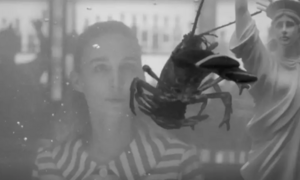
In a restaurant kitchen in New York’s Times Square, ‘La Cocina’ unfolds as an epic drama, whilst the camera condenses the hustle and bustle of the metropolis within the microcosm of the kitchen, leaving the viewer reeling. This talk examines how the sensory overload, physical strain and human exhaustion are staged in Ruizpalacios’s black-and-white film, culminating in a state of exhaustion that simultaneously appeals to a sense of possibility and implies resistance.
Further information here
1.5 degrees? How the media convey knowledge about climate change
Series of lectures
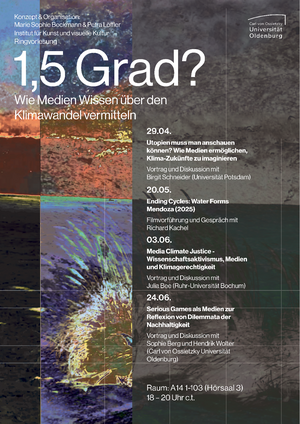
The series of lectures is dedicated to the question of how the media produce and communicate knowledge about climate change. In lectures and discussions, experts from science and artistic practice will discuss pressing questions on sustainability, climate justice and climate change, the role of media representations and mediations and the resulting responsibilities and possibilities for action for university research and teaching.
Concept & organisation: Marie Sophie Beckmann & Petra Löffler
Further information here
What Emerges in Submersion? | Experiences, Practices, and Politics from Below
Film, reading and discussion

Friday, 20 February 2026, 7.30 pm
diffrakt | centre for theoretical periphery, Berlin
Marie Sophie Beckmann, Petra Löffler and Amelie Wedel discuss the critical potential of sub(e)merging in dialogue with contemporary film and video works. What challenges does sub(e)merging pose to dominant modes of representation? How can going beneath the surface become a vantage point from which perception, speech and action can be organised differently? And to what extent does sub(e)merging destabilise the ground itself as a site of evidence and knowledge production?
Further information here
Remediation
Retreat of the research area Theory and History of Contemporary Media

7–9 October 2025
Wittbülten National Park Centre, Spiekeroog
The centre of the retreat was devoted to approaches from cultural and media studies to the term and concept of remediation. The aim of our discussion was to further develop these approaches conceptually and to open up the term for media-ecological considerations, as well as for the activation of colonial collections and archives, and for curatorial concepts and artistic or cinematic practices.
Further information here
Michael Klipphahn-Karge: No pictures? Material burdens of immaterial phenomena
Lecture
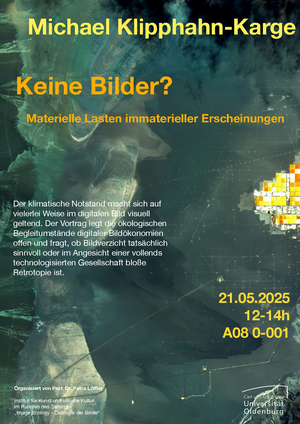
The climate emergency makes itself felt visually in many ways in the digital image. The lecture reveals the ecological circumstances of digital image economies and asks whether renouncing images really makes sense or is mere retrotopia in the face of a fully technologised society.
Organised by Petra Löffler
As part of the seminar "Image Ecology - Ecology of Images"
Further information here
From Debris to Sediment: Unearthing Imperial Geology
Workshop
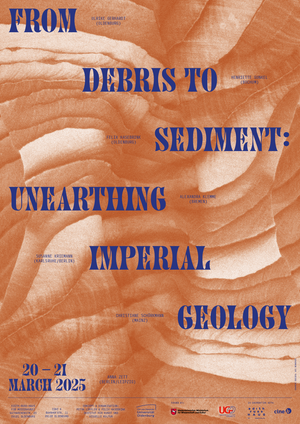
20–21 March 2025
House of Media Art & Cine K, Oldenburg
Concept & Organisation: Petra Löffler & Felix Hasebrink
Institute of Art and Visual Culture
, University of Oldenburg
More information here

IMAGE INTERFERENCE: Documentary film as critical practice
Lecture series
12 November 2024 // 3 December 2024 // 10 December 2024
‘Image Interference’ explores the role of documentary film as a critical practice.Documentary film has never been merely a sober representation of reality, but today it engages with socio-political discourses with renewed vigour and, through moving images, sound and language, opens up an independent, aesthetic space for reflection…
Organised by: Jakob Claus & Felix Hasebrink
Further information here
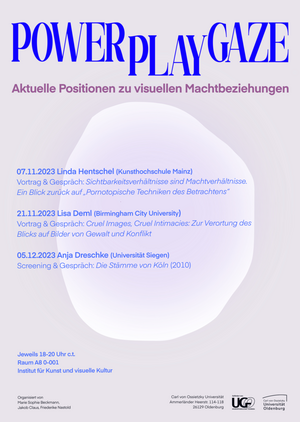
POWER - PLAY - GAZE
Lecture series
This lecture series explores contemporary perspectives and interdisciplinary theories on visual power relations. During the 2023/24 winter semester, Linda Hentschel, Lisa Deml and Anja Dreschke will be invited to present and discuss their research and work on issues of visual language, regimes of the gaze and power relations in contemporary media contexts.
Organised by: Marie Sophie Beckmann, Jakob Claus, Friederike Nastold
Further information here
Sub(e)merging: Poetics, Temporalities, Epistemologies
Workshop
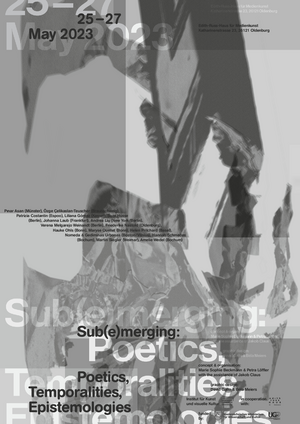
25–27 May 2023
Haus für Medienkunst, Oldenburg
Seeking to open up and expand the rich repertoire of meanings inherent in Gómez-Barris’s concept—and focusing on its generative potential by slightly altering its terminology—the artistic and scholarly contributions to the workshop explore the transformative potential of operating and perceiving from below, particularly in times of political and ecological crisis: Can ‘submerging’ be transformed into an aesthetic strategy? What role do imaging media and technologies play in the visualisation of the submerged? To what extent are forms of representation or supposedly self-evident spatial, temporal and historical orders called into question? How does it relate to the underground in its many geological, material and symbolic meanings? And what happens if we take seriously the processes of gathering and evolving inherent in the term ‘submerging’? In other words: What emerges through submersion?
Registration:
Concept and organisation: Marie Sophie Beckmann & Petra Löffler, in collaboration with: Jakob Claus
Further information here
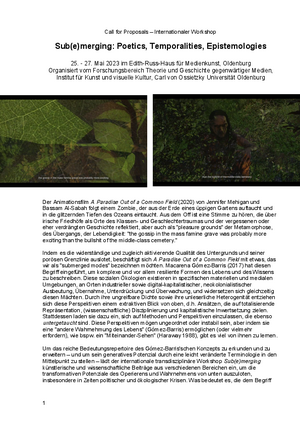
Sub(e)merging: Poetics, Temporalities, Epistemologies (2023)
Workshop - Call for Participation
From 25 to 27 May 2023, the international workshop ‘Sub(e)merging: Poetics, Temporalities, Epistemologies’ will take place at the Haus für Medienkunst.
The Research Area for Theory and History of Contemporary Media invites submissions of proposals for artistic or academic contributions by 10 February 2023 to . Further information on submissions and the thematic focus of the workshop can be found here in English and in German.
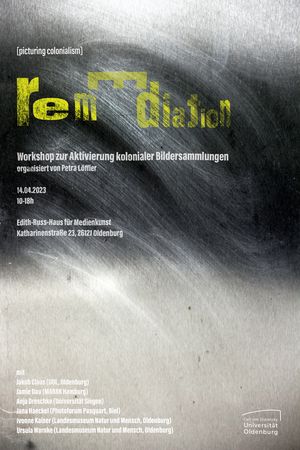
remediation
Workshop on bringing colonial image collections to life
14 April 2023
In the second workshop on the activation of colonial image collections, participants will explore, amongst other things, how the potential and possibilities of media remediation can be described in relation to the decolonisation of photographic collections. What potential does remediation offer for the cataloguing and critical engagement with colonial photographic archives? Can historical forms of knowledge production and their media formats (e.g. notebooks, reports, photographs, classifications, etc.) be critically examined through changes in format? To what extent do strategies of digital curation and exhibition lend themselves to this?
Organised by Petra Löffler
Further information here
access
Workshop on bringing colonial image collections to life
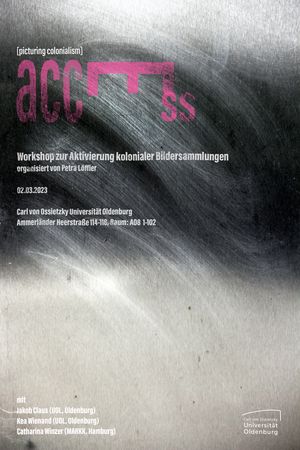
2 March 2023
The first workshop on the revitalisation of colonial image collections focuses on issues of access: what aspects of access to photographic images as academic objects can be explored using photographs taken during colonial ethnographic expeditions? Which forms of circulation (publication, archiving, digitisation) play a central role in this context, and what opportunities does the digitisation of photographic collections offer with regard to the restitution and decolonisation of ethnographic collections and archives?
Organised by Petra Löffler
Further information here
Records of Disaster. Infrastructures and material witnesses of climate change
Workshop
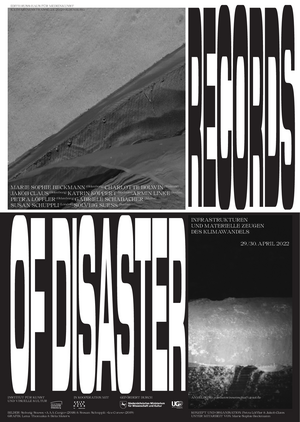
29 & 30 April 2022
House of Media Art
Katharinenstraße 23,
, 26121 Oldenburg
Whilst infrastructures appear to form the stable material and logistical foundation of our everyday lives, on closer inspection they are fragile constructs. This becomes clear from the regular breakdowns of networks that supply people with water, heat, goods and information. Such breakdowns are increasingly triggered by ecological disasters, such as wildfires, floods or tidal waves, which, as tangible evidence of global warming, also raise awareness of man-made climate change and its local impacts.
Registration: