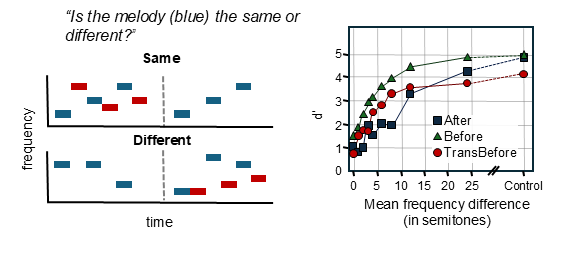
Reference:Bey & McAdams, 2002
In their 2002 study, Bey & McAdams investigated the recognizability of melodies in auditory scenes.
They studied how well target melodies were detected when interleaved with a distractor melody.
The paradigm uses an "isolated" target melody followed by an "interleaved" sequence (target + distractor).
In half of the presentations, the interleaved sequence contains a different melody instead of the target.
The listeners where tasked to judge whether the target melody was included in the interleaved sequence.
By varying the order (isolated first vs. interleaved first) and the frequency distance (semitones) between melodies,
they showed that prior knowledge (the "schema") and frequency separation improve melody detection.
Settings
Stimuli
▼ Experiment (5 Trials per Session)
Note: This section is an approximation for illustration. It is not the original experimental setup described in the reference but serves to provide a feel for the psychoacoustic effects at play.
▼ How to
Start a session and judge whether the isolated melody was included in the interleaved melody.
Press "Start" to start a experiment demonstration with the selected playback mode.
Mode:
Isolated-Interleaved: The isolated target-melody is presented first, followed by a short pause and the interleaved melody.
Interleaved-Isolated: The interleaved melody is presented first, followed by a short pause and the isolated target-melody.
Transposed-Interleaved: The transposed isolated target-melody is presented first, followed by a short pause and the interleaved melody.
The demonstration starts at a randomly selected semitone distance between the target-melody and interleaved melody.
For each stimulus, judge whether the isolated target-melody was included in the interleaved melody.
A total of 5 stimuli are presented throughout the demonstration.