▼ Details: Numerosity & Inharmonicity
Reference: Bogaard, Mesik & Oxenham(2025)
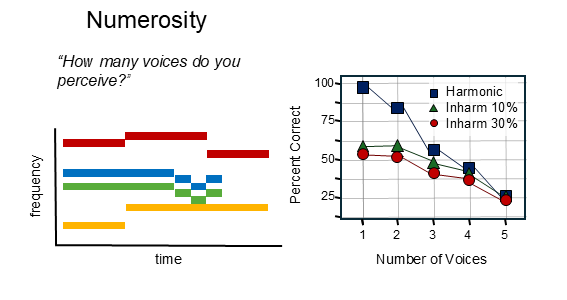
This tool is inspired by the experiment of Bogaard et al., (2025) to test the listeners’ ability to hear out voices. It uses additive synthesis and formant filtering to recreate the vocal /u/ timbre. The experiment tests how inharmonicity (jitter) affects your ability to count simultaneous voices (1-5). Each voice follows a pentatonic scale while avoiding note overlaps. The Distinct Timbre condition was added to display the effect of timbral homogenity.
This tool is inspired by the experiment of Bogaard et al., (2025) to test the listeners’ ability to hear out voices. It uses additive synthesis and formant filtering to recreate the vocal /u/ timbre. The experiment tests how inharmonicity (jitter) affects your ability to count simultaneous voices (1-5). Each voice follows a pentatonic scale while avoiding note overlaps. The Distinct Timbre condition was added to display the effect of timbral homogenity.