▼ Details: Instrument Identification
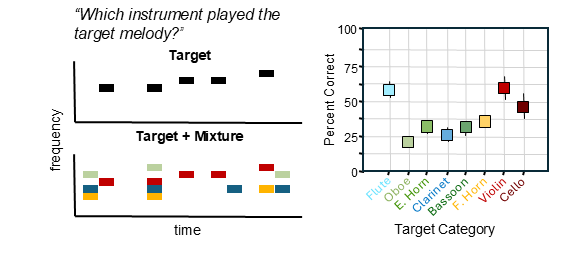
This paradigm is inspired by a study from Jacobsen and colleagues (2026) investigating how well we can isolate and identify individual instruments within a complex musical mixture.
The Original Experiment:
Jacobsen used realistic orchestral excerpts from Richard Wagner's Tristan Prelude. Participants listened to a simple pure-tone cue and then had to pinpoint which of 8 possible instruments played that exact melody within a dense mixture. To make it as realistic as possible, the study even simulated concert hall acoustics (reverb) and different stage seating arrangements!
Key Findings:
• Instrument & Pitch: Our ability to pick out an instrument depends heavily on the specific instrument class and its pitch (register).
• Musical Role: An instrument's position within the harmony (e.g., playing the highest voice vs. a middle voice) drastically changes how easily it is recognized.
• Acoustic Camouflage: The more similar the background instruments sound to the target instrument, the harder it is for our brain to separate them.
This web version recreates the core of this task. Listen to the excerpt and try to identify which instrument was highlighted!