▼ Description: Timbre & Auditory Streaming
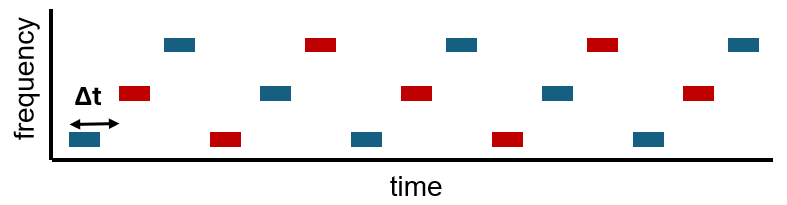
David Wessel demonstrated that when a sequence of notes alternates in timbre (A-B-A-B), the brain prioritizes timbral similarity over pitch proximity for auditory grouping. If the timbres of A and B are similar, the listener perceives a single, coherent ascending melody. However, as the timbral difference increases, the sequence 'splits' into two distinct rhythmic streams. This effect is highly dependent on tempo: at faster playback speeds, the auditory system is significantly more likely to group the notes by their timbre rather than their pitch.