The controversy over naming the university after Carl von Ossietzky
1972
6 June Hans-Henning Adler, the student member of the Founding Committee, proposed that the university be named after Carl von Ossietzky, an opponent of the Nazis and Nobel Peace Prize laureate, in the university charter. Reason: The university’s social mission, as set out therein – to place its work in the service of peace and democracy – should also be made clear through its name.
1973
21 April The Nordwest-Zeitung (NWZ) launched a reader survey on the choice of name and put forward, alongside Carl von Ossietzky, four other figures (Count Anton Günther, Wilhelm Heinrich Schüßler, Gustav Stresemann, Karl Jaspers) as well as the name ‘University of Oldenburg’ for a vote. The result: over half of the 3,111 participants voted in favour of ‘University of Oldenburg’.
1974
1 February The Founding Committee unanimously adopts the university charter, Section 1 of which provides for the university to be named after Carl von Ossietzky.
7 February The SPD-led Ministry of Education and Cultural Affairs approves the university charter, with the exception of the naming provision.
6 June In a meeting with the Council’s Executive Board, the Ministry confirms its opposition. Reason given: the name is no longer appropriate
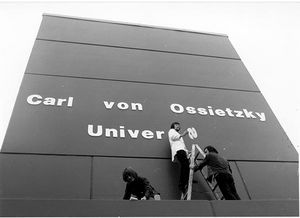
16 October One day after the start of the semester, students affix the words ‘Carl von Ossietzky University’ in large letters to the tower of the Allgemeines Verfügungszentrum (AVZ, now A1-4), making them clearly visible from a distance.
Students are putting up the sign reading ‘Carl von Ossietzky University’ at the AVZ.
1975
14 May To avoid losing a vote in the state parliament over a CDU proposal to remove the lettering, the SPD/FDP government announces that the lettering will be removed.
Police operation to remove the lettering ‘Carl von Ossietzky University’ from the AVZ (now A1-4)
27 June Under the protection of 200 police officers, painters remove the lettering.
2 July During the night, students reattach the sign reading ‘Carl von Ossietzky University’ in the same spot.
August/September The attempt to push through a compromise proposed by the university and accepted by the Minister for Science (“University of Oldenburg – University of Oldenburg”) with the state government and in parliament fails due to opposition from the SPD’s coalition partner, the FDP.
1976
18 December First information meeting of the Oldenburg Citizens’ Committee ‘University of Oldenburg’, which was formed on 5 August. In letters, Alfred Andersch, Heinrich Albertz, Willy Brandt, Axel Eggebrecht, Ossip K. Flechtheim, Helmut Gollwitzer, Günter Grass, Robert Kempner, Siegfried Lenz and Rosalinde von Ossietzky-Palm, amongst others, express their views on the university’s cause.
1978
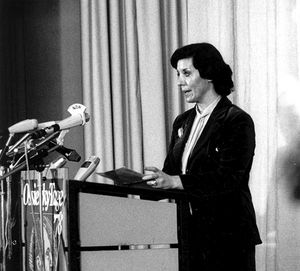
4–5 May Together with the International League for Human Rights, the DGB regional branch in Lower Saxony and the Federal Youth Council, the University of Oldenburg is organising a series of events known as the ‘Ossietzky Days’ to mark the 40th anniversary of the death of the Nobel Peace Prize laureate. Participants include, amongst others, DGB Chairman Heinz Oskar Vetter, the former Governing Mayor of Berlin, Heinrich Albertz, and the Irish Nobel Peace Prize laureate Betty Williams.
As part of this event, Rosalinde von Ossietzky-Palm, the daughter of the Nobel Peace Prize laureate, unveils a memorial by the Cologne-based artist Hans-Peter Reinartz, funded by donations from members of the university community. In 2005, it is given its permanent location in front of the lecture theatre complex.
The Irish Nobel Peace Prize laureate Betty Williams at the Ossietzky Days in 1978.
14 June The University Council, comprising 88 members, decides—with one vote against—to name the university after Carl von Ossietzky in matters of self-governance.
16 June The CDU-led Ministry of Science challenges the Council’s decision as unlawful. The university subsequently brings an action before the Oldenburg Administrative Court.
1980
February The Oldenburg Administrative Court rules that only the state parliament is authorised to decide on the names of universities and overturns the decisions of the university council and the University Senate.
1981
12 April Rosalinde von Ossietzky-Palm, the daughter of Carl von Ossietzky, bequeaths her father’s estate to the university. This forms the basis of the ‘Ossietzky Archive’.
Rosalinde von Ossietzky-Palm (right), daughter of the Nobel Peace Prize laureate, during her visit to the university in 1981 with President Horst Zillessen and his wife.
4 to 10 May For the second time, the university is organising the Ossietzky Days, which took place six times in the 1980s and addressed current socio-political issues.
1988
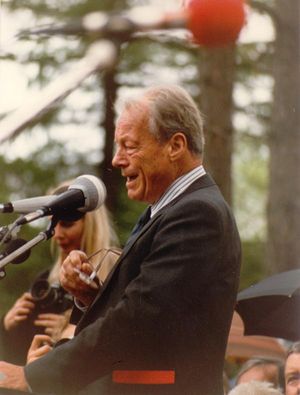
4 to 8 May Participants in the Ossietzky Days, entitled ‘Republicans without a Republic’, included, amongst others, the Nobel Peace Prize laureate and SPD Federal Chairman Willy Brandt, futurist Robert Jungk, poet Erich Fried and Axel Eggebrecht, co-founder of Nordwestdeutscher Rundfunk (NWDR, later NDR and WDR).
Willy Brandt delivering a speech at the former Esterwegen concentration camp during the Ossietzky Days in 1988
Summer An interdisciplinary team of researchers begins work on an annotated complete edition of the works of Carl von Ossietzky. The project, funded by the German Research Foundation (DFG), is completed in 1996 and published in eight volumes by Rowohlt.
1991
17 April The State Parliament approves the amendment to the Lower Saxony Higher Education Act (NGHG) with the support of all parliamentary groups. This enables the university to adopt the name of its choice.
29 May The University Council subsequently reaffirms its decision to name the university after Carl von Ossietzky.
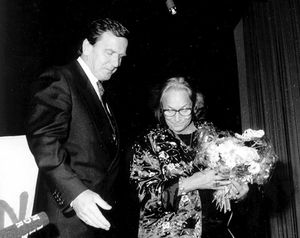
3 October A naming ceremony is held, attended by Minister-President Gerhard Schröder (SPD), who, on behalf of the state government, apologises to Rosalinde von Ossietzky-Palm for “what the state of Lower Saxony has done to your father’s name.”
Apology on behalf of the state government: Minister-President Gerhard Schröder and Rosalinde von Ossietzky-Palm.