


The protein KCC2 plays an important role in the body: if it does not function properly, this leads to chronic pain and epilepsy - and if it fails completely, newborn babies cannot breathe. Biologists from the University of Oldenburg have now published new findings on the evolution of this protein and its "family" as well as on its more precise function within the nervous system in two renowned scientific journals.
Specifically, the protein KCC2 - the abbreviation stands for potassium chloride cotransporter - is necessary for the maturation of neurons, specifically for that of inhibitory - i.e. inhibiting - neurons. In the human brain, with its trillions of neuronal connections, around a third of all synapses are inhibitory. Synaptic inhibition is essential, for example to be able to see contrasts or locate sound sources. In order for an inhibitory synapse to mature and start working, KCC2 must transport chloride ions out of the cell.
For several years, the Neurogenetics Working Group (WG) at the University of Oldenburg has been scrutinising exactly how the activity of KCC2 is regulated. Their most recent finding, which the "Journal of Biological Chemistry" has now published as the article of the week: If phosphates bind at two specific sites within the protein - at the amino acid sites serine 934 or threonine 937 - this increases the transport activity of KCC2.
Earlier analyses had shown that binding phosphates at other sites "slowed down" the protein. This fine regulation identified by the biologists may be important for the maturation process of nerve cells and will be investigated further in the future.
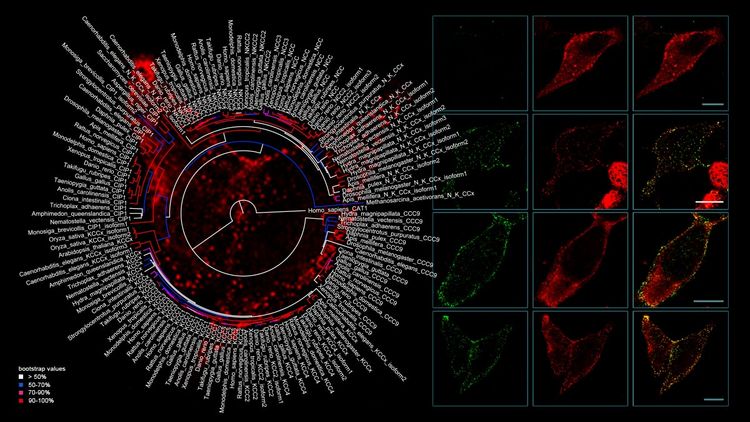
A look back into the "family history" of the KCC2 protein is described in another article by the Systematics and Evolutionary Biology working group, which appeared in the renowned journal "Molecular Biology and Evolution". According to the article, the cation-chloride cotransporter (CCC) family evolved early on, since the so-called archaea bacteria.
What is particularly interesting is that the KCC subfamilies - to which KCC2 also belongs - and NKCC arose before the first primitive nervous systems in cnidarians. Based on this, the researchers want to find out in future whether the KCC proteins may even have made the development of the inhibitory nervous system possible in the first place and whether excitatory and inhibitory synapses ensured a balance of activity in primitive nervous systems in invertebrates from the very beginning.
More on the topic
AG Neurogenetics
AG Systematics and Evolutionary Biology
JBC article: "A novel regulatory locus of phosphorylation in the C-terminus of the potassium chloride cotransporter KCC2 that interferes with N-ethylmaleimide or staurosporine mediated activation"
MBE article: "Evolution of the Cation Chloride Cotransporter Family: Ancient Origins, Gene Losses, and Subfunctionalization through Duplication "
Contact
Dr Anna-Maria Hartmann
Institute of Biology and Environmental Sciences
Tel: 0441/798-3966
anna.maria.hartmann@uni-oldenburg.de