

This year's Teaching and Learning Day on Thursday is all about "learning spaces of the future". Susanne Haberstroh, the new Head of the Department for Study Affairs, talks about spaces for experimenting outside of the natural sciences, virtual extensions to the campus and her own favourite places to learn.
Where, or rather in which learning spaces, did you particularly enjoy and learn well during your studies?
When I was studying psychology in the 1990s - before the internet and e-books - the library was an important place to work and study. I also spent many hours in a student-organised learning café. Since working on and conducting experiments played a major role, the laboratory, where we interviewed test subjects, for example, was also an important learning space for me as a student - with the classic one-way disc that allowed unnoticed observations.
What makes a successful learning space for you?
A successful learning space is designed in such a way that it promotes learning processes. Learning does not take place independently of the space in question. Regardless of whether we are in a physical, hybrid or virtual space. This is why space is also referred to as the "third pedagogue". It is therefore important that the structural and technical design of a learning space follows didactic guidelines. Learning processes should not adapt to the space, but the other way round. Learning spaces must therefore be flexible in design and multifunctional in use. It is also important that learning spaces are designed in such a way that they enable collaboration. In this way, central concepts from our teaching mission statement - such as research-based learning - can be successfully implemented.
What exactly does that mean, what could a space that adapts to learning processes look like? Can you give an example at the university?
The university library's Learning Lab is a good example. It offers flexible furniture and, in addition to analogue moderation material, various digital tools from smartboards, audio recording and video editing to 360-degree cameras, so that students can try out many things and design and use the space according to their needs. We generally speak of a "shift from teaching to learning", with the learner's perspective taking centre stage. In addition, against the backdrop of digitalisation, it is crucial that we interlink physical and virtual learning environments. We need to move away from the mindset that spaces are either physical or virtual. For example, the acquisition of certain future skills - i.e. key technological and digital competences - cannot be promoted in purely physical spaces.
What would you like to see - and how much room for manoeuvre does the university have? I'm thinking of the lack of space, for example...
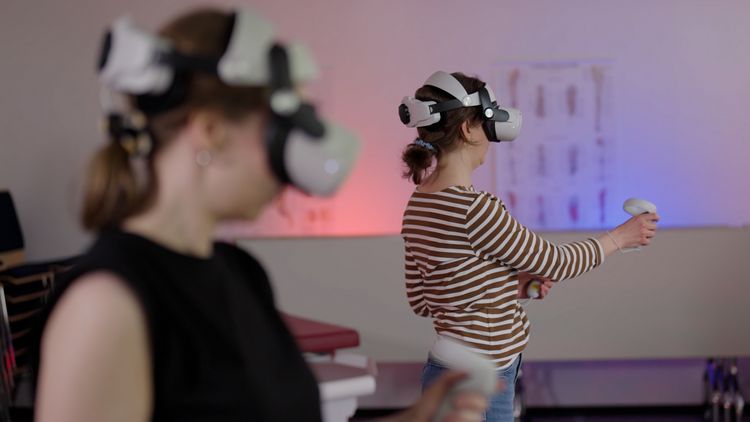
Of course, the shortage of space is a challenge that cannot be solved simply by remodelling the university as a place of learning and its learning spaces. However, by making learning spaces more flexible and variable than before, more usage and learning scenarios could emerge. The 'classic' lecture theatres are a good example of this. Without questioning the importance of lectures in general, we could think about whether and how we design lecture theatres in such a way that communicative and collaborative learning processes can also be promoted in them - for example through variable furniture: tables that can be pushed to the side or arranged into group tables can be very helpful. Expanding physical spaces with digital solutions - such as virtual reality glasses - can also be part of the solution. In this way, virtual learning environments can be added to the university as a place of learning. The university is already practising this: for example, in the virtual emergency room or in teacher training when virtually exploring non-university and extracurricular learning locations.
Learning culture will also be a topic at the "Day of Teaching and Learning". What is the connection between learning culture and learning space design?
The learning culture of a university is always reflected in the design of its learning spaces. This connection will be a central theme. In order to show how multifaceted and dynamic the learning culture of our university is, the University Didactics Department has launched the 'Learning Spaces Forum' - a film series that presents innovative learning spaces at our university and how they are designed to promote learning. In recent years, innovative learning spaces have been created in the Institutes of all Schools and in central facilities such as the University Library, each of which promotes very different forms of learning. The short films show that we are making good progress here.
In your opinion, what characterises the learning culture at the University of Oldenburg?
Our university cultivates a special culture of cooperation that we want to promote - the film series illustrates this, and that's how I perceive it. Students can learn in a self-organised way here and at the same time are supported in their individual learning paths. They also have various opportunities to influence the design of learning spaces and the learning processes that take place in them. The relatively "short distances" at our university favour this.
How could the learning culture develop further?
In my view, this requires above all spaces for experimentation. In this case, this doesn't mean - or not only - science labs, but spaces where innovative forms of teaching and learning can be tried out and further developed. With the aforementioned Learning Lab, which was created through the Participate@UOL project, there is already such a learning space explicitly for students. Here, they can try out new forms of joint or individual learning, support their learning processes with analogue and digital tools and adapt the space to all of this. A next and very important step is the development of a teaching lab in which teachers and students can try out future-orientated learning scenarios together.
How can teachers and students contribute their respective ideas to the "Day of Teaching and Learning" and help shape the future study culture?
There will be a joint workshop organised by Participate@UOL and Innovationscampus. Teachers, students and staff at our university can get creative and develop a shared perspective for the future using the "Lego® Serious Play®" method: What kind of learning spaces do we want in the future? The Vice President for Studies and Teaching, Prof Dr Andrea Strübind, will also take part in the final presentation. We are already looking forward to the discussion with the participants!
Interview: Deike Stolz