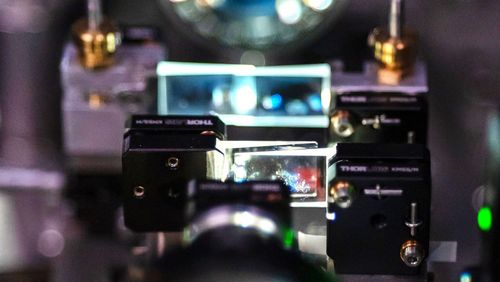
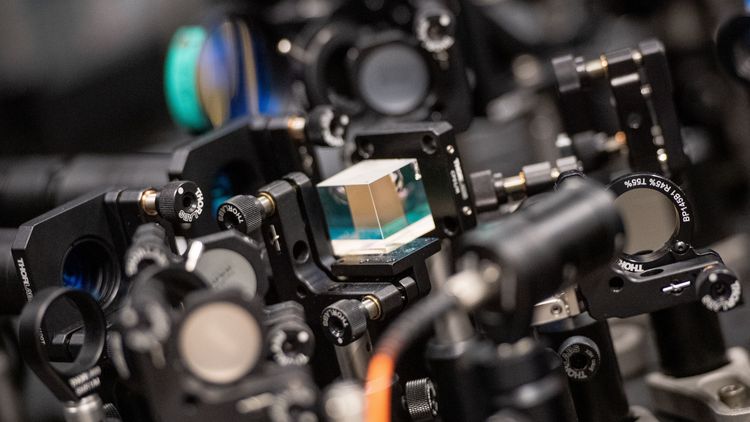
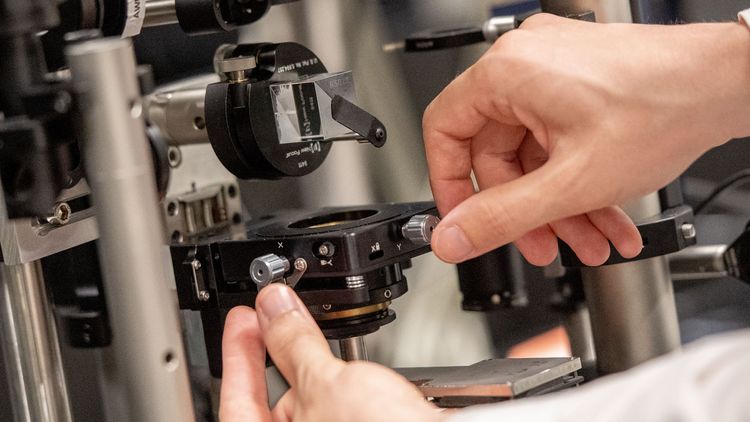
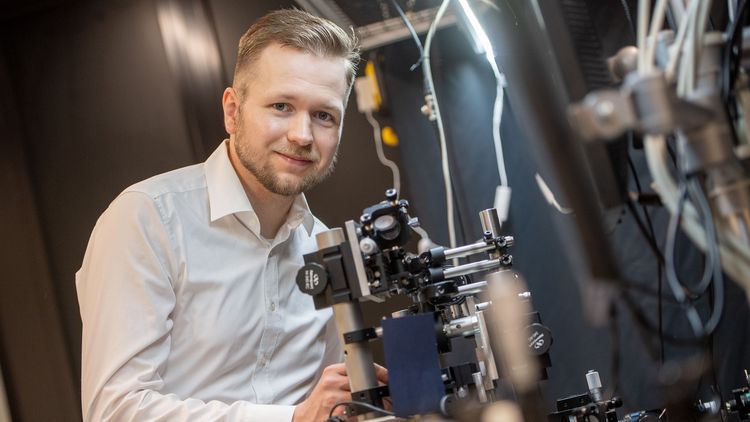



Der Physiker Martin Esmann hat für seine Forschung ein „Carl von Ossietzky Young Researchers‘ Fellowship“ der Universität erhalten. Der Forscher beschäftigt sich mit Schwingungen in Festkörpern.
Es ist eine exotische und fremdartige Welt, in der Dr. Martin Esmann zu Hause ist. Bevölkert von merkwürdigen Teilchen, die halb Licht, halb Materie sind, von Wellen, die sich wie Teilchen verhalten und von kuriosen Materialien, deren Eigenschaften von abstrakten mathematischen Konzepten beschrieben werden. Esmann, der seit April durch ein „Carl von Ossietzky Young Researcher‘s Fellowship“ der Universität Oldenburg gefördert wird, interessiert sich für das Reich der Quantenphysik, das er mit möglichst einfachen experimentellen Mitteln erkunden will. „Es fasziniert mich, wenn man eine abstrakte Fragestellung in ein schönes Experiment umwandeln kann und schließlich die Antwort sichtbar in den Händen hält“, sagt er.
Einen derartigen Aha-Moment erlebte Esmann beispielsweise während seiner Doktorarbeit, die er von 2012 bis 2016 in der Oldenburger Arbeitsgruppe von Prof. Dr. Christoph Lienau anfertigte: „Es ist mir damals gelungen, Licht auf sehr kleinem Raum einzusperren und damit eine neue Art eines optischen Mikroskops mit extrem hoher Auflösung zu erzeugen“, berichtet er. Das Ergebnis publizierte er in der renommierten Zeitschrift Nature Nanotechnology.
Akustische Schwingungen und exotische Teilchen
In seinem aktuellen Forschungsprojekt kombiniert Esmann gleich mehrere Phänomene, von denen Nicht-Physiker vermutlich noch nie gehört haben. In der Fachwelt gelten sie jedoch als besonders spannende Ansatzpunkte, um unbekannte Phänomene und fremdartige Zustände der Materie zu erforschen. Eine wichtige Rolle spielen die Topologie (ein abstraktes Konzept aus der Mathematik), Exziton-Polaritonen (eine exotische Teilchenart) und akustische Schwingungen in Festkörpern.
Mit diesen Schwingungen, die sich aus physikalischer Sicht auch als Teilchen betrachten lassen und Phononen genannt werden, hat sich Esmann während seines viereinhalbjährigen Aufenthalts als Postdoktorand in Frankreich eingehend beschäftigt. Von 2016 bis Anfang 2021 forschte er am Center for Nanoscience and Nanotechnology (C2N) in Palaiseau nahe Paris, einem der großen Zentren der französischen Forschungsorganisation CNRS. „Dort befindet sich einer der größten wissenschaftlichen Reinräume in ganz Frankreich“, berichtet er.
In dieser Zeit reifte in ihm die Idee heran, akustische Schwingungen in Festkörpern, die im Grunde eine Form von Wärme sind, nicht als Störung, sondern als interessante Zutat zu betrachten. „Phononen können etwa in Computerchips Schaltvorgänge durcheinanderbringen und gelten daher als nachteilig“, erläutert er. In Frankreich befasste sich Esmann intensiv damit, wie sich Phononen kontrollieren lassen. „Ich habe ein System gebaut, das Licht und Schall zusammen räumlich einsperrt“, berichtet der Forscher. Er untersuchte, wie sich die Wechselwirkung zwischen Licht und Schall fördern lässt – eine Voraussetzung dafür, die akustischen Schwingungen letztlich nutzbar zu machen.
Neue Quantenmaterialien
Mit diesen Erfahrungen im Gepäck ist Esmann nun nach Oldenburg zurückgekehrt und will sich hier ein eigenes Forschungsgebiet aufbauen, das die existierenden Schwerpunkte am Institut für Physik ergänzt. Esmann gehört zum Team der Arbeitsgruppe Quantenmaterialien von Prof. Dr. Christian Schneider. Sein durch das Ossietzky-Fellowship gefördertes Projekt befasst sich zunächst nicht direkt mit Phononen, sondern mit anderen merkwürdigen physikalischen Objekten: Exziton-Polaritonen, den Lieblingsteilchen der Arbeitsgruppe Quantenmaterialien. Diese Zustände kann man sich als Kopplung aus Lichtteilchen und angeregten Elektronen in Festkörpern vorstellen. Sie bestehen sozusagen gleichzeitig aus Materie und Licht – und kombinieren auch deren Eigenschaften.
„Exziton-Polaritonen haben viele Gemeinsamkeiten mit einer Flüssigkeit“, erläutert Esmann. Die Teilchen seien etwa beweglich wie Lichtteilchen und wechselwirken miteinander wie Elektronen. Unter bestimmten Umständen verschmelzen die milliardstel Meter kleinen Exziton-Polaritonen zu einem einzigen Objekt, das (für die Verhältnisse der Quantenphysik) makroskopisch sichtbar wird, etwa in einer Größenordnung von Bruchteilen eines Millimeters. „Der Clou daran ist: Wir erhalten eine Plattform, mit der man Quantenmechanik auf der Makroskala beobachten kann“, so der Forscher.
Derartige Systeme, so die Idee, lassen sich nutzen, um quantenmechanische Prozesse, die sonst verborgen bleiben, gleichsam zu simulieren und zu verstehen. In Halbleitern lässt sich der erforderliche Zustand der Exziton-Polaritonen nur bei extrem kalten Temperaturen erzeugen, doch die Oldenburger Forschenden um Schneider nutzen unter anderem dünne Eiweißschichten, in denen das Phänomen bereits bei Raumtemperatur auftritt.
Wenn Wellen nur in eine Richtung wandern
Esmann will Erfahrungen mit Exziton-Polaritonen sammeln und diese Kenntnisse anschließend nutzen, um neue Methoden für seine Experimente mit Phononen zu entwickeln. Dabei kommt schließlich auch die Topologie ins Spiel, ein mathematisches Konzept, mit dessen Hilfe sich ungewöhnliche Symmetrie-Eigenschaften von Festkörpern beschreiben lassen. Diese Symmetrien können zum Beispiel dazu führen, dass sich wellenartige Anregungen an Grenzflächen in eine bestimmte Richtung fortbewegen. Eine von Esmanns vielen Ideen Phononen zu nutzen besteht darin, die akustischen Schwingungen mit Licht zu kombinieren und so chemische Reaktionen zu steuern. Eine andere, mit ihrer Hilfe die Trennung von Ladungen, etwa in Solarzellen, zu erleichtern.
Nach vier spannenden und prägenden Jahren in Paris freut sich der Forscher, dass er durch das Ossietzky-Fellowship mit seiner Familie nach Oldenburg zurückkehren konnte: „Ich bin sehr dankbar, von der Universität bei diesem herausfordernden Karriereschritt zu einer eigenen Arbeitsgruppe Unterstützung zu bekommen.“ Der Anfang dafür ist gemacht: Esmann hat bereits erste Proben hergestellt, Experimente zum Laufen gebracht – und damit begonnen, ein kleines Team aufzubauen.