News

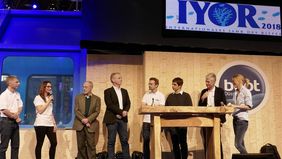
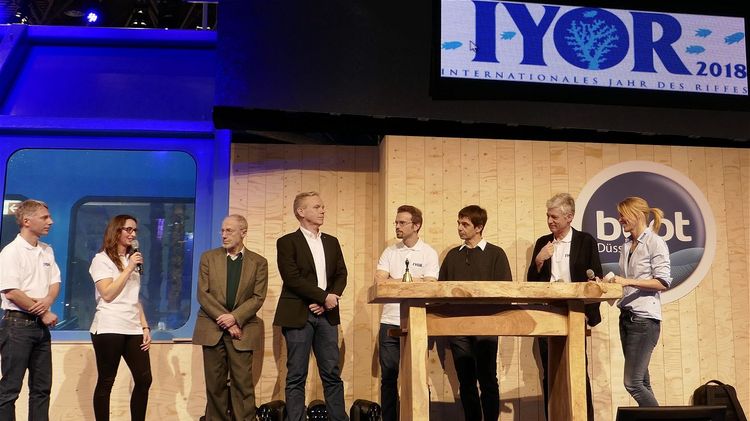
  • Eröffnung des Internationalen Jahr des Riffes (IYOR 2018) auf der boot in Düsseldorf. Von links nach rechts: Prof. Dr. Ralph Schill, VDST; Marina Schiller, Uni Bochum; Prof. Dr. Helmut Schuhmacher i.R., Univ. Duisburg-Essen; Prof. Gert Wörheide, LMU München; Dr. Sebastian Ferse, ZMT Bremen; Prof. Peter Schupp, Uni Oldenburg, Prof. Reinhold Leinfelder, FU Berlin; Anna von Boetticher, Moderatorin.

IYOR 2018 starts in Germany with participation of ICBM

The German branch of the 3rd International Year of the Reef (IYOR 2018) has been officially opened on 28 January in Dusseldorf, Germany during the trade fair „boot“. On this occasion, the ICBM was represented by Prof. Dr. Peter Schupp, head of the research group Environmental Biochemistry at the Institute. For several years, Schupp and his group have been investigating different aspects of reef-forming corals.

Dusseldorf. The German branch of the 3rd International Year of the Reef (IYOR 2018) has been officially opened on 28 January in Dusseldorf, Germany during the trade fair „boot“. On this occasion, the ICBM was represented by Prof. Dr. Peter Schupp, head of the research group Environmental Biochemistry at the Institute. For several years, Schupp and his group have been investigating different aspects of reef-forming corals.


The global initiative IYOR was proclaimed for the first time in 1997. Since then, things have not gone too well with coral reefs: In the past two years the world has been facing the most devastating coral bleaching event ever since observations started. More than 90 percent of Australia‘s Great Barrier Reef were affected. As predicted by climate models, up to the middle of the century almost the same amount of reefs will regularly bleach on a global scale, if no countermeasures are taken. To these, anyone could contribute, by e.g. reducing the individual carbon footprint, waste prevention and taking advantage of sustainable tourist offers.
 

More (German only)

The university newspaper of the University of Oldenburg
(only German)

The research magazine of the University of Oldenburg

Campus Life

  • Eröffnung des Internationalen Jahr des Riffes (IYOR 2018) auf der boot in Düsseldorf. Von links nach rechts: Prof. Dr. Ralph Schill, VDST; Marina Schiller, Uni Bochum; Prof. Dr. Helmut Schuhmacher i.R., Univ. Duisburg-Essen; Prof. Gert Wörheide, LMU München; Dr. Sebastian Ferse, ZMT Bremen; Prof. Peter Schupp, Uni Oldenburg, Prof. Reinhold Leinfelder, FU Berlin; Anna von Boetticher, Moderatorin.

IYOR 2018 starts in Germany with participation of ICBM

The German branch of the 3rd International Year of the Reef (IYOR 2018) has been officially opened on 28 January in Dusseldorf, Germany during the trade fair „boot“. On this occasion, the ICBM was represented by Prof. Dr. Peter Schupp, head of the research group Environmental Biochemistry at the Institute. For several years, Schupp and his group have been investigating different aspects of reef-forming corals.

Dusseldorf. The German branch of the 3rd International Year of the Reef (IYOR 2018) has been officially opened on 28 January in Dusseldorf, Germany during the trade fair „boot“. On this occasion, the ICBM was represented by Prof. Dr. Peter Schupp, head of the research group Environmental Biochemistry at the Institute. For several years, Schupp and his group have been investigating different aspects of reef-forming corals.


The global initiative IYOR was proclaimed for the first time in 1997. Since then, things have not gone too well with coral reefs: In the past two years the world has been facing the most devastating coral bleaching event ever since observations started. More than 90 percent of Australia‘s Great Barrier Reef were affected. As predicted by climate models, up to the middle of the century almost the same amount of reefs will regularly bleach on a global scale, if no countermeasures are taken. To these, anyone could contribute, by e.g. reducing the individual carbon footprint, waste prevention and taking advantage of sustainable tourist offers.
 

More (German only)

Study in Oldenburg

Degree Programmes

The University of Oldenburg offers a broad range of subjects. Learn about the opportunities available at our university.


Degree Programmes A-Z

Accomodation and Living

New to our university, but no idea where to live? We provide an overview of accommodation, recreational and cultural offerings.


Campus Life

Application

Each degree programme has a specific application process and requires certain documents and qualifications. You can find detailed information here.


Application Portal

Newly appointed at the university

Who is new in which subject?
An overview of newly appointed professors in chronological order.

  • Eröffnung des Internationalen Jahr des Riffes (IYOR 2018) auf der boot in Düsseldorf. Von links nach rechts: Prof. Dr. Ralph Schill, VDST; Marina Schiller, Uni Bochum; Prof. Dr. Helmut Schuhmacher i.R., Univ. Duisburg-Essen; Prof. Gert Wörheide, LMU München; Dr. Sebastian Ferse, ZMT Bremen; Prof. Peter Schupp, Uni Oldenburg, Prof. Reinhold Leinfelder, FU Berlin; Anna von Boetticher, Moderatorin.

IYOR 2018 starts in Germany with participation of ICBM

The German branch of the 3rd International Year of the Reef (IYOR 2018) has been officially opened on 28 January in Dusseldorf, Germany during the trade fair „boot“. On this occasion, the ICBM was represented by Prof. Dr. Peter Schupp, head of the research group Environmental Biochemistry at the Institute. For several years, Schupp and his group have been investigating different aspects of reef-forming corals.

Dusseldorf. The German branch of the 3rd International Year of the Reef (IYOR 2018) has been officially opened on 28 January in Dusseldorf, Germany during the trade fair „boot“. On this occasion, the ICBM was represented by Prof. Dr. Peter Schupp, head of the research group Environmental Biochemistry at the Institute. For several years, Schupp and his group have been investigating different aspects of reef-forming corals.


The global initiative IYOR was proclaimed for the first time in 1997. Since then, things have not gone too well with coral reefs: In the past two years the world has been facing the most devastating coral bleaching event ever since observations started. More than 90 percent of Australia‘s Great Barrier Reef were affected. As predicted by climate models, up to the middle of the century almost the same amount of reefs will regularly bleach on a global scale, if no countermeasures are taken. To these, anyone could contribute, by e.g. reducing the individual carbon footprint, waste prevention and taking advantage of sustainable tourist offers.
 

More (German only)

Video Portal

International researchers in Oldenburg

International students in Oldenburg:
"It feels like a second home"

Your Campus! Your Doctorate! Your Academic Career! 

Zum Seitananfang scrollen Scroll to the top of the page