


Beliebte Pastagerichte oder Kochrezepte für Seifenblasen – aus komplexen Wissenschaftsthemen leichte Kost zu machen, dieser Aufgabe stellten sich am Montagabend fünf Nachwuchswissenschaftler vor großem Publikum bei der Verleihung des „Groschen“.
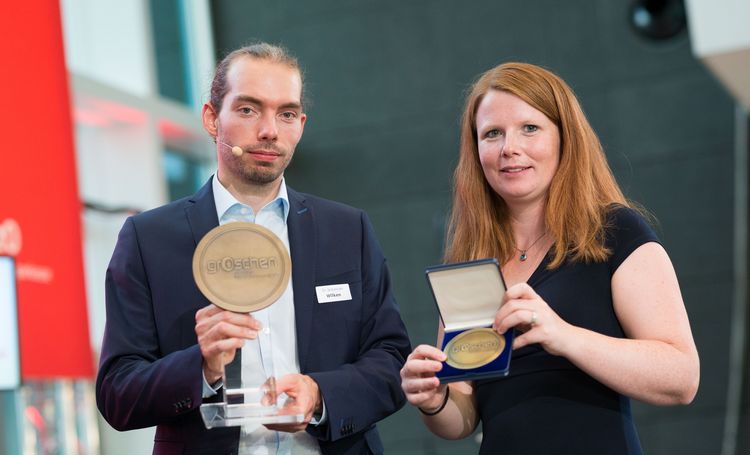
Forschung für Laien verständlich zu erklären – darum geht es alle zwei Jahre beim Preis für Wissenschaftskommunikation der Landessparkasse zu Oldenburg. In weniger als acht Minuten gelang es den fünf Finalisten, ihre Themen von der theoretischen Physik bis zur Germanistik anschaulich darzustellen. Den mit 10.000 Euro dotierten „groschen 2018“ erhielt schließlich der Physiker Dr. Sebastian Wilken. Der Publikumspreis, und damit 1.000 Euro, gingen an die Biologin Anne Depping.
Was haben Spaghetti Bolognese mit organischen Solarzellen zu tun? Diese Frage beantwortete Wilken, Postdoktorand in der Abteilung Energie- und Halbleiterforschung (EHF) am Institut für Physik der Universität, in seiner unterhaltsamen Präsentation. Ganz nebenbei erklärte er so die physikalischen Prozesse, die im Inneren der Solarzelle ablaufen. Am Ende hatten Jury und Publikum verstanden, wie eine gut funktionierende organische Solarzelle aufgebaut sein muss: Die Polymere, also die Spaghetti, zwischen denen sich kleinste fußballartige Moleküle, also die Hackfleischbällchen, befinden, brauchen einen Kleber – das ist die Soße. Nur so kann das Material Lichtenergie möglichst effizient in elektrischen Strom umwandeln.
Dass Vögel über tausende von Kilometern ihren Weg in die Winterquartiere und zurück in die Brutgebiete finden, schilderte Depping in ihrem Vortrag. Die Doktorandin aus der Arbeitsgruppe Neurosensorik am Institut für Biologie der Universität setzte wandernden Singvögeln eine virtuelle Brille auf und erklärte so, wie die Tiere das Magnetfeld der Erde sehen können. Welches Molekül im Auge der Vögel für den Magnetsinn verantwortlich ist, hatte sie in ihrer Masterarbeit herausgefunden.
Auch die anderen drei Finalteilnehmer, die als Preis je 500 Euro erhielten, schafften es, selbst schwierige Themen verständlich darzustellen: Jannik Ehrich, Doktorand am Institut für Physik, schickte die Zuhörer gedanklich auf den Kramermarkt, um in der Menschenmenge nach einer Wurstbude zu suchen. Er erklärte so unter anderem, wie kleinste Systeme – etwa Nanoteilchen – in ihrer Umwelt Energie als Wärme abgeben. Mit einem Kochrezept für Eier verglich der Geoinformatiker Robin Rofallski von der Jadehochschule seine Methode, mit der er das Volumen von Riesenseifenblasen – oder auch großen Vogel- und Fischschwärmen – errechnen kann. Ein ganz anderes Thema brachte Dr. Jan Michalsky, Postdoktorand am Institut für Germanistik, zur Sprache: Er schilderte unter anderem, dass sich der Klang der Stimmen von Gesprächspartnern, die einander sympathisch finden, im Laufe einer Unterhaltung angleicht. Gleich und gleich gesellt sich gern, so sein Fazit.
Der LzO-Preis für Wissenschaftskommunikation wird seit 2010 vergeben und war in diesem Jahr zum fünften Mal ausgeschrieben. Die Jury hatte die fünf Finalisten aus insgesamt 21 Bewerberinnen und Bewerbern der Universitäten Oldenburg und Vechta sowie der Jade Hochschule ausgewählt.