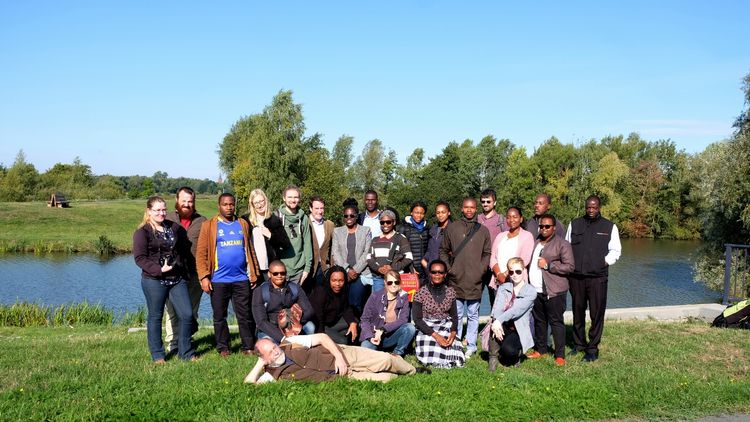


19 students and doctoral candidates from South Africa, Tanzania and Germany are currently meeting in Oldenburg for the Ecosola project's summer school.
Jama Mashele has gained a positive first impression of Germany in Oldenburg. "Visiting a country that is so efficient also gives me hope for our country," says the doctoral student from Nelson Mandela University in George, South Africa. Together with 18 other Master's students and doctoral candidates from South Africa, Tanzania and Germany, Mashele is currently taking part in the ECOSOLA Summer School at the University of Oldenburg, which is focussing on sustainable urban development - including topics such as organic farming, urban planning and ecosystem services.
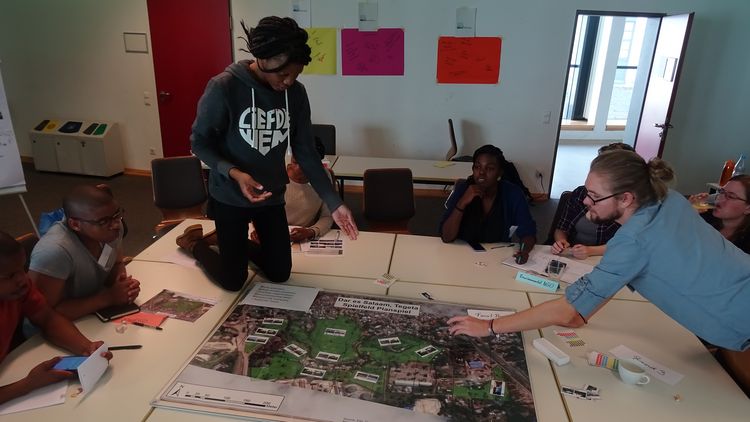
The programme of the summer school, which runs until 12 September, includes lectures, group work, simulation games and excursions. The interdisciplinary group will visit the airbase in Oldenburg and the Links der Weser park in Bremen to see examples of sustainable urban development. The participants will also spend several days working on a case study - a specific Tanzanian or South African city. The group will research the problems that arise and develop strategies to solve them sustainably.
What potential does urban agriculture have?
"Our participants and speakers come from the fields of economics, environmental sciences and sustainable development, but also from agriculture and forestry," reports Oldenburg economist Prof. Dr Bernd Siebenhüner, who organised the event together with landscape ecologist Prof. Dr Michael Kleyer, agroecologist Prof. Dr Raymond Auerbach from Nelson Mandela University and geologist Dr Pius Yanda from the University of Dar es Salaam. The Summer Academy is part of the ECOSOLA (Ecosystem-based solutions for resilient urban agriculture in Africa) project, which is funded by the German Federal Ministry of Education and Research (BMBF) and the German Academic Exchange Service (DAAD). The joint research project between the University of Oldenburg, Planungsgruppe Grün in Bremen, the University of Dar es Salaam in Tanzania and Nelson Mandela University aims to investigate the potential of urban agriculture in the South African province of Western Cape and in the growing megacity of Dar es Salaam.
Does it make sense to grow vegetables, fruit or cereals in cities? Bernd Siebenhüner is convinced of this: "Agriculturally utilised areas offer a variety of ecosystem services: The plants provide shade, reduce soil erosion, can contribute to local recreation and also improve the nutrition of the population." So far, however, many African cities have expanded more or less unplanned. "Green spaces are not given high priority," reports the researcher. He is particularly interested in the institutional framework conditions that regulate the growth of cities - for example, who owns the land, what kind of lease agreements exist and who might be interested in agricultural use.
Discussions and suggestions
Jama Mashele is one of the researchers involved in ECOSOLA. Her doctoral thesis deals with a special form of organic farming in South Africa. There are many organic farms there, but it is too costly for small farmers to be certified for an organic label. Instead, customers can see the quality of the products for themselves on the farms. This process, known as the "Participatory Guarantee System" (PGS), works well in urban areas, but less so in remote rural areas, she reports. The agricultural scientist is hoping for lively discussions and a variety of suggestions at the Summer School in order to gain new perspectives on her research topic.
Tejas Kulkarni, a Master's student at the University of Hanover, feels the same way. The hydrogeologist comes from Bangalore in southern India and has already worked as an environmental engineer for several years. He enjoys the international environment of the Summer School - and has already noticed in the introductory round that the challenges of urbanisation in Africa, India and Europe are similar: "When you talk to colleagues from other parts of the world, you realise that many problems are interlinked."