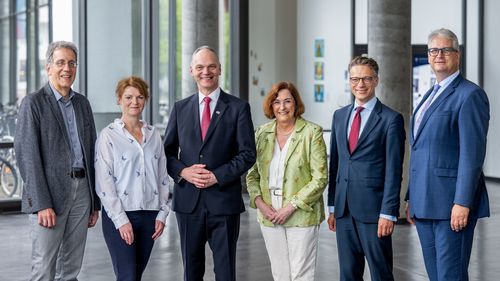


The handling of veterinary pharmaceuticals affects us not only as meat consumers, but also as users of water resources. Oldenburg hydrogeologist Victoria Burke analyses residues of veterinary pharmaceuticals from liquid manure in soil and groundwater - as head of a new junior research group.
Lower Saxony: Germany's number one agricultural state and the centre of the German meat industry. It is well known that its by-product, liquid manure - applied to agricultural land as fertiliser - has an impact on our groundwater. For example, in the form of excessive nitrate pollution, which is often the focus of public debate. Hydrogeologist Dr Victoria Burke is now focusing on another potentially harmful component of liquid manure for humans, animals and the environment: residues of veterinary medicines.
What do these residues mean for the soil that the manure fertilises - and for the groundwater that feeds our drinking water? The young scientist from the Institute of Biology and Environmental Sciences (IBU) will be addressing this question over the next three years - as head of her own research group. The Kurt Eberhard Bode Foundation is providing her with a total of 460,000 euros for this purpose. The 34-year-old will also use these funds to employ two doctoral candidates.
"It's about a topic that directly affects everyone: the quality of our groundwater. Because around 70 per cent of the drinking water we use is extracted from it," explains Burke. The Bode Foundation only approves a junior research group on the sustainable use of water resources every three years. "The call for applications came at the perfect time for me and I'm still surprised that it actually worked out."
Her goal: to understand how traces of various veterinary medicines are transported into the soil and groundwater and possibly degraded - and to make this knowledge usable in practice, for example in the form of a concept for sustainable fertilisation.
The application of animal-based fertilisers such as liquid manure on agricultural land is considered the main source of veterinary drug residues entering the environment. This is because animals generally excrete a significant proportion of the active substances - in some cases 90 or even 100 per cent of the dose - either unchanged or as a degradation product. Some is retained in the soil, others seep away, and rain washes parts into deeper soil zones. "Different substances behave differently," emphasises Burke. "We want to work out which pharmaceutical residues enter the groundwater quickly, how and in what concentration, and which are retained - temporarily or over the longer term - in the zone above the groundwater."
The degradation of these trace substances will also be a topic of research: What happens to antibiotics, for example, and how quickly are they broken down? Which medicines leave trace substances in the soil and groundwater, so that the respective water supplier may have to react - depending on the concentration? They have to comply with strict limits, as studies have shown the negative effects of pharmaceutical and other chemical residues on humans, animals and the environment.
"We are trying to trace the entire path from entry to groundwater, on various scales from laboratory to field trials," says Burke, who already focused on hydrogeology during her geology studies in Berlin before completing her doctorate in Oldenburg under Prof Dr Gudrun Massmann on the degradation of human pharmaceuticals in groundwater.
The smallest scale will be the so-called column experiments in her future laboratory: narrow, metre-high stainless steel cylinders with various soil and sediment cores hidden inside. Using three typical north-west German soils - limestone marsh, plaggenesch and podzol - Burke wants to analyse the "behaviour" of veterinary drug residues by sprinkling the soil cores with the appropriate amount of liquid manure. A fourth column will simulate the so-called saturated zone, i.e. the aquifer.
For the next experimental level, Burke will use a university-owned facility on the Wechloy campus: The "large lysimeter facility" there consists of several so-called lysimeters, huge test columns with a diameter of two metres and four different soil types that are built into the ground, so to speak. The water that seeps through them can be analysed - along with the substances it contains - thanks to a central observation and measuring shaft at a depth of almost two and a half metres.
Burke can carry out her field test at the test site of the Lower Saxony Chamber of Agriculture in Wehnen, which provides her with a test area as well as pig manure for her research. As with the lysimeter trials - and as in real agriculture - she plans to apply slurry in line with plant requirements. This also involves the question of how laboratory results can be better transferred to what actually happens in nature in order to be able to predict the effects on our water more reliably in future.