
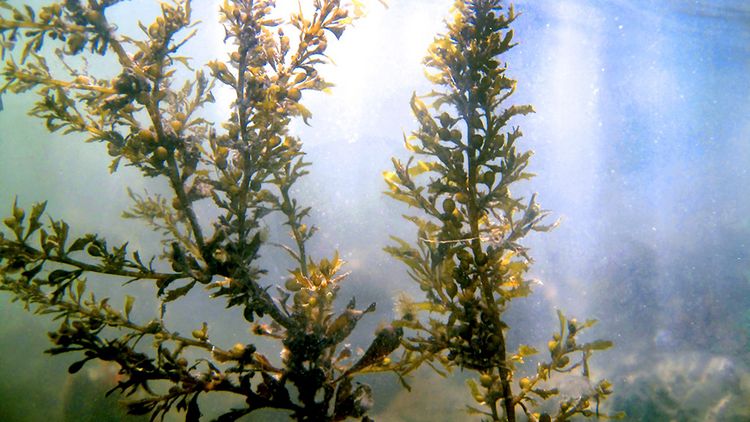

Scientists from Oldenburg and Frankfurt have modelled how global cargo ship traffic leads to the spread of invasive species. In their study recently published in the journal "Proceedings of the National Academy of Science" (PNAS), they come to the conclusion that increased invasions, i.e. the "immigration" of foreign plants and animals, can be expected in the future, particularly in regions with high shipping traffic and a temperate climate, such as the North Sea.
The invaders can change entire ecosystems and cause billions in damage. The new modelling method, which was developed under the leadership of the Oldenburg Institute of Chemistry and Biology of the Marine Environment (ICBM), can also be used to predict the immigration of other animal and plant groups.
Cargo ships transport goods of all kinds across the globe and connect countries and cities over huge distances - a large proportion of world trade is carried by international shipping. "As a result of this intensive trade, not only goods but also plants and animals get on board as stowaways and are spread around the world," explains Dr Hanno Seebens, the lead author of the study. A large number of species can be found on ship hulls and in the ballast water of large ships, which survive the long journey and are transported from Singapore to Hamburg, for example, in a short space of time. "The animals and plants arrive in areas that they would never have reached without the help of humans," explains Seebens.
Together with colleagues at the ICBM at the University of Oldenburg and the Senckenberg Biodiversity and Climate Research Centre in Frankfurt, he has developed a new method for modelling these invasions in the world's oceans. "It is important to know when and where animal species migrate into our oceans in order to avoid or minimise negative impacts," explains the ecologist. Damage caused by invasive species is estimated to cost several billion euros per year in the European Union alone.
"For our simulations, we use a mathematical model that combines data on ship movements and ship sizes with water temperatures and salinity to determine the probability of an invasion," explains Prof. Dr Bernd Blasius, Professor of Mathematical Modelling at the ICBM. Similar models have been used before, but they could not predict which species to expect. "We have now adapted such modelling and coupled it with distribution maps of potentially invasive species. This allows us to predict the species that are most likely to migrate to a particular marine region," adds Seebens.
The study shows that increased invasions are to be expected in the North Sea and on the west coast of the USA in particular. The research team cites the similar conditions in the marine regions around Japan and China and the North Sea as the reason for the many potential immigrating species in the North Sea. In addition, these areas are well connected by intensive shipping traffic. "Two new algae species - Prorocentrum minimum and Polysiphonia harveyi - have already colonised the North Sea, which we have classified as 'high-risk species'. Our predictions have already been confirmed here," adds Seebens.
In the USA, global climate change and the associated increase in water temperature are expected to lead to increased invasions of marine animals on the west coast. This region is frequently visited by ships from Asia, although most species have not yet survived the comparatively low water temperatures. Seebens comments: "Climate change is increasing the risk of invasion - we are already seeing the first migrations from Asia as a result of the increased water temperature."
In addition to the computer simulations, the researchers are also investigating the biological relationships that favour the colonisation of invasive species. Ultimately, all the information will be collated in order to prevent further invasions as efficiently as possible. "Even though our study is currently limited to the spread of marine algae, the model can easily be extended to other animal groups - and not just in the marine environment," summarises Seebens.