

During a student exchange programme, Japanese and German students visited the chemistry didactics working group at the University of Oldenburg. There they learnt about various environmental protection professions in the school laboratory.
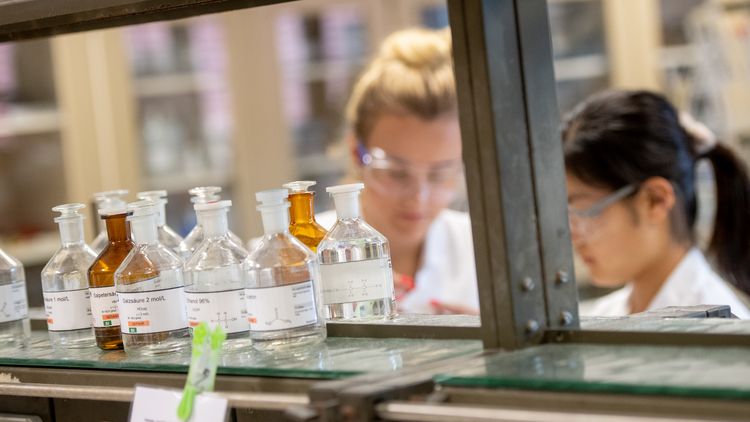
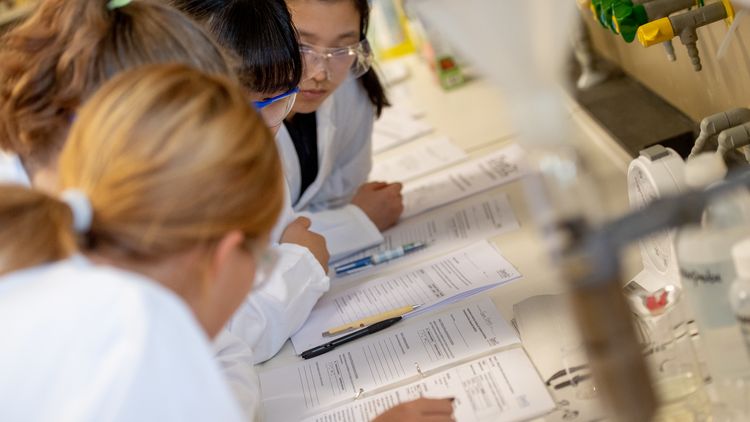
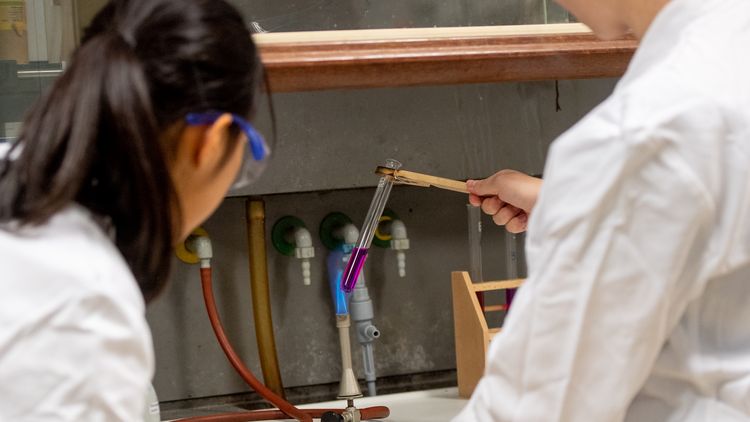
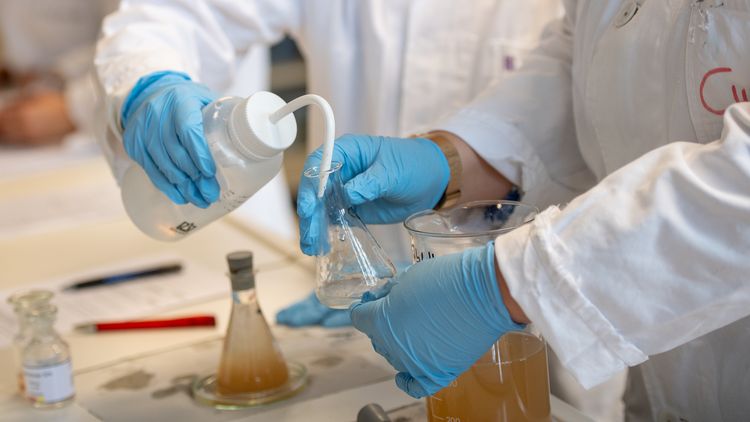
Over twenty young adults bustle around the university's school laboratory. In groups of two or three, they stand at work tables and bend over scales, test tubes or test strips in their white coats. Scraps of Japanese, German and English fly around the room. The group of young Japanese people have been in Germany for a week-long student exchange programme for a few days now. Together with exchange partners from Neues Gymnasium Wilhelmshaven, they are exploring various environmental protection professions at the university today by means of experiments. The Japanese students come from the Super Science High School Ichikawa, which is located on the outskirts of Tokyo and specialises in the natural sciences. The German youngsters also have a soft spot for biology, physics, maths and chemistry: the teachers deliberately selected exchange participants with a keen interest in science. The pupils also had to justify their desire to take part in the programme in a letter of motivation.
Chemistry teacher Prof Dr Verena Pietzner helped to initiate the exchange programme. Projects like this are particularly close to her heart: "Because our future working world is becoming increasingly networked, it is helpful to come into contact with a different culture at an early stage. But even more importantly, it's something really great for your own personal development." The chemistry teacher has close personal and academic appointments with Japan. She travels to the country every year to visit friends or cooperation partners. Prints of Japanese artworks hang in her office and Japanese textbooks are on the shelves. Pietzner will accompany the pupils and their teachers to the Land of the Rising Sun next year. She has already noticed that the Japanese and German young people get on very well, despite the differences in everyday life and culture.
Gambling dens and mudflats
"On the surface, Japan is very westernised, but if you go a little deeper, the cultures are very different. When the Japanese students presented their everyday life there, the Germans had to swallow a little. The life of a young person in Japan is very different from here," she says. The German students were particularly surprised by the so-called gambling dens where the Japanese spend a lot of their free time. These arcades, which are often spread over several floors, are characterised by a particularly high noise level and long rows of brightly flashing machines. The 17-year-old Jannes has already noticed the first cultural differences. "The Japanese students are a bit reserved," he says. "And they were very fascinated that we almost all live in our own houses with only a few storeys." Mana, one of the Japanese exchange students, was also surprised by all the greenery: "I like the nature and all the animals here. We don't normally see that in Japan." Pietzner explains that the city and nature are more separate there. Due to the lack of space in the big cities, there is also more building upwards. Another thing that Mana had not expected: the many wind turbines in northern Germany. The typhoons in Japan make it very difficult to install such turbines there.
The school laboratory in which the young people carry out the experiments is the result of a project by the German Federal Environmental Foundation. The experiments were developed by a former doctoral student at the Institute. Mana and Jannes would like to study medicine later on, but for Mana the experiments still had a very clear benefit. "I believe that all natural sciences are interconnected. That's why I think it's important to learn everything," she says. She particularly liked the experiment to determine the oxygen content of a water sample, which introduces the academic appointment of an environmental protection laboratory technician. Jannes, on the other hand, was enthusiastic about an experiment in which ammonium ions are filtered out of a drinking water sample using a layer of sand and gravel. This experiment introduces the pupils to the tasks of a chemical engineering technician.
In addition to the excursion to the university, trips to Bremen and the Wadden Sea are also planned over the next few days. The return visit to Japan will then follow in April next year. "I'm looking forward to the Japanese Alps because I like running or cycling in the mountains," says Jannes. He is also particularly excited about the Matsuri festivals, where people parade through the streets with lanterns and illuminated dragons. Jannes will get to know more of the country's typical customs over the next few months as the students prepare intensively for their time in Japan.