
The number is enormous: four out of five maths students at German universities drop out of their studies. Prof Dr Daniel Grieser, university lecturer in mathematics, has addressed this problem and developed the lecture "Mathematical Problem Solving and Proving".
"In mathematics, the transition from school to university is considered particularly difficult," explains Grieser. One reason for this is the traditional concept of the degree programme. From the outset, mathematical theories are presented in an abstract scientific language for which the students are not prepared. "One of the main reasons for the students' rapidly dwindling motivation," says the university lecturer.
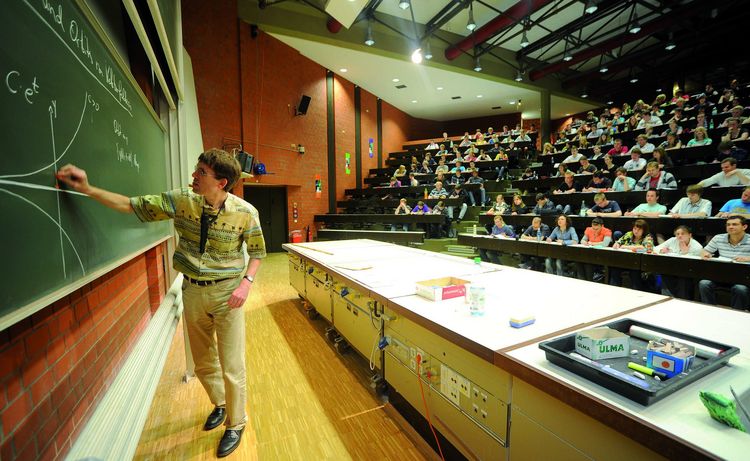
Grieser's lecture is quite different: Mathematical problem solving and proof - two core pieces of mathematics - are at the centre. Students learn to solve problems independently and develop mathematical proofs. In this way, they learn how maths works and develop their mathematical creativity.
"Enthusiasm for science is the most important prerequisite for successful studies," emphasises Grieser. This is why it is important to foster students' enthusiasm for their subject in the long term. Grieser achieves this by constantly presenting his students with new challenges: "The problems are easy to formulate, but you have to come up with something to solve them."
An example from Grieser's lecture and at the same time a mathematical problem that comes into play in the development of computer chips: you draw five dots anywhere on a sheet of paper. The aim is to connect each of the dots with each other in such a way that the lines do not cross. The connecting lines do not have to be straight. "The solution to this problem and its justification requires a high degree of mathematical creativity - this provides the necessary incentive for the students," explains Grieser.
Another special feature of the lecture is that the students learn about mathematical research methods early on in their studies. Grieser has selected the problems in such a way that mathematical working methods are anchored and fundamental mathematical ideas are introduced. This creates a solid basis for further study.
Grieser, who previously won gold at the International Mathematical Olympiad, uses his experience from intensive Olympiad training and applies it in his lectures and seminars. "You can learn to solve problems. It creates self-confidence and motivation. The key competence of problem solving is indispensable for all mathematical professions - whether in business, research or school," says Grieser.
The lecture is not, as is usually the case, a pure lecture. Instead, the students engage in dialogue with the lecturer and develop their own solution ideas. They are also supervised in small groups by experienced tutors. The tutors are in close dialogue with the lecturer and can therefore inform the lecturer directly about any difficulties the students are experiencing. Students are given weekly homework assignments to practise the new problem-solving methods they have learnt. Grieser has set up the Mathematics Learning Centre for this purpose. Students can get help there if they get stuck with a problem. Interactive lectures, tutorials and the learning centre ensure efficient teaching that is directly geared towards the diverse needs of students.
Grieser recently received the "Teaching Prize" from the University of Oldenburg for his new teaching concept. His latest book "Mathematisches Problemlösen und Beweisen - Eine Entdeckungsreise in die Mathematik" (Mathematical Problem Solving and Proving - A Journey of Discovery into Mathematics) serves as a textbook for students and at the same time offers interested laypeople a new approach to mathematics.
"Mathematisches Problemlösen und Beweisen - Eine Entdeckungsreise in die Mathematik", Grieser, Daniel, Springer-Spektrum-Verlag, 292 pages, 22.95 euros.
More on the topic
Contact
Prof Dr Daniel Grieser
Institute of Mathematics
Tel: 0441-798/3230
daniel.grieser@uni-oldenburg.de