
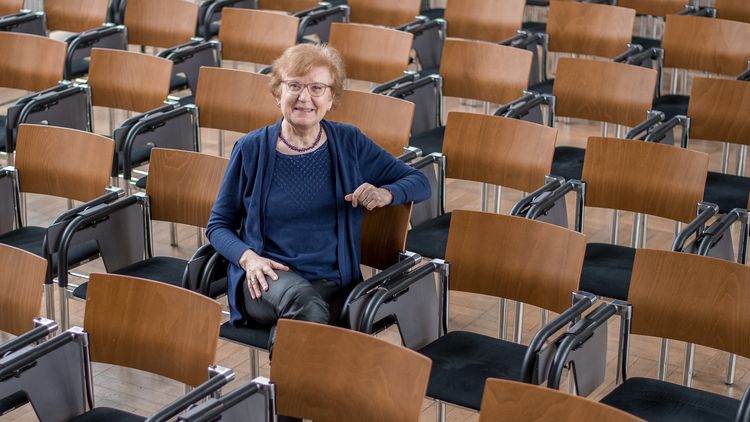

An image, a thought or a text - composer Violeta Dinescu is inspired by a wide variety of things. Above all, the university lecturer wants to teach her students how to compose authentic music. An interview.
QUESTION: Ms Dinescu, in your latest work, which was recorded last year, the pianist uses two pianos. One of them is a Rabbler - a very old instrument that rattles and produces different sounds than a melodious grand piano. How did that come about?
VIOLETA DINESCU: For decades, people have been preparing pianos or grand pianos to alienate sounds - John Cage started it. The preparation can be done in very different ways, for example with objects on the sides. But at the request of the pianist Sorin Petrescu, who recorded the compositions, we have not selected a prepared piano here, but an old one that would normally have to be thrown away. The sound box is damaged and it can no longer be tuned. But Petrescu has a special sensitivity for such objects. I felt the same way when I came to Germany from Romania. To this day, I have a strange feeling when I see how easily people throw things away. That's why Petrescu's idea immediately appealed to me.
Is this idea also behind the title of the work - "Wings and Debris"?
The title of the work and the CD has to do with a photograph by Alexander Bold. You can see rubble on a beach - old, abandoned, gigantic stones that belonged to a building. Seagulls are sitting on these depressing objects. It's a very impressive photo. Alexander Bold photographs abandoned buildings or curious objects in such a way that it has a poetic effect. That is his central idea. Together with Petrescu's wish and this photograph, the work was created.
Do you draw creative inspiration for your compositions from such images?
I am inspired by very different things. It can be a thought, but also a picture or part of a poem or novel. Sometimes I react directly to such extra-musical impulses. And I also try to convey this to my students: I want to sensitise them to react to impulses that don't make a statement on first perception but do on second, deeper reflection.
How do you convey what makes a good composition?
Good composition teaching is that which encourages students to truly do what they feel inside. But in my opinion, you can only have good ideas if you have already cultivated an inner musical instinct. It's a bit like when you're in Italy - in these fantastic places where there's art on the street. People who live in such an atmosphere acquire a kind of aesthetic imagination - even if they don't study art. Or if you live in a fantastic landscape. You absorb proportions. It's the same in music: you can't teach one hundred per cent that a composition has to be one way or another. And depending on what kind of instruments you use, the material allows for certain sound spaces. Otherwise the music is not authentic. In addition, of course, there are a number of technical aspects - such as knowledge about the nature of acoustic instruments.
What should a composer know about this?
Nowadays, you can create electronic sounds with computers, create very complex structures and design music yourself - without performers. And you can find out about the characteristics of any instrument on the Internet. But you still have to find out for yourself: How do you play an instrument? Some works are difficult to write, for example, but easy to perform - if you know the nature of the instrument. Conversely, you can write in such a way that it looks easy. In reality, however, it is almost impossible to play the piece because it does not do justice to the instrument. This knowledge about an instrument can be obtained, for example, by analysing works in which composers use this instrument. Once you know these practical things, you can decide for yourself: Where do I want to push the boundaries? For example, with so-called extended techniques that allow me to express myself in a certain way, such as conveying tension.
And that's what you teach your students.
Basically, I have a coaching function. I don't want to tell the students what they should do. Instead, I try to discover what they bring to the table themselves and then bring it to light so that they realise: That's me.
You have been teaching composition in Oldenburg since 1996. What do you personally take away from this?
I experience this every semester: when I see how a student works at the beginning of the semester and how he or she finally gains an inner confidence. At the end of the semester, as part of the composers' colloquium, they also have to explain to an audience how they made a particular composition. They don't just talk about their work in technical terms, but everyone has the freedom to say what they want to achieve. And the joy that I see on their faces comes back to me.
In your opinion, how can you give people access to classical music?
There are always situations in which we want to experience something. There is an Icarus in all of us. Regardless of whether we engage with music in theory or not, the curiosity is there. There is a kind of music that invites me to think along and understand what is going on. Beethoven's music is a good example. As you can see from his facsimiles, Beethoven himself often struggled with the material: for the 5th Symphony, for example, he initially drafted a very long melody, which he repeatedly shortened until he arrived at the famous "dadadadaam" (sings). He took this element and set it a little lower. And he then turned this melody - a major third and a minor third, by the way, the building blocks of a major triad - like a wheel. Basically, he got the whole symphony out of this strong idea, which he didn't let go of until the end. He worked like a researcher. Beethoven teaches you: You can hear the music, like the Moonlight Sonata, so dreamy. But if you listen to it consciously, then you understand the musical logic. In my opinion, the secret is this: Listening again and again. People who are not music connoisseurs sometimes sense more complex situations than those who are.
What is special about your own music?
I don't work with all the notes, as was very fashionable in the 20th century. I believe that if you work too democratically with the musical material, there is total confusion. You can't go into all tonal spaces at the same time. That's why I work with the idea of tone centres: I call them attractors, i.e. tones that attract certain tones. It's like the idea of a cadence in which the dominant - the chord based on the fifth note of a scale - wants to reach the tonic, the root chord. It can't stay in the air.
What does that mean in concrete terms?
In music, there is a tone that divides the octave symmetrically, the tritone. This tone, depending on how you interpret the notes, always tends towards a centre. But all four tones of a chord lead to four different centres, which can be major or minor. Then there are eight possibilities. So I use tones that are not indifferent to each other, but want to move in a certain direction. I seek these magnetising forces both through inspiration - it has to sound right for me - and through constructions based on mathematical principles, for example. I want to arrive at a tapestry of sound that is true. You try to create a bit of order, but then you don't want to abandon your own instinct. Most of the scores I make are either commissions or requests from musicians. But my intention is not to please everyone. That's not possible - not everyone likes Madonna or Michael Jackson either. Because I know that, I don't set out to reach everyone at the same time. But I am very interested in the reactions of musicians and audiences.
When do you even find time to compose?
I ask myself that, I teach and organise the weekly composers' colloquia and the annual symposium "Zwischen Zeiten". But I couldn't survive without composing. That's why I find the time. I work continuously - even if I've been at university all day. I don't go to sleep without thinking about music. Even if I didn't have any commissions - I have so many ideas for works I still want to write.
Interview: Constanze Böttcher