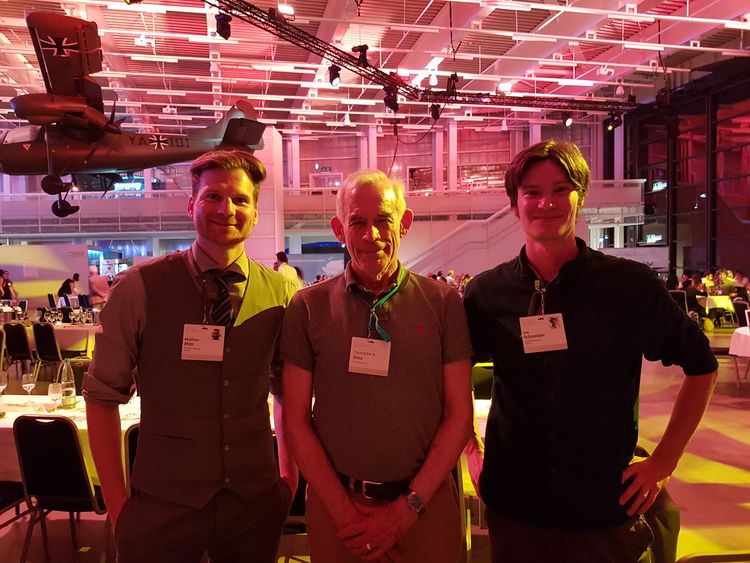

16 Nobel Laureates, 360 young economists, 66 nations: that was the 6th Conference of Nobel Laureates in Economic Sciences in Lindau. Two of the coveted places went to research assistants from the Institute of Economics: in addition to Jan Schneider, Mathias Mier also prevailed in the multi-stage application procedure. His experience report.
Lindau on Wednesday, 29 August 2017: Heavily armed police officers, broad-shouldered security guards with baggy jackets, circling police helicopters, admission checks at the municipal theatre. Why? The 6th Conference of Nobel Laureates in Economics is taking place. Every year, the Nobel Prize winners meet at Lake Constance - this time the chemists were already there in June, now the economists at the end of August (even if the economists are not actually "real" Nobel Prize winners, but memorial prize winners). Mier and Schneider are right in the middle of it, with 360 other "Young Economists" from 66 countries. All of them went through a more or less elaborate selection procedure. In our case, there were three rounds, twice we had to submit something in writing, once we had to appear in person on Rose Monday for a 10-minute small talk in Hamburg. In mid-May, we were informed that we were in. Excellently organised (there was even a dedicated app) and wonderfully guided through the programme by Countess Bernadotte (formerly of the Swedish royal family, now in Mainau), the whole thing is financed behind the scenes by foundations. Each selected "Young Economist" received a grant of EUR 5,000. Sounds like a lot, and it is. However, many waited until the end for the big bang, a gala dinner with star chefs, a whirlpool on the final boat trip to Mainau, none of which materialised. Instead, there were 16 Nobel Prize winners, Mario Draghi and Peter Altmeier.
"We have sex because we want to"
The 16 Nobel Prize winners were of course the centrepiece of the event. Most of them received the Nobel Prizes for their work in the 1970s and 1980s, which makes them no less interesting. Each gave a 30-minute presentation on a topic of their choice. Frankfurt-born Robert Aumann (2005 prize, game theory) was the absolute highlight. He focussed on what drives people. According to him, people don't have sex for reasons of reproduction, but because they want to, because they crave it or simply for fun. It is entertaining to hear something like this from the mouth of a white-bearded 87-year-old conservative Israeli. In my opinion, Christopher Sims (2011, Macroeconomics) made the sharpest arguments, James Heckmann (2000, Analysing Selective Sampling) presented the best, Finn Kydland (2004, Macroeconomics) was the best to celebrate with, and Jean Tirole (2014, Market Power and Regulation) was remarkably funny.
"We are not alone in the universe"
Peter Altmeier was flown in for the gala dinner and gave a 60-minute speech. He called for global free trade and justified this with comparative cost advantages. However, this theory, developed by David Ricardo in 1817, no longer adequately reflects mechanisms in trade between developed and less developed countries and is therefore no longer considered up-to-date. The last sentence of his speech caused the audience to frown, as he offered every prizewinner present a job in Germany and made it clear that we are "not alone in the universe". Election campaign mode was evident throughout the entire performance. Fortunately, there was some excellent Palatinate wine.
In contrast, Mario Draghi gave a very successful opening speech on Wednesday morning. And once he had disappeared after the lunch break, there were no more heavily armed police officers or circling helicopters. After that, it was just another normal conference.
Mathias Mier completed his master's degree in industrial engineering at TU Berlin in 2013. In the same year, he became a research assistant in the Department of Finance at the Institute of Economics at the University of Oldenburg. His main research interest is the future design of electricity markets under the influence of high shares of fluctuating renewable energies such as wind and solar.