
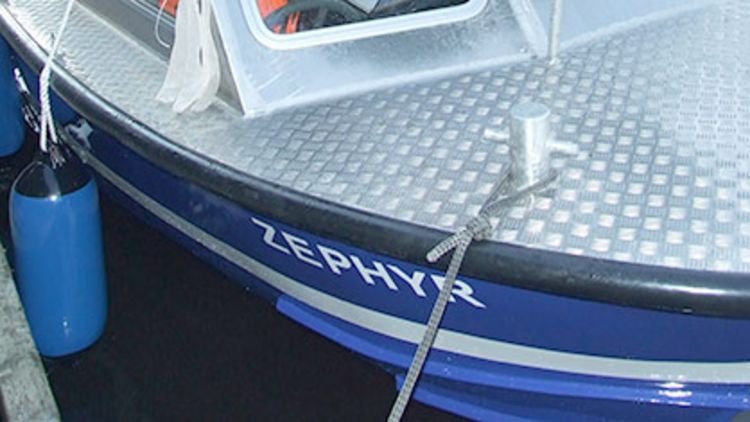
Die „Zephyr” ist das neue Forschungsboot des Instituts für Chemie und Biologie des Meeres (ICBM). Es ist klein, wendig und schnell – und soll so helfen, die wenig erforschte Interaktion des Wattenmeers zwischen Land und offener Nordsee zu verstehen.
Es ist benannt nach einer griechischen Windgottheit, die den milden Westwind verkörpert: Zephyr, das neue Forschungsboot des Instituts für Chemie und Biologie des Meeres (ICBM) der Universität Oldenburg. Universitätspräsidentin Prof. Dr. Babette Simon hat es in der vergangenen Woche im Oldenburger Hafen getauft. Das Boot ergänzt neben den Schiffen Otzum und Navicula die Forschungsflotte des ICBM. Durch seinen Tiefgang von nur 30 Zentimetern ist es besonders für Einsätze im Niedrigwasser des Wattenmeers und in Küstennähe geeignet.
„Das ICBM liefert mit seiner international beachteten Umwelt- und Meeresforschung einen wichtigen Beitrag zum Erhalt der Küsten“, so Simon. Die Zephyr biete eine wichtige Forschungsinfrastruktur, auf die das ICBM angewiesen sei, um anspruchsvolle Fragen beantworten und international anschlussfähige Forschung betreiben zu können. Die Verfügbarkeit eines solchen Schiffes sei auch ein wichtiger und wertvoller Zugewinn für das besonders ausgewiesene forschungsorientierte Studium im Bereich der Umwelt- und Meeresforschung, zum Beispiel in den Studiengängen Marine Umweltwissenschaften oder Marine Sensorik an der Universität Oldenburg.
Die Feltz-Werft in Hamburg baute das siebeneinhalb Meter lange und zweieinhalb Meter breite Forschungsboot, das Platz für fünf Personen bietet. Ein 150-PS-starker Außenbord-Motor treibt die Zephyr mit einer Höchstgeschwindigkeit von bis zu 20 Knoten (37 km/h) an. Ausgestattet ist das Forschungsboot mit drei Messarbeitsplätzen sowie mit modernsten Forschungsinstrumenten wie einem Echolot, einer Wetterstation oder einer DGPS-Navigation. Am Heck der Zephyr befindet sich ein Geräterahmen, der Messungen mit speziell entwickelten Sonden oder Sidescan-Sonar erlaubt. Mit einem Kranausleger können Wasserproben mit einem Kasten- oder Kranzwassergreifer in bis zu 50 Metern Wassertiefe entnommen werden. Und durch einen sogenannten „Moonpool“, ein Schacht im Rumpf des Schiffes, lassen sich Messsonden während der Fahrt einsetzen.
„Die Zephyr ist ein außerordentlich wendiges und schnelles Forschungsboot. Mit ihm können wir innerhalb kürzester Zeit an unterschiedlichen Orten, zu unterschiedlichen Tiden und bei unterschiedlichen Wettersituationen Messdaten erheben“, erklärt Prof. Dr. Oliver Zielinski, Hochschullehrer für Marine Sensorsysteme an der Universität.
Das Einsatzgebiet der Zephyr reicht von der Ems bis zur Elbe, es ist hauptsächlich jedoch im Wattenmeer und im Jadebusen. Mit dem Boot können Messdaten erhoben werden, die Aufschluss über den Transport von Sedimenten und Nährstoffen in den Seegatten – die Strömungsrinnen zwischen Inseln – geben. So gehen die WissenschaftlerInnen unter anderem der Frage nach, ob das Wattenmeer mehr Nährstoffe aus der Nordsee zieht oder verstärkt Nährstoffe an diese abgibt. Die Interaktion des Wattenmeers zwischen Land und offener Nordsee sei momentan noch wenig erforscht, betont Zielinski. „Wir erhoffen durch den Einsatz der Zephyr Messdaten zu erhalten, die es ermöglichen, den Massentransport zu bilanzieren, und so den Küstenschutz in Zeiten des Klimawandels vorantreiben.“