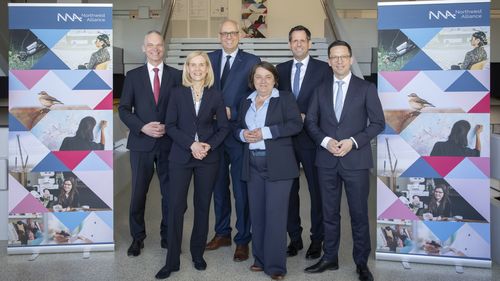


How do documents that have been forgotten for centuries change our view of an entire epoch? What does the seabed tell us about climate and currents? Science Minister Falko Mohrs gained exciting insights into research at the university during his inaugural visit.
"Strong in research, teaching and transfer, successful as a founding university and with special roots in the region" - this is how the new Science Minister Falko Mohrs described the University of Oldenburg during his inaugural visit at the weekend. He was able to see for himself "how well positioned the University of Oldenburg is" in talks with the Presidential Board and was very pleased to gain direct insights into two of the numerous outstanding fields of research, the Minister added. After an exchange with the Presidential Board, Mohrs visited both the Haarentor campus and the Wechloy campus, which is characterised by the natural sciences and medicine.
How does the cataloguing of hundreds of thousands of previously long-forgotten documents from the period between 1652 and 1817 change our current view of an era of great upheaval? The director of the academy project "Prize Papers", Oldenburg historian Prof Dr Dagmar Freist, spoke to the minister about this. The long-term historical project of the Lower Saxony Academy of Sciences and Humanities in Göttingen, which is funded equally by the federal government and the state of Lower Saxony, has been working on the indexing, digitisation, research and presentation of the so-called Prize Papers since 2018. These are stored in more than 4,000 boxes in London's National Archives: more than 100 types of documents in 19 languages, including an estimated 160,000 letters alone that were confiscated in the course of ship captures and never reached their original addressees.
The international Prize Papers team is based in Oldenburg, London and Göttingen; at the University of Oldenburg, it comprises five academics and currently 16 research students. After a virtual tour of the project and its locations, Freist and her colleagues presented the Minister with, among other things, the centrepiece of the project, the freely accessible and constantly growing online portal (portal.prizepapers.de).
How can climate and currents be reconstructed using the seabed, and how can the finest traces of various elements be detected in seawater in a so-called clean room laboratory? Mohrs gained theoretical and practical insights into this at the university's Institute of Chemistry and Biology of the Marine Environment (ICBM). ICBM Director Prof. Dr Heinz Wilkes welcomed the Minister with a brief overview of the Institute's focus on marine and environmental research, before geochemist Prof. Dr Katharina Pahnke used a sediment core to illustrate climate reconstruction. For Mohrs, this also included a close look at a sample through the microscope - as well as a flying visit to the completely dust- and metal-free clean room laboratory of Pahnke's "Marine Isotope Geochemistry" working group, special protective clothing included.
Founded in 1987, the ICBM has sites in Oldenburg and Wilhelmshaven and employs around 235 people in a total of 26 working groups. The home institute of the deep-sea research vessel "Sonne" offers five degree programmes, which the Minister also found out about.