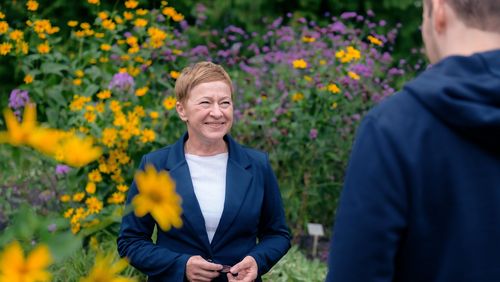
The mentee: Prof. Dr Sinikka Lennartz has been Junior Professor of Biogeochemical Ocean Modelling at the Institute of Chemistry and Biology of the Marine Environment (ICBM) at the University of Oldenburg since April 2021. She is currently on leave of absence for a one-year research stay at the Massachusetts Institute of Technology (MIT) in the USA. Previously, she was a postdoctoral researcher in the Marine Geochemistry research group, a bridge group between the Max Planck Institute for Marine Microbiology and the ICBM. Lennartz studied geoecology in Tübingen and Braunschweig and wrote her doctoral thesis at the GEOMAR Helmholtz Centre for Ocean Research Kiel.
"I already gained a lot of experience at research institutes during my studies. Since then, I realised that I wanted to pursue a career in science. When I applied for the mentoring programme, I was a postdoc and wanted to take the next step towards group leadership. As a mentor, I was looking for someone who had already travelled this path.
It was actually not that easy to find a female mentor in my field. The topic of modelling is very male-dominated. But then I came across Julia: She is a renowned researcher in a field that doesn't overlap too much with mine, but is similar enough to be able to exchange ideas well. We didn't know each other before.
My initial intention was to gain a retrospective perspective with Julia's help. I wanted to be able to better formulate and reflect on my position. But during our discussions, the help quickly became very specific. For example, the topic was: How do I conduct a job interview? Julia provided me with questionnaires because she had of course already thought about this. She also gave me a lot of support with the application procedure for my junior professorship, which was really great.
I thought it was good that the "Progressio" programme pursues three complementary approaches. Firstly, you have the mentoring relationship, then the exchange with other female academics who are at the same career stage and have the same questions. And then, of course, the courses that round off the whole thing. For example, I found the workshops on time management and conflict management very helpful.
What I took away for myself is a bit more composure. Through the discussions with Julia and the other participants, I realised that uncertainties are normal in such a new phase.
Even after the programme is over, Julia and I are still in contact. If I have a question, I send her a short email and her answer usually gives me a new perspective on my problem. That's a good way to go, because we're both busy with work and family."