
Mehr als die Hälfte der Erde ist von Wasser bedeckt, doch selbst die Rückseite des Mondes ist gründlicher erforscht als die Weltmeere. Ein Geheimnis der Ozeane haben Forscher nun gelüftet: Sie haben herausgefunden, wie die heißen Quellen der Tiefsee dazu beitragen, das globale Klima stabil zu halten. Wie schafft es die Erde, das Klima stabil zu halten? Der Antwort auf diese Frage ist ein internationales Forscherteam um den Geoökologen Prof. Dr. Thorsten Dittmar vom Institut für Chemie und Biologie des Meeres (ICBM) der Universität Oldenburg ein Stück näher gekommen. Die WissenschaftlerInnen aus zehn verschiedenen Instituten in Europa und den USA haben entdeckt, dass der Vulkanismus in der Tiefsee eine entscheidende Rolle für das langfristige Klima spielt. Die Ergebnisse sind in der Oktoberausgabe der Wissenschaftszeitschrift „Nature Geoscience“ veröffentlicht worden. Seit jeher tragen die Ozeane viel dazu bei, dass das Klima auf der Erde stabil bleibt. Sie enthalten eine Menge Kohlenstoff, wesentlich mehr als im Kohlenstoffdioxid der Atmosphäre gebunden ist. Das Meer speichert den Kohlenstoff unter anderem im sogenannten gelösten organischen Material, das nach der englischen Übersetzung („dissolved organic matter“) mit DOM abgekürzt wird. Ein Großteil des DOM überdauert viele tausend Jahre lang im Meerwasser. Es fungiert somit als ein großer Langzeit-Kohlenstoffspeicher. In der aktuellen Studie wollten die ForscherInnen um den Wissenschaftler Dr. Jeffrey Hawkes vom ICBM herausfinden, was mit dem DOM passiert, wenn es in die heißen Quellen der Tiefsee gelangt. Mithilfe von Tauchrobotern sammelten sie Proben aus mehreren Tausend Metern Tiefe an verschiedenen Stellen im Atlantik und Pazifik. In der Tiefsee ist nicht nur der Druck viel höher als an der Wasseroberfläche, es gibt am Meeresboden außerdem heiße Quellen und Vulkane, in denen sich das Meerwasser auf über 400 Grad Celsius aufheizt. Die genaue Frage der Forscher: Wird durch die Hitze neues DOM aufgebaut oder das vorhandene zerstört? Die klare Antwort nach sechs Jahren Forschungsarbeit: Es wird zerstört. Selbst die stabilsten Verbindungen haben bei 400 Grad keine Chance mehr. Und: Das DOM hat dadurch eine begrenzte Lebensdauer. Sie liegt bei maximal 40 Millionen Jahren. Denn innerhalb dieser Zeit hat der gesamte Ozean einmal die geothermalen Quellen durchlaufen. Damit haben die ForscherInnen eine Erklärung dafür gefunden, wie das Meer es schafft, den Anteil an Kohlenstoff auch über sehr lange Zeiträume im Gleichgewicht zu halten. Denn was es aufnimmt, muss es wieder loswerden - eine wichtige Voraussetzung für ein stabiles Klima. Dass mit der Zerstörung des DOM in der Tiefsee ein Kohlenstoff- und damit letztlich auch ein CO2-Speicher verloren geht, halten die ForscherInnen trotz der aktuellen Diskussion um den Treibhauseffekt für unbedenklich, denn die untersuchten Prozesse sind nur über sehr lange Zeiträume von Jahrmillionen von Bedeutung. „Das CO2 ist an sich nichts Schlechtes. Schlecht sind nur die schnellen Veränderungen im Augenblick“, erklärt Dittmar. Tatsächlich sei das CO2 sogar lebenswichtig, denn ohne könnten Pflanzen, Tiere und Menschen gar nicht existieren. Auf dem Mars gebe es beispielsweise sehr wenig CO2, was ihn unbewohnbar mache. Die Venus habe zu viel des Treibhausgases. Auf der Erde dagegen ist der CO2-Anteil und das Klima für Leben optimal. Die neu entdeckte Rolle der heißen Quellen in der Tiefsee ist einer der Faktoren, die auf den CO2-Gehalt und das Klima über sehr lange Zeiträume einwirken, aber auf die aktuellen Klimaveränderungen keinen Einfluss haben. An der Studie beteiligt waren neben dem ICBM folgende Institute: MARUM − Zentrum für Marine Umweltwissenschaften an der Universität Bremen; Max-Planck-Institut für Marine Mikrobiologie Bremen; Alfred-Wegener-Institut Helmholtz-Zentrum für Polar- und Meeresforschung Bremerhaven; GEOMAR Helmholtz-Zentrum für Ozeanforschung Kiel; Jacobs University Bremen; Skidaway Institute of Oceanography, USA; University of Washington, USA; University of Southampton, UK; Université de Toulouse, Frankreich. Original Artikel: „Efficient removal of recalcitrant deep-ocean dissolved organic matter during hydrothermal circulation” by Jeffrey A. Hawkes, Pamela E. Rossel, Aron Stubbins, David Butterfield, Douglas P. Connelly, Eric P. Achterberg, Andrea Koschinsky, Valérie Chavagnac, Christian T. Hansen, Wolfgang Bach and Thorsten Dittmar, Nature Geoscience, doi 10.1038/NGEO2543.
-

-
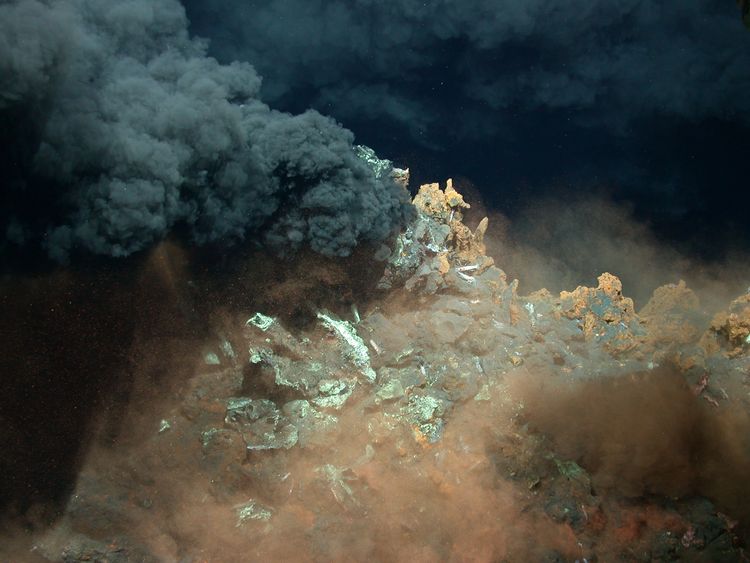
Aus diesem „Schwarzen Raucher“ am Mittelatlantischen Rücken in fast dreitausend Metern Wassertiefe haben die Wissenschaftler einen Teil der Proben entnommen. Foto: MARUM − Zentrum für Marine Umweltwissenschaften, Universität Bremen
Forscher lüften Geheimnis der Tiefsee


Topics
- Astronomy
- Biology
- Botanical garden
- Chemistry
- Computing Science
- Cooperations
- Covid
- Culture
- Dutch Studies
- Early Career
- Economics
- Educational Sciences
- Energy
- Energy Research
- Environmental Sciences
- Equal opportunities
- German Studies
- Graduate academy
- Health Services Research
- Higher Education Policy
- History
- Human Medicine
- International affairs
- Marine Sciences
- Material Culture
- Medical ethics
- Medical Physics and Acoustics
- Music
- Neuroscience
- People
- Philosophy
- Physics
- Presidential Board
- Psychology
- Research
- Slavic Studies
- Social Sciences
- Special Needs Education
- Sport Science
- Study Affairs
- Sustainability
- Teacher Education
- Theology
- Transfer
- University Medicine
- Ukraine
- Wind Physics