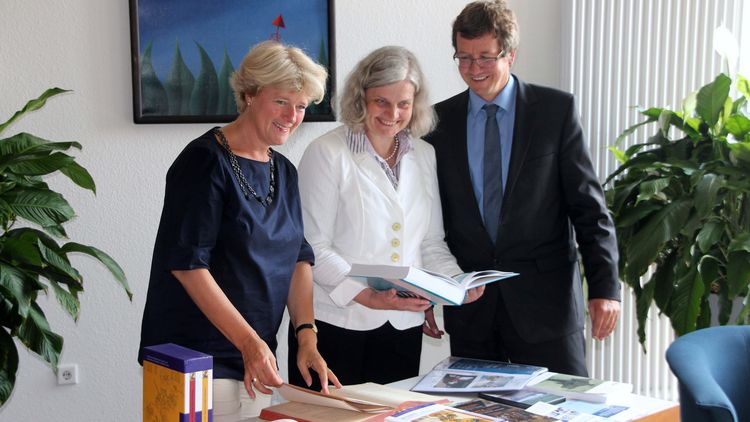
Wenige Monate nach ihrem Amtsantritt besuchte die neue Beauftragte der Bundesregierung für Kultur und Medien (BKM), Monika Grütters, das Bundesinstitut für Kultur und Geschichte der Deutschen im östlichen Europa (BKGE) in Oldenburg.
Die Staatsministerin bezeichnete es als ein wichtiges Anliegen, das BKGE – die einzige Ressortforschungseinrichtung in ihrem Geschäftsbereich – persönlich kennenzulernen. „Das Bundesinstitut leistet hervorragende Arbeit für die Bundesregierung. Seine wissenschaftliche Expertise macht es zu einem international geschätzten Ansprechpartner für das weite Themenspektrum des kulturellen Erbes der Deutschen im östlichen Europa“, so Grütters bei ihrem Besuch in der vergangenen Woche. „Dieses Erbe zu erforschen, zu erhalten und zu vermitteln, ist eine Aufgabe, die zu einem verbindenden Element für ein gemeinschaftliches Europa der Kulturen geworden ist.“
Dazu arbeite Deutschland eng mit seinen östlichen Partnerländern zusammen. „Durch das Engagement im „Europäischen Netzwerk Erinnerung und Solidarität“, der einzigen multilateralen Zusammenarbeit auf staatlicher Ebene, die sich der Aufarbeitung des von Diktaturen und Gewalterfahrungen besonders geprägten 20. Jahrhunderts widmet, trägt das BKGE zu einer freiheitlichen Erinnerungskultur in einem Europa mündiger Bürgerinnen und Bürger bei.“
Prof. Dr. Matthias Weber, Direktor des 1989 gegründeten BKGE, und sein Mitarbeiterteam stellten der Staatsministerin die Arbeit des Instituts vor, neueste Publikationen, herausragende Objekte aus der BKGE-Spezialbibliothek sowie ausgewählte Forschungs- und Kooperationsprojekte: „Adel in Schlesien“, „Moderne Architektur in Breslau und Schlesien“ und das „Europäische Netzwerk Erinnerung und Solidarität“. Weber wies auch auf die vielfältigen Kooperationen des BKGE mit der Universität und die erfreulichen Synergieeffekte bei den europäisch ausgerichteten Schwerpunkten der Universität hin.
Die gute Zusammenarbeit von BKGE und Universität wurde auch durch die Teilnahme der kommissarischen Präsidentin der Universität Oldenburg an dem Gespräch mit der Kulturstaatsministerin deutlich. Prof. Dr. Katharina Al-Shamery dankte ausdrücklich für die umfangreiche BKM-Drittmittelförderung, die an die Universität Oldenburg fließt. So werde beispielsweise das mehrjährige, über die Wissenschaft hinausweisende Projekt „Freiheitsraum Reformation“ unter der Leitung von Prof. Dr. Dagmar Freist, an dem Partner aus Wissenschaft, Kultur, Gesellschaft und Kirche in Oldenburg und im Nordwesten Deutschlands beteiligt sind, seit 2012 mit 300.000 Euro von der BKM gefördert. Ein weiteres großes Kooperationsprojekt von BKGE und Universität sei das Online-Lexikon zur Kultur und Geschichte der Deutschen im östlichen Europa unter der Leitung von Prof. Dr. Sabine Doering. Al-Shamery hob die Bedeutung dieses Projekts für die Studierenden hervor. Via Internet könne die junge Generation besonders gut einen Zugang zum Themenspektrum der Kultur und Geschichte der Deutschen im östlichen Europa gewinnen.
Das BKGE ist seit 2000 An-Institut der Universität Oldenburg, seine wissenschaftlichen Mitarbeiter sind auch im Bereich der akademischen Lehre in verschiedenen Disziplinen (Geschichte, Kunstgeschichte, Volkskunde/Europäische Ethnologie/Germanistik) eingebunden.