
In der Nähe von Seen und Flüssen sind sie zu Hause – die rund 70 Libellenarten in Niedersachsen. Doch jede dritte ihrer Art ist gefährdet, so auch die Grüne Mosaikjungfer. Die Arbeitsgruppe Vegetationskunde und Naturschutz setzt sich nun für ihren Erhalt ein.
Schutzmaßnahmen für die Grüne Mosaikjungfer planen und umsetzen, das ist das Ziel der Arbeitsgruppe, die der Biologe Prof. Dr. Rainer Buchwald leitet. Dabei kooperiert er mit den Gewässer-Unterhaltungsverbände Wüsting und Stedingen, den Landkreisen Oldenburg und Wesermarsch sowie der Stadt Oldenburg. Die Deutsche Bundesstiftung Umwelt (DBU) fördert das Kooperationsprojekt bis 2014.
Im Mittelpunkt der wissenschaftlichen Untersuchungen stehen das Ausbreitungsverhalten und die Populationsdynamik. Auf Basis dieser Daten will Buchwalds Arbeitsgruppe in Zusammenarbeit mit den jeweiligen Umweltämtern und Unterhaltungsverbänden Artenschutzmaßnahmen konzipieren und vor Ort erproben.
Die Grüne Mosaikjungfer ist an Gewässer gebunden, in denen die Krebsschere (Stratiotes aloides) vorkommt, eine Wasserpflanzenart aus der Familie der Froschbissgewächse. Sind dichte Krebsscheren-Bestände vorhanden, besiedelt die Libellenart Gräben, Fließgewässer mit geringer Strömung und Stillgewässer. Im Projektgebiet ist sie in Krebsscheren-Gräben des Naturschutzgebiets Bornhorster Huntewiesen, in Oberhausen/Hude und bei Berne zu finden.
„Die Grüne Mosaikjungfer legt ihre Eier ausschließlich in diese seltene Wasserpflanze ab“, erläutert Buchwald. Deshalb gelte die Libelle als extremer Lebensraumspezialist und könne als Charakterart von Krebsscheren-Gewässern bezeichnet werden. Eine wichtige Maßnahme zum Schutz der Grünen Mosaikjungfer sieht der Vegetationskundler daher in der Sicherung dichter Krebsscheren-Bestände: „Wir brauchen einen Gewässerschutz, der die Lebenszyklen und ökologischen Ansprüche sowohl der Libellen- als auch der Wasserpflanzenart berücksichtigt“, betont Buchwald.
„Zusätzlich sollten in geeigneten Gewässern wieder Krebsscheren-Bestände angesiedelt werden.“ So könnten neue Lebensräume für die bedrohte Libellenart geschaffen und eine bessere Vernetzung weit auseinanderliegender Lebensräume erreicht werden. Ein Anfang ist gemacht: In den letzten Wochen haben in der Wesermarsch und dem Landkreis Oldenburg erste Maßnahmen stattgefunden.
-
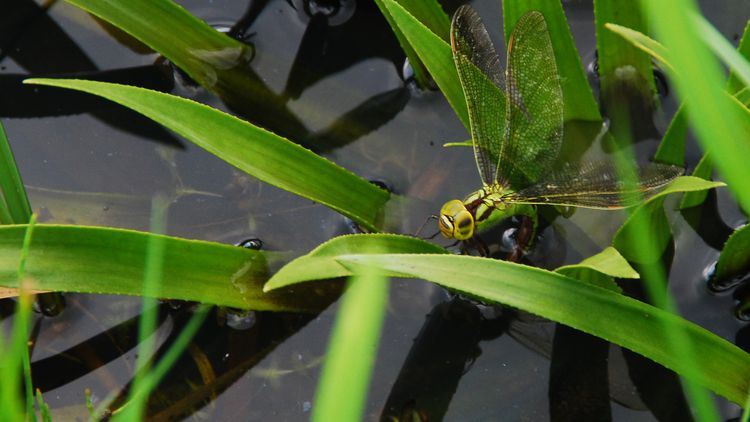
Weibchen der Grünen Mosaikjungfer bei der Eiablage. Foto: Friederike Kastner
Lebensraumspezialist Libelle
Topics
- Astronomy
- Biology
- Botanical garden
- Chemistry
- Computing Science
- Cooperations
- Covid
- Culture
- Dutch Studies
- Early Career
- Economics
- Educational Sciences
- Energy
- Energy Research
- Environmental Sciences
- Equal opportunities
- German Studies
- Graduate academy
- Health Services Research
- Higher Education Policy
- History
- Human Medicine
- International affairs
- Marine Sciences
- Material Culture
- Medical ethics
- Medical Physics and Acoustics
- Music
- Neuroscience
- People
- Philosophy
- Physics
- Presidential Board
- Psychology
- Research
- Slavic Studies
- Social Sciences
- Special Needs Education
- Sport Science
- Study Affairs
- Sustainability
- Teacher Education
- Theology
- Transfer
- University Medicine
- Ukraine
- Wind Physics