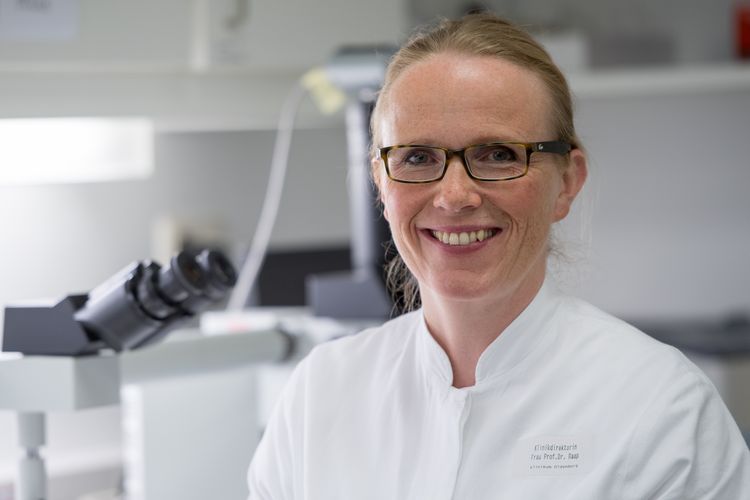

Das größte Sinnesorgan des Menschen ist Gegenstand ihrer Forschung und medizinischen Fürsorge: die Haut. Für Dermatologin Ulrike Raap „ein architektonisches Meisterwerk“, dessen Bausteine sie im Dienste neuer Therapien noch besser verstehen will.
Bunt schillernd schweben sie an diesem Sommerabend über die Bühne des Experimentierhörsaals auf dem Campus Wechloy. Seifenblasen. Dafür sorgen die jüngsten Zuhörer des Vortrags „Wenn die Haut Blasen schlägt“ von Dermatologin Ulrike Raap: ihre beiden Söhne. Soeben hat die 45-Jährige ihre Antrittsvorlesung gehalten, dabei ist sie längst angekommen – in Oldenburg, am Klinikum, wo sie als Direktorin die Universitätsklinik für Dermatologie und Allergologie leitet, an der medizinischen Fakultät mit ihrem grenzüberschreitenden Modellstudiengang „European Medical School Oldenburg-Groningen“.
Davon zeugt nicht nur der – mit den neuen Kollegen, Studierenden und Mitarbeitern aus Fakultät und Klinik ebenso wie mit langjährigen Wegbegleitern – volle Hörsaal. Raap, die bereits einen Monat nach Annahme des Rufs an die Universität mit der ganzen Familie nach Oldenburg gezogen ist, hat die Zeit seit ihrem Dienstantritt im Herbst 2016 genutzt. So ist die erste gemeinsame Publikation mit ihrem Groninger Fachkollegen und dortigen Klinikdirektor Marcel Jonkman entstanden, ein gemeinsames Forschungsprojekt der beiden zu blasenbildenden Hauterkrankungen startet im Januar. In ihrer Klinik hat Raap Abläufe und Strukturen geändert, ein Bad in ein Aufnahmezimmer umbauen lassen, auf elektronische Patientenakten und überwiegend papierfreie Büros umgestellt.
Dekan Hans Gerd Nothwang nennt die Dermatologin eine „Powerfrau“. Wer mit zwei Kindern eine erfolgreiche wissenschaftliche Karriere in der Medizin hinlege und zudem Marathon laufe, lasse erahnen, „was da an Energie dahintersteckt“. Raaps wichtigster Antrieb, so Nothwang, dürfte aber ihre große Faszination für die Haut sein.
Dynamik und dramatische Geschehnisse in der Haut
Ihre offensichtliche Begeisterung für dieses größte menschliche Sinnesorgan – und den „hautnahen“ Kontakt zu den Patienten – packte Ulrike Raap schon im ersten Jahr ihres Medizinstudiums, das sie in Lübeck begann und in ihrer Heimatstadt Hannover abschloss. Um im Studium Geld zu verdienen, arbeitete sie als Aushilfe im Krankenhaus und wurde schnell dauerhaft in der Dermatologie in Lübeck eingesetzt. „Auch als Aushilfe durfte ich schnell komplizierte Wundversorgungen übernehmen und das hat mir viel Freude und Spaß bereitet“, erinnert sie sich. Das Team sei stets sehr freundlich und entspannt gewesen, was Raap nachhaltig beeindruckt hat. In der Dermatologie an der Medizinischen Hochschule Hannover (MHH) gewannen die Kollegen sie nach der Famulatur als Doktorandin. Auf die Promotion folgte die Facharztausbildung in der Dermatologie.
Seither befasst sich Raap Hautschicht um Hautschicht und Zelltyp für Zelltyp immer genauer mit der Materie, verfügt seit einem einjährigen Aufenthalt als Postdoktorandin in der Neuroimmunologie in Marburg zudem über eine ausgewiesene immunologische Expertise. Die molekularen und zellulären Prozesse, die im Körper etwa beim Erkennen und Abwehren von (tatsächlichen oder vermeintlichen) Störfaktoren ablaufen, hat sie dabei nicht nur durchdrungen. Sie kann diese zudem anschaulich vermitteln, auch Laien. So ist, wenn die Hochschullehrerin von der Haut spricht, die Rede von Autobahnen und Tankstellen, von brodelnden Zellen und Waffenarsenalen – und es lässt sich erahnen, welche Dynamik und teils dramatischen Geschehnisse sich unter der Oberfläche abspielen.
In diesen bildhaften Schilderungen geht es etwa um die sogenannten eosinophilen Granulozyten, über die Raap 1999 an der Medizinischen Hochschule Hannover (MHH) promovierte und die aufgrund ihres doppelten Zellkerns „immer so aussehen, als hätten sie eine Sonnenbrille auf“. Es handelt sich um mobile Zellen, die im Knochenmark gebildet werden und insbesondere bei der Parasitenabwehr eine Rolle spielen. „Die Eosinophilen wandern zum Entzündungsgeschehen, dorthin, wo sie gerade gebraucht werden“, so Raap. „Wenn jemand also zum Beispiel einen Parasiten im Darm hat, erhalten diese Jungs ein Nachrichtensignal, kommen anmarschiert und beschießen den Parasiten mit Sauerstoffradikalen und Zytokinen, das sind bestimmte Proteine.“ Quasi durchlöchert werde der Parasit am Ende ausgeschieden.
Aber auch bei mancher Erkrankung der Haut sind die Parasitenbekämpfer präsent. „Wenn jemand eine Neurodermitis hat, und man sieht, dass die eosinophilen Granulozyten vermehrt in der Haut sind – mit dem Waffenarsenal, das sie freisetzen können – dann weiß man, warum die Patienten eine so schwere Hautentzündung haben.“ Die Dermatologin fand mit ihrem Team heraus, dass die Eosinophilen gerade bei Neurodermitis-Patienten einen Nerven-Wachstumsfaktor namens BDNF produzieren und freisetzen können. Die entstehenden, gewissermaßen hyperaktiven Nervenzellen sind demnach ein Grund dafür, dass Betroffene häufig sehr schnell Juckreiz bekommen.
Auch die Juckreiz-Forschung zählt zum Portfolio von Ulrike Raap. Sie stellte fest, dass ein erst 2004 von US-Amerikanern identifiziertes, Juckreiz verursachendes Protein namens Interleukin-31 bei Neurodermitis-Patienten mit der Krankheitsschwere korreliert. „Das zu überprüfen war eigentlich eine ganz einfache Idee, die mir damals am Wickeltisch in den Sinn kam“, erinnert sich Raap. „Dass meine technische Assistentin und ich dieses Projekt nachher in einem der größten immunologischen Journale platzieren würden, damit konnten wir nicht rechnen“.
In der Folge entstand eine weitere hochkarätige – und hochdotiert ausgezeichnete – Publikation, in der Raap gemeinsam mit einer Lübecker Kollegin nun die Interleukin-31-Konzentration bei Mastozytose-Patienten unter die Lupe nahm. Mastozytose bedeutet eine erhöhte Zahl der in der Haut jedes Menschen ohnehin vorhandenen Mastzellen, die den Botenstoff Histamin freisetzen und damit Juckreiz auslösen. Eine schwerwiegende Erkrankung, so Raap: „Wenn Mastzellen vermehrt im Darm vorliegen, leiden die Patienten unter Umständen unter Durchfällen; treten die Mastzellen vermehrt im Knochenmark auf, kann es etwa zu einer Osteoporose kommen.“ Sie stellte zusammen mit ihrer Kollegin fest, dass auch bei Mastozytose-Patienten das Interleukin-31 vermehrt freigesetzt wird – und dass die IL-31-Konzentration mit der Progression korreliert, also mit dem Fortschreiten der Krankheit.
Wenn Kaugummi-Klebekraft nicht genug Halt gibt
Klar ist inzwischen auch, dass das Juckreiz-Protein IL-31 wiederum mit den eosinophilen Granulozyten zusammenhängt – den Blutzellen also, deren Aussehen an eine Sonnenbrille denken lässt. Zum Beispiel beim bullösen Pemphigoid, einer blasenbildenden Autoimmunerkrankung der Haut. Wenn sie auftritt, bewirken Auto-Antikörper, „dass die Hautzellen, die eigentlich wie ein Kaugummistreifen zusammenkleben, auseinanderweichen und dass sich eine Blase bildet“, so die Dermatologin. Nicht nur in der Haut und im Blut seien vermehrt Eosinophile zu finden, sondern in der Blasenflüssigkeit fast in Reinkultur – „wie ein kleines Atomkraftwerk“. Diese könnten unter anderem IL-31 produzieren und würden andererseits von diesem aktiviert: ein Perpetuum mobile. „Es hängt alles zusammen“, betont Raap.
Die zellulären Prozesse hinter Hauterkrankungen noch besser nachvollziehen und gegensteuern zu können: Darauf zielt die Forschung der Dermatologin. Unter anderem leitet sie in ein von der Deutschen Forschungsgemeinschaft (DFG) gefördertes Teilprojekt zum bullösen Pemphigoid in der Klinischen Forschergruppe Autoimmunität. Darin stehen neben den eosinophilen auch sogenannte basophile Granulozyten im Fokus, die etwa bei allergischen – auch akuten und potenziell lebensbedrohlichen – Entzündungen eine Rolle spielen. An einem Projekt einer Münsteraner Fachkollegin zum Thema Juckreiz ist Raap beteiligt. Hinzu kommt ab Januar das Projekt aus fakultätseigenen Mitteln, in dem Raap gemeinsam mit ihrem Groninger Kollegen Jonkman ein besonderes Hautmodell für blasenbildende Autoimmunerkrankungen etablieren möchte.
Detektivarbeit bei unverhoffter Allergie
Die Forschung, etwa wöchentliche Laborbesprechungen mit ihrem Laborleiter auf dem Campus Wechloy, Bernhard Gibbs, gilt es für Raap nicht nur mit der Klinikleitung inklusive Privatambulanz und Tagesklinik zu verbinden. Hinzu kommt die Lehre in der „European Medical School“. Raap zeigt den Studenten gern, was in der Dermatologie alles möglich ist. Ob es zum Beispiel um sexuell übertragbare Krankheiten in der Ambulanz gehe, um die Detektivarbeit bei unverhofft aufgetretenen Kontaktallergien, schwerste Autoimmunerkrankungen oder plastische Operationen vom Grützbeutel bis hin zu Hautkrebs: Die große Bandbreite ist für Raap „ein echter Traum“.
Wie in der Klinik hat sie auch in Forschung und Lehre letztlich immer die Patienten im Blick, deren Wohl ihr am Herzen liegt. „Wir arbeiten an den Patienten, mit den Patienten, und dabei ist es unser Ziel, für sie neue Therapieoptionen zu entwickeln“, betont Raap. Dafür bediene ihr Team die „gesamte Klaviatur“ der immunologischen Forschung: „Vor uns sind keine Zellen sicher“. Damit die Haut – anders als im Titel ihrer Antrittsvorlesung – möglichst keine Blasen schlägt.