
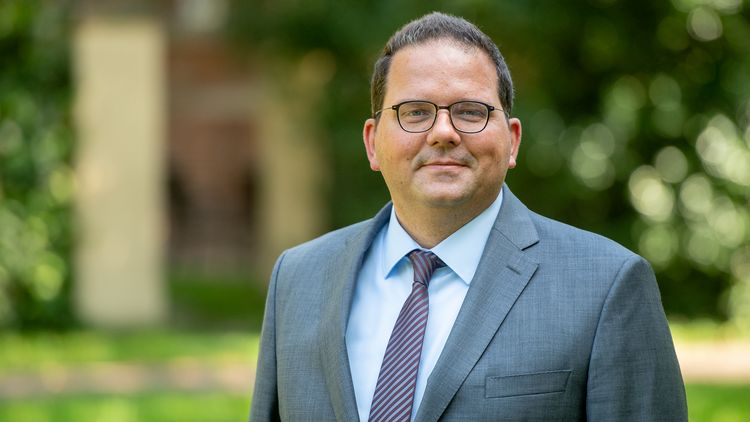


At the cutting edge of science: Oldenburg psychiatrist René Hurlemann is researching how new types of medication and procedures can help people with severe depression.
They find it difficult to cope with daily tasks, feel listless and are in a depressed mood. People who suffer from depression are mentally and often physically severely impaired. "Depression is a common and serious illness," says Prof Dr Dr René Hurlemann, Professor of Psychiatry and Psychotherapy at the University of Oldenburg's School of Medicine.
According to estimates by the World Health Organisation (WHO), a good four million people are affected in Germany alone and around 300 million worldwide. Depending on its severity, depression can be treated well with psychotherapy and medication. However, around a fifth of those suffering from severe depression do not respond to the usual therapies. "This is of course particularly problematic," says Hurlemann.
Ketamine already admitted in the USA
The physician, who has also been Director of the University Clinic for Psychiatry and Psychotherapy at the Karl Jaspers Clinic since September of this year, wants to help these people in particular - and break new ground in the process. In his research, he is focussing, among other things, on ketamine - an active ingredient that has not yet been admitted as a medication for depression in this country.
"Ketamine is an old anaesthetic that is mainly used in veterinary medicine today," explains Hurlemann. In high doses, it combats pain and leads to coma, while low doses have an antidepressant effect. Since a clinical trial in the USA in the mid-2000s successfully treated depressive patients with ketamine for the first time, psychiatrists have placed great hope in the drug.
In March 2019, the US Food and Drug Administration (FDA) admitted a nasal spray containing the active ingredient esketamine for people with severe depression. The Committee for Medicinal Products for Human Use (CHMP) of the European Medicines Agency (EMA) also recently spoke out in favour of admission of the nasal spray in the EU.
Active ingredient is not uncontroversial
In Germany, severely depressed patients who do not respond to any other medication have so far only received the active ingredient off-label - i.e. outside of the use authorised by the drug authorities. Hurlemann carried out the first studies with ketamine during his previous work at the University Hospital in Bonn. "Even during the infusion, patients start to feel better: They relax, become more tired and lose the heaviest sadness," he reports.
However, ketamine is not without controversy: Among other things, the active ingredient causes perceptual disturbances and can be addictive if abused. The drug may therefore only be administered under supervision in the USA. It also only has a short-term effect, emphasises Hurlemann. "And it is still unclear how often patients need to receive the drug and what the long-term effects are," he adds. The scientist therefore sees a great need for research - especially when it comes to the causes of depression and the mechanisms of action of ketamine.
For example, it is a common idea that the amygdala, also known as the amygdala complex, plays a central role in depressive illnesses. The amygdala is also known as the fear centre - anxiety is a common symptom of depression. However, Hurlemann and his colleagues were also able to observe the rapid antidepressant effect of ketamine in a patient whose amygdala is damaged due to a rare genetic disorder and who therefore does not experience fear.
Treatment specially tailored to patients
According to Hurlemann, this is significant in two respects: "A lot of research funding goes into investigating functional changes in the amygdala in depression. But our case study indicates that the assumption that the amygdala plays a key role in the disease may be wrong. Apparently, severe depression can also develop when there is no amygdala at all," he says. In addition, it is not known exactly how ketamine actually works in depression. "However, our findings mean that temporary inhibition of the fear centre can no longer be considered as an explanation," adds the physician.
In addition to ketamine, Hurlemann is also investigating other methods that could help severely depressed patients in the future. In transcranial magnetic stimulation (TMS), for example, a magnetic coil stimulates metabolic activity in areas of the brain close to the surface. "This improves networking with regions in the depths of the brain, such as the reward centre, and thus alleviates depression. Because depression is a network disorder," he explains.
The procedure is gentle and painless, does not require anaesthetics and is currently experiencing a boom thanks to the new possibilities of precision medicine, Hurlemann emphasises: "The treatment is based on a patient's individual measurement parameters and is therefore precisely tailored to them." The so-called "one size fits all" principle, which has long been the norm in psychiatry, is now a thing of the past.
New forms of therapy accessible
Another promising drug is the body's own bonding hormone oxytocin, which Hurlemann has been researching for over ten years. In future clinical studies, he wants to investigate whether oxytocin can be used to treat depressive disorders, anxiety disorders or borderline personality disorder even better and more quickly, especially in combination with proven psychotherapies.
"Patients in the region benefit directly from University Medicine Oldenburg and the development of the University Clinic for Psychiatry and Psychotherapy at the Karl Jaspers Clinic," says Hurlemann. "They can already take part in clinical studies on new forms of therapy that may not become part of standard care for many years."