
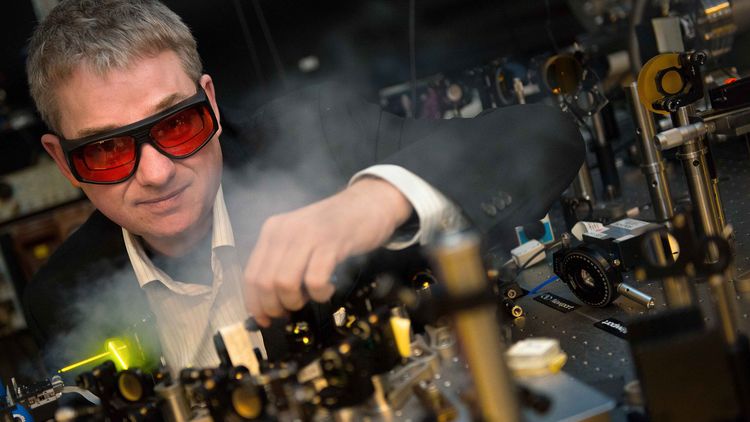

Researchers around the world are working hard to develop new time-resolved electron microscopes. Oldenburg physicists have now taken an important step towards realising such microscopes: They propelled electrons with short flashes of light.
Electron microscopes are powerful tools for visualising the smallest nanoparticles. However, their time resolution has so far been limited: They are often unable to resolve rapid temporal changes in the structure of nanoparticles. The movement of electrons, which takes place on extremely short time scales of femtoseconds - the cheapest part of a second - therefore usually remains hidden. However, these movements are crucial for the function of nanoparticles, for example in solar cells or batteries. Researchers worldwide are therefore working intensively on the development of new, time-resolved electron microscopes.
A team of Oldenburg physicists from the "Ultrafast Nanooptics" working group led by Prof. Dr Christoph Lienau has now taken an important step towards the realisation of such microscopes. In the 30 November issue of the renowned journal "Physical Review Letters", they show how the movement of electrons ejected from fine gold tips can be manipulated and controlled using short flashes of light.
"As with the classic Einstein photoelectric effect, we use light to release electrons from a metal tip," says Oldenburg physicist Doojae Park. "In our case, however, we use extremely short pulses of light whose electric fields are so strong that electrons tunnel out of the tip. We can see how the light field near the tip accelerates these electrons and determines their direction of flight."
The key difference to conventional electronic components, such as those found in every computer: The physicists do not use electrical voltages to propel the electrons, but directly the oscillating electrical field of extremely short light pulses. The electron moves on the light wave in a similar way to a surfer on a large ocean wave. "This is an important step towards controlling the movement of electrons on time scales of less than a femtosecond," says Lienau, head of the Oldenburg project, which is funded by the German Research Foundation as part of the "Ultrafast Nanooptics" priority programme.
Doo Jae Park, Bjoern Piglosiewicz, Slawa Schmidt, Heiko Kollmann, Manfred Mascheck and Christoph Lienau: "Strong Field Acceleration and Steering of Ultrafast Electron Pulses from a Sharp Metallic Nanotip", published 11 December 2012 in: Physical Review Letters 109, 244803