
Didactics of Biology
Didactics of Biology
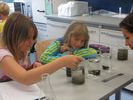
Poster presentation - Between delegation and taking responsibility
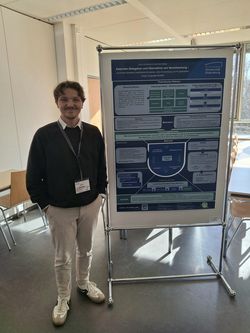
Joris Achilles presented a poster on his doctoral project at the 27th Spring School of the Didactics of Biology section of the VBIO, which took place this year at the Technical University of Dresden. The conference offered doctoral students involved in biology didactics research a platform to exchange information on current research projects focussing on methodological approaches.
The poster presented, entitled "Between delegation and taking responsibility", presents the research background on the question of the extent to which learners use large language models (e.g. ChatGPT) to deal with bioethical conflicts in the classroom. The starting point of the study is the observation that AI-supported tools are increasingly being used as a matter of course in everyday school life, but that the technical background and the limits of their use are often unknown. While many didactic discussions focus on regulated or guided use, the doctoral project specifically investigates situations in which learners use such systems without explicit instruction to make moral judgements on bioethical issues.
The centre of the qualitative study is the reflection and integration of the AI offerings as part of the individual judgement process. In particular, it examines the extent to which responsibility for moral judgements is delegated to AI systems or whether they are used more as support for independent judgement formation. In addition, the effects of this AI-supported judgement process on the development of maturity in the context of bioethical issues will be analysed.
New publication: Bioethik unterrichten - Urteilsfähigkeit fördern
A collection of essays by subject didacticians and educational scientists for the educational landscape
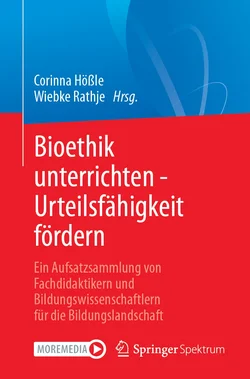
Advances in medicine, science and technology also present us with a multitude of ethical questions. What is permissible in order to cure serious illnesses or guarantee the birth of healthy children? What costs for environmental protection and animal welfare must be accepted for prosperity and food security? Which consumption patterns are ecologically and socially acceptable? These and other social debates have a far-reaching impact on education and must be addressed responsibly in order to enable learners to participate in socially relevant bioethical contexts and promote a democratic approach to new technologies.
- This anthology introduces bioethical conflicts and current research on judgement processes
- It offers students, lecturers and teachers an overview of proven models of judgement and evaluation skills
- In addition, practical concepts for teaching and learning are presented that specifically promote students' judgement skills
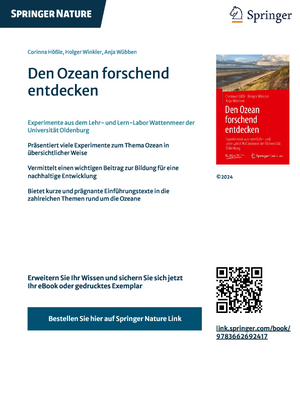
New publication: Den Ozean forschend entdecken
Experiments from the Wadden Sea Teaching and Learning Laboratory at the University of Oldenburg
- Presents many experiments on the topic of the ocean in a clear way
- Makes an important contribution to education for sustainable development
- Provides short and concise introductory texts on the numerous topics relating to the
oceans
The ocean is the basis of all living things on this earth and provides us with a
multitude of resources. And yet this system is under massive threat
from anthropogenic use.
This textbook uses simple experiments and well-structured
instructions to provide you with important chemical, physical and biological background information on the
complex and sensitive system of the ocean. For the first time, the experiments of a school laboratory, which have been
tested and optimised several times, are being published, based
on many years of collaboration between marine scientists and
specialist didacticians. The Wadden Sea Teaching and Learning Laboratory at the University of Oldenburg
hereby makes its interdisciplinary and didactically
reflected experimental programme available to all interested parties. In addition, you will receive materials
to promote responsible judgement and action in relation to
ocean use. These enable easy integration into lessons and
spark exciting discussions. You will be introduced to a method that enables an
ethical evaluation of anthropogenic uses of the ocean, taking into account
ecological, social and economic aspects. In the process,
methods for value analysis, argumentation and impact analysis as well as for
changing perspectives are presented, which enable direct practical implementation in
different educational institutions. The book thus takes up the goals
of education for sustainable development in concrete terms and offers you many
valuable and very well-developed opportunities to implement them in your educational area in an action-oriented way using the example of the topic
ocean.
Use this comprehensive offer to integrate relevant topics into your curriculum
.