
News
News
04.03.2025 Expertise of Oldenburg hearing research in the press
Medical or lifestyle product? The opportunities and risks of hearing-improving in-ear headphones are the subject of an article in the current issue of the German medical journal Deutsches Ärzteblatt. Once again, the expertise of Prof Dr Dr Birger Kollmeier, spokesperson for the Hearing4all cluster of excellence, ENT experts, the German Association for the Hard of Hearing (DSB) and a hearing aid manufacturer was sought.
Hearing aid provision: Hearing aids without a doctor or acoustician
Smartphones offer extensive health functions. They have long been able to count steps, display calorie consumption and predict periods. Another field in which a global company is now making an offer is hearing.
By Gisela Gross
Deutsches Ärzteblatt
Issue 4/2025
Online version here
26.12.2024 Expertise of Oldenburg hearing research in the press

In recent weeks, a number of national press articles relating to hearing research have appeared in which the expertise of scientists from the University of Oldenburg was in demand. The spokespersons of the Hearing4all Cluster of Excellence and the Collaborative Research Centre Hearing Acoustics as well as those responsible for various research laboratories were involved.
How hearing aids can be better adapted to their users
By Björn Lohmann
WESER-KURIER 25/26 January 2025
Online version here
Hearing well at last
Many people put off their first hearing test. This can be dangerous for the brain. About new findings from hearing research, do-it-yourself tests and earpods as a replacement for hearing aids.
By Bernhard Albrecht
Stern, 26 December 2024
Online version here
Hear me when you can
If your ears start to ring, it's not enough to amplify the sound. How technology is helping people to participate in life again.
By Andreas Frey
Frankfurter Allgemeine Sonntagszeitung, 15 December 2024
Online version here (Why it is so difficult to adjust a hearing aid)
Many people shy away from going to the hearing care professional. Yet hearing aids are getting better and better thanks to AI - and sometimes even develop true superpowers.
By Christian Heinrich
Süddeutsche Zeitung, 2/3 November 2024
Online version here(Why hearing aids are finally getting better)
Can in-ear headphones replace a hearing aid?
Smartphone manufacturer Apple is adding a hearing aid function to its AirPods Pro 2 in-ear headphones for people with mild to moderate hearing loss. How useful can this kind of support be instead of a hearing aid?
By Sven Stein
Apotheken Umschau, 28 October 2024
Online version here
Father of local hearing research
Prof. Dr Dr Birger Kollmeier is making a name for himself around the world and causing surprises
By Heidi Scharvogel
Nordwest-Zeitung (print edition), 26 October 2024
Photo: © H4a
13.10.2022 Upgrade of anechoic free-field room is finished

The door of the Anoechoic Lab on Wechloy Campus opens onto a world of silence. The key feature of the recently renovated acoustics lab is its huge wedge-shaped sound absorbers.
Noises from outside cannot penetrate the walls of this room, and any sound waves inside are instantly absorbed: the "anechoic free-field chamber" at Oldenburg University is one of the quietest rooms in Oldenburg – and probably one of the quietest in all Germany. Almost 40 years after it was first built, the university’s extraordinary acoustics laboratory needed a major overhaul: each one of its wedge-shaped sound absorbers had to be replaced. The renovation was planned and carried out by the Staatliches Baumanagement Region Nord-West Region in collaboration with the architecture firm Architekt Fritsch. The university used its own funds to finance the measure.
“The anechoic chamber is a key research facility for the Hearing4all Cluster of Excellence, the Collaborative Research Centre Hearing Acoustics and many more of our research projects. In addition, non-university hearing research institutions also use the room,” stresses acoustician Prof. Dr. Steven van de Par, whose department runs the laboratory. “The renovated lab now once again offers optimal conditions and the necessary flexibility for numerous technical measurements and our tests with test persons.”
The scientists use the lab to perform extremely precise analyses of the acoustic properties of devices such as loudspeakers and microphones which are needed in certain research projects. They also use it to conduct hearing experiments with test subjects, in particular spatial hearing tests.
Acoustics like those on the top of a mountain when there’s no wind
The renovated lab is located in a separate building adjacent to the physics department on Wechloy Campus. It was built together with the main building in 1984 and is a "room-in-room” construction, with an inner room supported by metal springs and thereby isolated from the outer environment. There is also a one-metre gap between all the walls and the outer shell of the building, and the ventilation and lighting systems can be operated almost silently. All six walls, including the ceiling and floor, have been sound-proofed using the 1.5-metre-long wedges. "There are more than 2,500 wedges in total," points out Dr Stephan Töpken, who supervised the technical aspects of the renovation together with technician Christoph Scheicht.
Considerable effort was put into preventing sound reflections in the room: the new absorbers are covered with a special, non-combustible fabric which reflects hardly any sound. To facilitate the installation of experimental set-ups and measuring devices, a number of rods and hooks were attached to the floor and ceiling in between the sound absorbers. "Our lab offers controlled acoustic conditions across almost the entire hearing frequency range," Töpken emphasizes.
A special feature of the Oldenburg laboratory is that thanks to the large size of the sound absorbers even low-frequency sound waves are effectively absorbed. The sound absorption extends all the way down to a frequency of 50 hertz – a very low hum. Because sound is not reflected back from any of the three spatial directions, the acoustics are equivalent to those experienced on the top of a mountain when there is no wind. Experts refer to this as “free field” acoustics.
In addition to researchers from various departments at the University of Oldenburg, the Anechoic Lab is also used by research teams from the Jade University of Applied Sciences and the Fraunhofer Institute for Digital Media Technology IDMT.
[Text/photo: Presse release of the Universität Oldenburg (in German), 07.11.2022]
22.09.2022 Anna Warzybok-Oetjen receives prize of the German Society for Audiology
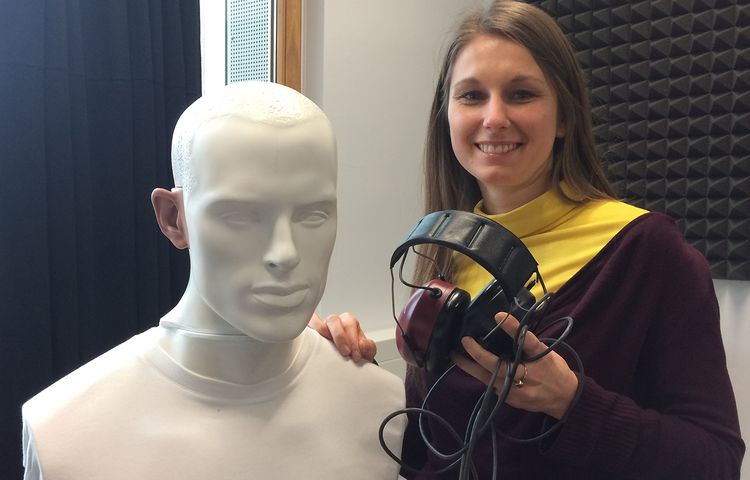
Oldenburg. The German Society for Audiology (DGA) has awarded the Meyer-zum-Gottesberge Prize to Dr. Anna Warzybok-Oetjen from the University of Oldenburg, for her work in the field of hearing research.
Warzybok-Oetjen has contributed to making matrix language tests that researchers use to measure a person's speech comprehension available in other languages. Her work is important for the transferability of test results and contributes to the internationalisation of speech audiology.
Anna Warzybok-Oetjen has already received several awards, including the Lothar Cremer Prize of the German Society for Acoustics. She now accepted the Meyer-zum-Gottesberge Prize at the DGA annual conference in Erfurt. She is the fourth prize winner from the University of Oldenburg.
Contact
Dr. Anna Warzybok-Oetjen, Tel.: 0441/798-5499, e-mail:
08.07.2022 Oldenburg hearing research looks back on a successful decade
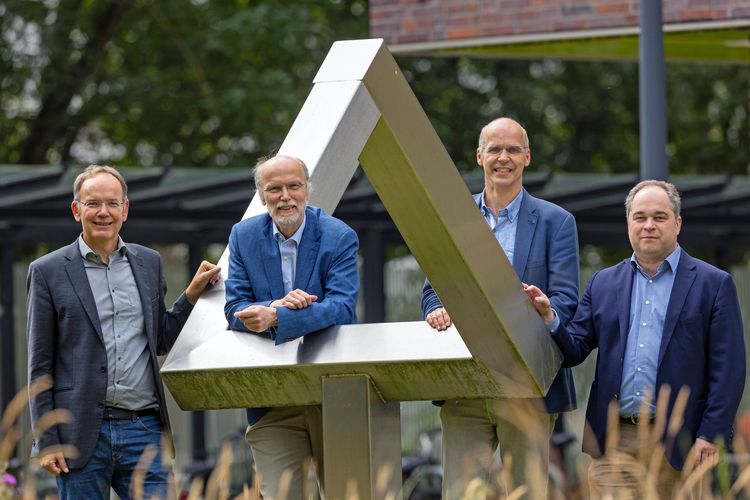
Ten years Cluster of Excellence and Department of Medical Physics and Acoustics
Oldenburg. They pursue a common goal - hearing for all - and research, develop and teach at the interfaces between medicine, physics and engineering sciences: the scientists of the Department of Medical Physics and Acoustics at Oldenburg University and the Cluster of Excellence Hearing4all anchored there. Today they celebrated the tenth anniversary of both the Cluster of Excellence and the Department - one of five in the Faculty of Medicine, which was also founded in 2012 - with alumni and guests at a festive colloquium.
"We thus have double and triple reason to celebrate," said the founding director of the department and Hearing4all spokesperson Prof. Dr. Dr. Birger Kollmeier. In addition to the anniversaries, there is also the joy about the recent promise of further funding for the special research area "Hearing Acoustics", which is also located at the department. Oldenburg's hearing research, founded almost 30 years ago, can look back on an extremely successful decade as a "pacemaker" for the university, the physicist and physician summed up.
"The fact that about 80 per cent of hearing aids worldwide contain know-how from Oldenburg impressively illustrates the importance of our hearing research. It enjoys the highest national and international recognition," said University President Prof. Dr. Ralph Bruder. In addition to Hearing4all, which scored points in the Excellence Strategy of the federal and state governments for the second time in 2018 and will be funded until the end of 2025, the structure as a department has also proven itself. Its graduates are "in enormous demand from industry, clinics and academia".
Some of this circle returned to Oldenburg on the occasion of the anniversary and met for an alumni morning. The keynote speeches at the subsequent colloquium were given by Prof. Dr. Tanja Schultz, a computer scientist from Bremen and an expert in cognitive systems, and Prof. Dr. Gerhard Fettweis, an expert in communications engineering from Dresden. Afternoon tours of the department's laboratories, also for the general public, rounded off the day.
The roots of Oldenburg's hearing research lie at the Institute of Physics, where acoustician Prof. Dr. Volker Mellert taught and researched from 1974, and at the then Institute for Human-Environment Relations, which also appointed psychologist and noise researcher Prof. Dr. August Schick in 1974. Kollmeier joined in 1993 with what was then a Fiebiger Professorship - a support programme for young researchers - and subsequently built up the Department of Medical Physics. The foundation stone for Oldenburg's hearing research was laid.
Today, the Department of Medical Physics and Acoustics employs a total of almost 120 people in its ten departments and seven other working groups. Ten years ago, it was instrumental in establishing the Faculty VI of Medicine and Health Sciences. In the Cluster of Excellence Hearing4all, the researchers of the Department and those of the Neurosciences and Psychology cooperate with the Hannover Medical School and the University of Hannover. Further partners are the Jade University of Applied Sciences and Arts, the Hearing Centres Oldenburg and Hannover, the Fraunhofer Institute for Digital Media Technology and the Laser Centre Hannover.
Web links
[Text/Photo: University of Oldenburg press release, 08.07.2022]
22.06.2022 - Third place for Wiebke Middelberg in the ARD/ZDF award
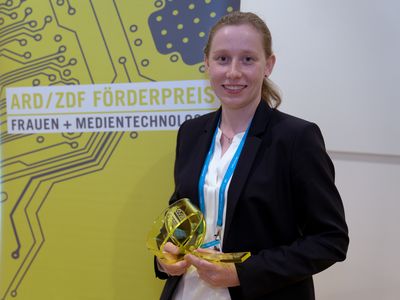
Oldenburg. Wiebke Middelberg, doctoral student at the Department of Medical Physics and Acoustics at the University of Oldenburg, was awarded third place in the ARD/ZDF "Women + Media Technology" 2022 award in Bonn. She is the first successful female graduate of the University of Oldenburg in this competition.
Middelberg wurde für ihre Masterarbeit ausgezeichnet, mit der sie im vergangenen Jahr ihr Engineering-Physics-Studium abgeschlossen hat. Darin beschäftigt sie sich mit der Frage, wie Menschen, die ein Hörgerät nutzen, Gesprächen besser folgen können. Ihr Ansatz: Die im Alltag zahlreich – zum Beispiel in Smartphones – vorhandenen Mikrofone können dabei helfen, Störgeräusche und erwünschte Sprachsignale besser zu unterscheiden. Am Beispiel einer Cocktailparty hat sie durch die Verwendung dieser Mikrofone zusätzlich zu den Hörgerätemikrofonen aus dem Stimmenmix eine einzige Stimme in ihrer Verständlichkeit erhöht und alle anderen als unerwünschte Schallquellen unterdrückt. „Anwendungsgebiete von neuen Lösungen durch verbesserte Algorithmen liegen nicht nur in der untersuchten Hörgerätetechnik, sondern zum Beispiel auch in der Sprachsteuerung digitaler Medien“, hieß es in der Begründung der Jury. Middelbergs Arbeit entstand im Sonderforschungsbereichs Hörakustik, der von der Deutschen Forschungsgemeinschaft (DFG) gefördert wird. Aktuell promoviert die 25-Jährige in der Arbeitsgruppe Signalverarbeitung von Prof. Dr. Simon Doclo.
Middelberg recieved the price for her master's thesis dealing with the question of how people with hearing aids can follow conversations better. Her approach: the numerous microphones available in everyday life - in smartphones, for example - can help to better distinguish between background noise and desired speech signals. Taking the example of a cocktail party, she used these microphones in addition to hearing aid microphones to increase the intelligibility of a single voice from the voice mix and suppress all others as unwanted sound sources. "Areas of application of new solutions through improved algorithms are not only in the hearing aid technology studied, but also, for example, in the voice control of digital media," the jury's statement said. Middelberg's work was done in the Collaborative Research Center for Hearing Acoustics, which is funded by the German Research Foundation (DFG). The 25-year-old is currently working on her doctorate in the signal processing group of Prof. Dr. Simon Doclo.
Mit dem zum 14. Mal vergebenen Förderpreis zeichnen die öffentlich-rechtlichen Rundfunkanstalten Absolventinnen von Hochschulen und Universitäten in Deutschland, Österreich und der Schweiz aus. Ziel ist, talentierte Frauen zu motivieren, sich im Rahmen des Studiums und ihrer Forschung mit dem Bereich der audiovisuellen Medienproduktion und -distribution zu befassen. Unter dem Motto „Meine Idee schreibt Zukunft“ können Frauen Abschlussarbeiten einreichen, die sich mit aktuellen Fragestellungen aus dem Bereich der Medientechnik befassen. Die Teilnehmerinnen sollen durch den Wettbewerb außerdem karrierefördernde Kontakte in die öffentlich-rechtlichen Rundfunkanstalten erhalten.
The award, which is being presented for the 14th time, is given by the public broadcasters to female graduates of colleges and universities in Germany, Austria and Switzerland. The aim is to motivate talented women to engage with the field of audiovisual media production and distribution as part of their studies and research. Under the motto "My idea writes the future," women can submit theses that address current issues in the field of media technology. The competition is also intended to provide participants with career-enhancing contacts at public broadcasters.
[Text: Pressemitteilung der Universität Oldenburg, 22.06.2022]
27.05.2022 - Another success for Oldenburg's hearing research:
Collaborative Research Centre Hearing Acoustics to receive funding for another four years
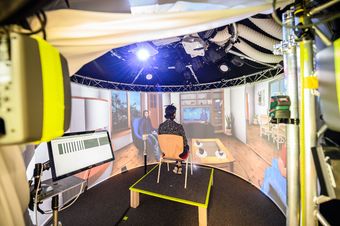
Oldenburg. Smart hearing aids that adapt to the individual needs of the user: for the last four years, the researchers of the Collaborative Research Centre (CRC) Hearing Acoustics have been working towards this goal. Now the German Research Foundation (DFG) has extended the funding of the project. Led by Prof. Dr. Volker Hohmann, a hearing researcher at the University of Oldenburg, the CRC will receive up to 8.1 million euros for a second funding phase running from 2022 to 2026. With the official title “Hearing Acoustics: Perceptual Principles, Algorithms and Applications” (HAPPAA), the CRC is focusing on developing hearing aids and hearing assistance systems that use artificial intelligence (AI) to automatically adjust to different environments, making these devices more adaptable to the specific needs of individual users. In addition to the University of Oldenburg, the Jade University of Applied Sciences, the Fraunhofer Institute for Digital Media Technology IDMT, the Hörzentrum Oldenburg gGmbH, RWTH Aachen University and the Technical University of Munich – all leading institutions in the field of hearing research – are involved in this large-scale project which is scheduled to run for a total of twelve years.
"In our ageing society it is becoming increasingly urgent to develop hearing aids and other communication aids that work effectively in difficult acoustic environments and really help people in daily life. Oldenburg's hearing research is doing excellent work and is highly recognized both nationally and internationally. The German Research Foundation's renewed funding commitment underlines this in an impressive way," said University President Prof. Dr. Ralph Bruder.
The Collaborative Research Centre Hearing Acoustics brings together various disciplines, in particular acoustics, psychoacoustics, audiology, engineering sciences and physical modelling. In the first funding period the focus was on the interactions between people with impaired hearing and their acoustic environment. "In real life, the hearing situation changes constantly because people react to voices and sounds. For example, they turn their head towards the sound source, or shift their gaze in that direction. We call this the 'acoustic communication loop'," says Hohmann. This dynamic loop had received little attention in hearing acoustics in the past, he notes.
In the last few years the team has succeeded in incorporating the hearing aid into this acoustic communication loop. "We have developed a first prototype of the so-called 'immersive hearing aid' which constantly assesses the acoustic situation and identifies which sound source a test person is directing their attention towards at a given moment," Hohmann explains. The device determines the direction of the test person's gaze and head movements and then adjusts the signal processing to ensure that the targeted sound source can be optimally heard by the test person. The current prototype can be used in field experiments as well as in the lab.
Among other factors, new perception models developed by the research team for use in different hearing situations have paved the way for this success. "These models predict how a test person will perceive a sound signal in a given situation – whether or not they will be able to follow a conversation in a noisy environment, for instance," Hohmann explains. Simulating hearing with and without hearing impairment in different hearing situations involving background noise and reverberation is essential for the development and evaluation of innovative methods for signal processing in hearing aids, he stresses.
Another important result from the first funding period is the "hearpiece" – a special, particularly high-quality earpiece for research purposes. Inserted in the ear and featuring several integrated microphones and small loudspeakers, the device can boost sound in exactly the same way as a hearing aid. The researchers can use it to test new algorithms for signal processing directly in the ear, for example. The special feature here is that the hearpiece is acoustically transparent – which means that hearing with this device corresponds to normal hearing with an open ear. "Thanks to the interdisciplinary collaboration within the CRC we were able to combine acoustics and signal processing methods and have made considerable progress as a result," says Hohmann.
The team has also developed an interactive, audiovisual virtual reality set-up in the lab for conducting hearing experiments with test subjects under controlled conditions. With this technology, real-life situations can be simulated more realistically than was previously possible. To this end, the team created several complex audiovisual scenarios in which test persons can "immerse" themselves, including a virtual restaurant, an underground station and a living room. These scenarios, together with the related data, have been made freely available to research laboratories across the world so that they can conduct their own hearing experiments.
In the second funding period that will now commence, the CRC team plans to refine and merge its perception models, algorithms and applications. One goal is to develop algorithms for the hearpiece and the immersive hearing aid that can actively control noise depending on the acoustic scenario. To do this, the researchers are using cutting-edge AI methods which they themselves developed. The long-term goal is for each hearing aid to constantly learn and get better at predicting which setting is optimal for the respective user in a specific situation. People with impaired hearing are to be able to enter the necessary feedback themselves via their smartphone. "However, we still have a lot of work to do before we reach this goal," notes Hohmann.
The team is also working on establishing international standards for complex acoustic scenarios in hearing research and audiology in order to facilitate and enhance exchange between different laboratories. In addition, the CRC aims to develop new hearing-acoustic tests in virtual environments that enable researchers to better identify differences in individual perception. This should make it possible to design diagnostics and hearing aid rehabilitation measures that are optimally tailored to individual needs.
The Collaborative Research Centre complements the research conducted by the Cluster of Excellence Hearing4all, which is also led by researchers from the University of Oldenburg. In addition, it actively supports the doctoral projects of early career scientists with its own integrated Research Training Group.
[Text: Press release of the Univerity of Oldenburg], 27.05.2022
22.03.2022 - DEGA Student Award for Wiebke Middelberg

M.Sc. Wiebke Middelberg, PhD student in the Signal Processing group of Prof. Dr. Simon Doclo, has received the student award of the German Society for Acoustics (DEGA) for her master thesis during the DAGA conference on March 22, 2022.
In her master thesis, entitled "GSC-based noise and interferer reduction for binaural hearing aids exploiting external microphones," which was written in the framework of the CRC 1330 Hearing Acoustics, Wiebke Middelberg explored different ways to improve speech intelligibility in hearing aids by using external microphones to reduce ambient noise and competing speakers.
For more information, see (in German):
19.02.2021
15th EFAS congress taking place ONLINE on May 20th/21st, 2021
Dear colleagues and supporters of the European Federation of Audiology Societies (EFAS), dear persons interested in recent developments in Audiology,
This is to invite you to the first ONLINE congress of EFAS to take place on May 20th/21st, 2021 – please have a look at our website www.efas-virtual.org and register for the very special event!
We offer:
- 6 focus sessions with invited international experts
- highlighted free paper presentations
- an industry online exhibition plus 2 special industry highlight sessions,
- an online poster forum (accessible 24 hours)
- awards for best poster and best young investigator contribution
- accreditation for continuous (medical) education by EACCME and ÄKN (pending)
- attractive price performance ratio (full registration: 75 €, young professionals and students: 25 €)
Paper or poster submission deadline is April 1st, 2021, (see efas-virtual.org/#/call-for-contributions)
We are counting on your contribution and invite you to participate –
welcome to the European spirit of audiology to be celebrated online!
Sincerely ,
Prof. Dr. Dr. Birger Kollmeier,
Universität Oldenburg, Germany
EFAS president 2019 – 2021
www.efas.ws
06.06.2019
An ode to the ear - Florian Denk wins 9th Oldenburg Science Slam
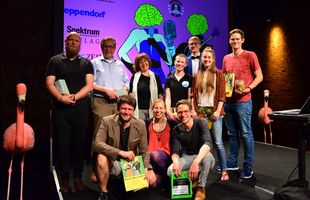
Oldenburg. Ten minutes, scientific content and a lot of fun: these were the rules of the 9th Oldenburg Science Slam. Five young scientists competed this year in the sold-out Exerzierhalle. At the end of the evening, the audience chose Florian Denk, a doctoral candidate in the Department of Medical Physics and Acoustics at the University of Oldenburg, as the winner. He won the "Golden Brain" and prize money of 150 euros donated by the University of Oldenburg's Graduate Academy.
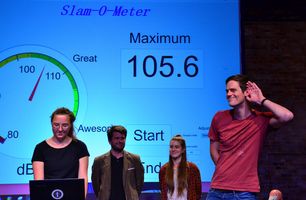
"Weird shapes, great acoustics - an ode to the ear" was the title of Denk's slam. The doctoral candidate explained why the shape of the human ear contributes significantly to the fact that it works so well. The 150 guests voted on the presentations by means of varying doses of applause, which was recorded by the "Slam-o-Meter". Out of competition, political scientist Prof Dr Torsten J. Selck delivered the first slam of the evening with "The EU, Brexit and me", much to the delight of the audience.
Like Selck and Denk, the other slammers literally brought the atmosphere in the Exerzierhalle to the boil. In addition to linguist Dr François Conrad from Leibniz Universität Hannover, three other Oldenburg doctoral candidates were represented. While the native Luxembourger explained why German sounds so hard for non-native speakers, Nina Gmeiner (Department of Economics and Law) slammed about seeds as a common good and what Filipino rice farmers have to do with their scientific findings. Rosanna Schöneich-Argent (Institute of Chemistry and Biology of the Sea) illustrated the influence of the cold easterly wind on the direction of the North Sea current using a hairdryer and a teacup. It was almost a little scary in the hall of mirrors about alienation in service-orientated system catering, staged by Jonathan Gilbert (Department of Economics and Law). The young academics took second to fifth place and were rewarded with subscriptions to specialist journals.
The "Power Point Karaoke" was once again on the programme. This involved two professors presenting each other's lecture - without any preparation or knowledge of the topic. This year, neurologist Prof Dr Karsten Witt and historian Prof Dr Almut Höfert ventured into the limelight. Their improvisation skills were rewarded with thunderous applause.
The event was organised by the Research Centre Neurosensory Science, the Graduate Academy and the Graduate Schools for Social Sciences and Humanities (3GO) and for Natural Sciences, Medicine and Technology (OLTECH) at the University of Oldenburg. The Oldenburg State Theatre is a cooperation partner.
06.05.2019
Simon Doclo is the new Director of the Department of Medical Physics and Acoustics
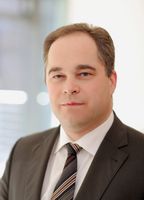
Oldenburg. Prof. Dr Simon Doclo, Professor of Applied Physics with a focus on signal processing, is the new Director of the Department of Medical Physics and Acoustics at the School V - School of Medicine and Health Sciences at the University of Oldenburg. Prof Dr Dr Birger Kollmeier and Prof Dr Volker Hohmann were elected as his deputies.
Doclo studied electrical engineering at the Catholic University of Leuven (Belgium), where he also obtained his doctorate in 2003 and subsequently worked in the Department of Electrical Engineering. Before accepting the professorship for Applied Physics with a focus on signal processing at the University of Oldenburg in 2009, Doclo was the scientific head of the Sound and Acoustics working group at NXP Semiconductors. His research focus includes acoustic signal processing to improve speech quality, computer-based acoustic scene analysis and assistive audio technology. Simon Doclo is one of the leading researchers in the Hearing4all cluster of excellence and the Collaborative Research Centre Hearing Acoustics.
Further information: uol.de/sigproc/
18.04.2019
Hearing researcher Steven van de Par is co-initiator of a new DFG Priority Programme

Oldenburg. Prof. Dr Steven van de Par, Professor of Applied Physics and Acoustics at the University of Oldenburg, has initiated a priority programme of the German Research Foundation (DFG) together with four other experts. The DFG will be funding the "Auditory Cognition in Interactive Virtual Environments (AUDICTIVE)" programme from next year. The coordinator of the priority programme is Prof. Dr. Janina Fels from RWTH Aachen University; the Oldenburg physicist van der Par is a member of the programme committee.
The priority programme combines the disciplines of acoustics, cognitive psychology and Computing Science. Among other things, the research aims to expand knowledge about hearing-related cognitive performance in real-life scenes - for example in acoustically unfavourable environments such as classrooms or open-plan offices. In addition, outdoor situations in which multiple, sometimes moving sound sources are used will be analysed. Another question is how acoustic and visual components and other factors influence the ability to interact with the scene.
Van de Par studied Applied Physics at Eindhoven University of Technology, where he also completed his doctorate. He investigated the binaural (binaural) perception of acoustic signals at low and high frequencies. In 2000, van de Par moved to the Philips Research centre in Eindhoven, and in 2010 he was appointed to the University of Oldenburg. Here, van de Par heads the Department of Acoustics, which deals with the human perception of sound and the aural analysis of acoustic signals.
DFG Priority Programmes investigate fundamental questions in particularly current or emerging research areas. A total of 14 programmes were approved at the beginning of April and will begin their work in 2020. They are interdisciplinary in nature and are characterised by the use of innovative methods.
Further information: uol.de/akustik/
25.01.2019
School of Medicine honours its graduates
School VI doctoral supervision award goes to Simon Doclo
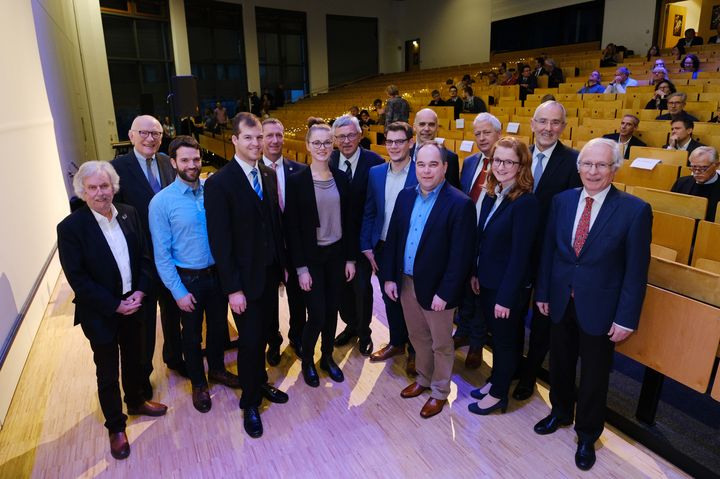
Oldenburg. School V - School of Medicine and Health Sciences at the University of Oldenburg honoured its graduates at a ceremony. These include the first four graduates of the pilot degree programme in Human Medicine at the ‘European Medical School Oldenburg-Groningen’ (EMS). This programme was launched in the 2012/13 winter semester. A further 37 EMS students have passed the equivalent of the first stage of the medical examination. This stage, formerly known as the ‘Physikum’, covers, for example, the so-called pre-clinical subjects such as anatomy, physiology, chemistry and physics. Thirty-two graduates of the international Master’s degree programme in ‘Neurocognitive Psychology’ were also delighted to have successfully completed their studies. Dean Prof. Dr Hans Gerd Nothwang also congratulated 18 graduates on obtaining their doctorates in natural sciences and human medicine, as well as one candidate who has completed their habilitation in the subject of urology.
“Alongside the personal achievements of our graduates, we are also celebrating a success for our still-young School of Medicine today: founded six years ago, we can now rejoice in the first doctors to have completed their training,” said Prof. Dr Meinhard Simon, Vice-President for Research and Transfer at the University of Oldenburg. The breadth of the School’s subject areas – ranging from human medicine to medical physics and acoustics, the neurosciences, psychology and health services research – is also “an asset the university can capitalise on”, according to Simon.
During the ceremony, Dean Hans Gerd Nothwang also recognised outstanding achievements: Nadine Jacobsen achieved the highest Master’s degree in the “Neurocognitive Psychology” degree programme, whilst Dr Andreas Schönfeld was honoured for his PhD in Medical Physics. School VI’s doctoral supervision award, worth 1,000 euros, went to Prof. Dr Simon Doclo from the Department of Medical Physics and Acoustics. “Our aim is to offer all students and early-career researchers an excellent education and support. To this end, we have put all the necessary conditions in place over the last six years and will continue to devote our full efforts to this cause,” explained Nothwang.
Prof. Dr Reto Weiler, a neurobiologist and co-initiator of University Medicine Oldenburg, emphasised in his keynote speech the great importance of University Medicine Oldenburg for north-western Germany. Prof. Dr Erik Boddeke, Dean of Research at the University Medical Centre Groningen (UMCG), congratulated the honoured students and graduates of the Oldenburg School on behalf of the Dutch partners.
10.01.2019
Festive New Year's reception with honours
President's badge of honour goes to Birger Kollmeier, Volker Hohmann, Henrik Mouritsen, Kirsten Gehlhar and Klaus Peter Kohse
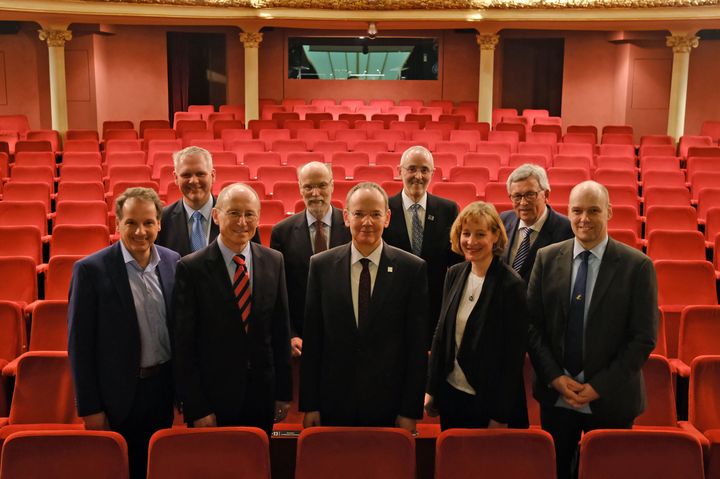
Traditional reception hosted by the University and the University Society with the Minister for Science
Oldenburg. “2018 was a year of great successes for the University of Oldenburg. Particular mention must certainly be made of hearing research, with the ‘Hearing4all’ cluster of excellence and the new Collaborative Research Centre on ‘Hearing Acoustics’,” said Lower Saxony’s Minister for Science and Culture, Björn Thümler, at the traditional New Year’s reception hosted by the University of Oldenburg and the University Society of Oldenburg e.V. (UGO) at the Oldenburg State Theatre.
On the evening, University President Prof. Dr Dr Hans Michael Piper honoured five individuals for their outstanding services to the University of Oldenburg. In front of an audience of around 550 guests, Piper presented the President’s Medal of Honour to the physician and physicist Prof. Dr Dr Birger Kollmeier, the psychoacoustician Prof. Dr Volker Hohmann, the biologist Prof. Dr Henrik Mouritsen, as well as to Dr Kirsten Gehlhar and Prof. Dr Dr Klaus Peter Kohse, who head the Dean’s Office of the School of Medicine.
“It gives me great pleasure, on this festive occasion – and in the presence of the Minister for Science – to honour five individuals who have rendered outstanding service to the University of Oldenburg with the utmost dedication and in a truly exceptional manner,” emphasised Piper.
The physicist and physician Prof. Dr Dr Birger Kollmeier received the award in his capacity as spokesperson for the “Hearing4all” (“Hearing for All”) cluster of excellence, which has once again secured funding. The cluster has been recognised under the federal and state governments’ Strategy for Excellence and will receive funding for a further seven years. Piper explained that it is the flagship of Oldenburg’s renowned hearing research, which Kollmeier has consistently and strategically built up since 1993.
Hearing researcher Prof. Dr Volker Hohmann was also honoured for his exceptional commitment to research: as spokesperson, he was responsible for the successful acquisition of funding from the German Research Foundation (DFG) for the Collaborative Research Centre ‘Auditory Acoustics: Perceptual Principles, Algorithms and Applications’, funded by the German Research Foundation (DFG). The project opens up a new dimension for electroacoustic communication systems, said Piper. This lays the foundations for novel hearing aids that can actively adapt to changing acoustic environments.
Prof. Dr Henrik Mouritsen has also rendered outstanding services to Oldenburg as a centre of research: the biologist is the spokesperson for the recently secured DFG Collaborative Research Centre “Magnetic Reception and Navigation in Vertebrates: From Biophysics to Brain and Behaviour”. Piper said that Mouritsen had thus succeeded in establishing a new focus for biological research in Oldenburg. Placing the topic of animal navigation at the centre of an interdisciplinary scientific project is unique worldwide.
Piper paid tribute to Dr Kirsten Gehlhar and Prof. Dr Dr Klaus Peter Kohse for their exceptional commitment to University Medicine Oldenburg. As heads of the Dean’s Office for Academic Affairs at the School of Medicine, they are responsible for establishing and expanding the model degree programme in human medicine. Both had also made a significant contribution to ensuring the School was exceptionally well prepared for this year’s review by the German Council of Science and Humanities, Piper added.
Minister Thümler had also previously commented on the current developments at University Medicine Oldenburg: “With the doubling of first-year places at the EMS for the coming winter semester, a milestone has been reached in the creation of new medical degree places in Lower Saxony. In doing so, the University of Oldenburg is making a significant contribution to improving healthcare provision in rural areas,” said Thümler.
The cultural highlight of the evening at the State Theatre was the musical drama “Comedian Harmonists”. The guests, who had previously been welcomed by Lower Saxony’s Minister for Science Björn Thümler, Lord Mayor Jürgen Krogmann, University President Piper and UGO Chair Hon.-Prof. Dr Werner Brinker, were able to immerse themselves in the music of the group that enjoyed such success in the 1920s and 1930s. The performance was followed by the traditional ‘after-show chat’.
By purchasing their tickets, guests at the New Year’s reception once again supported the “Deutschlandstipendium” programme, which provides funding for particularly talented and committed students.