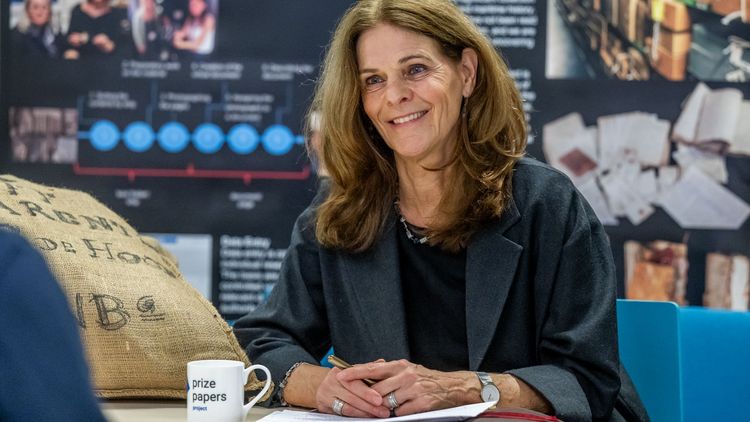

Historian Dagmar Freist recently presented the Prize Papers Project at the Spanish Embassy in London. In this interview, she talks about captured galleons, secret trade networks, slavery, and moving letters that never reached their destination.
You were recently invited by the Spanish Ambassador in London to talk about the Prize Papers Project. How did this come about?
As part of the project, we are researching documents, valuables and other sources that have been kept for centuries in The National Archives in London as captured cargo. A significant part of this collection comes from Spanish ships that the British captured in the 17th and 18th centuries. In 2023, when we published three particularly interesting case studies on Spanish ships written by our research assistants and cooperation partners, the media response in Spain was huge – not least because we were able to present previously unknown archive materials and objects from early modern Spain and its colonial past. This led to a lively exchange with two Spanish colleagues, María Saavedra and Milagrosa Romero Samper, both based at the San Pablo-CEU University in Madrid. They facilitated further contacts, for example with archivists at the Armada Historical Archive in Madrid, who are naturally particularly interested in the subject, and to our surprise, also with the Spanish Embassy.
In what historical context were the ships captured?
In the early modern period, privateering was a legitimate means of warfare. Governments issued letters of marque allowing a ship’s captain to capture enemy ships and, if successful, keep at least part of the seized cargo as booty – however, only if they could prove in admiralty courts that it was really an enemy ship. A good example from our Spanish case studies is the galleon La Nuestra Señora de Covadonga, a large, heavily armed vessel that had been sailing the major trade route between Acapulco in Mexico and Manila in the Philippines in the Pacific for twelve years before its capture. In the early modern period, large quantities of silver and the most valuable commodities of the time, such as jade from China, were transported along this trade route and exported from the Americas to European markets. In 1743, the Covadonga, fully laden and with 530 people on board, was captured off the Philippines by British captain George Anson. In addition to a huge quantity of silver worth around 60 million pounds today, the cargo included correspondence between colonial officials, merchants and private individuals, as well as valuable gifts. All this survived as captured cargo and is now available in digital form and can be researched worldwide via our online platform.
Can you tell us a little about the other case studies?
Another ship from our Spanish case studies is the La Ninfa. It was a merchant ship that sailed the Atlantic between Cádiz and Veracruz transporting a wide variety of goods including wine, liqueur, steel and textiles, as well as mailbags and private merchant archives as was customary in those times. It was captured in 1747 – and in this case, too, everything that could be used as evidence was brought before the High Court of Admiralty in London. As a result, private correspondence between family members, friends and business partners in Spain and Mexico has been preserved. These letters not only provide insights into trade strategies, smuggling, diseases and family matters, but also into the complex and little-known history of European migration to the Americas. We learn how stringent rules on migration were circumvented in the hopes of escaping poverty or of a better life – in this case, by Europeans.
An official cooperation agreement was signed with Spanish researchers this year. What does the agreement foresee?
This collaboration is the latest in a series of similar agreements with other international partners developed by our project team member Lucas Haasis in consultation with Amanda Bevan of the British National Archives for the Prize Papers Project. The aim is to secure academic support in the cataloguing of this huge collection of sources and, in return, give our partners direct access to documents that are of particular interest to them for their own research and teaching. Our collaboration with Spain involves working together in the supervision of doctoral students and on teaching and knowledge transfer. To this end, our Spanish colleagues are helping us to index and catalogue sources that are written in Spanish. The cooperation agreement also lays the foundation for linking the Prize Papers portal to Spanish databases via an interface. The database of the Armada Historical Archive in Madrid is of particular interest to us because it contains a wealth of information on shipbuilding, sea routes and naval history in general.
It includes some extremely valuable documents, books and objects, the likes of which we haven’t yet encountered in the other collections.
Prof. Dr Dagmar Freist
Back to ships: how does the cargo seized from the Spanish ships differ from that of other nations?
It includes some extremely valuable documents, books and objects, the likes of which we haven’t yet encountered in the other collections. In addition, the ship’s papers and the preserved business letters provide insights into the trade networks that spanned the Pacific and also shed light on the many middlemen in the different countries of that region. These findings thus broaden our research perspective on European expansion and colonialism, which in Europe still tends to focus on transatlantic business relations. These global trade networks, in particular, also show that colonialism cannot be researched solely from a nation-state perspective, but that many actors – women, men, entire families – from many cities and regions of Europe played all kinds of roles here. People also exploited grey areas to circumvent trade restrictions or – as mentioned above – the restrictions on migration between states and continents that were common at the time.
Can you give an example of this from your case studies?
A good example is the ships papers and court records of the O Vaz de Lisboa, which was sailing under the Portuguese flag from Sanlúcar de Barrameda in Spain to Amsterdam in 1748 with a full cargo of brandy when it was captured by a British privateer. Although Portugal’s relations with Britain were friendly at the time, trading in Spanish goods was frowned upon in times of war. Nevertheless, there wasn’t necessarily a legal reason justifying the ship’s capture. The fact that the capture was ultimately declared legal after endless wrangling in court and allegations of bribery raises many questions. However, what may sound like a tedious legal dispute provides insights into internationally operating trade networks that allowed for flexible and often fictitious transfers of ownership, facilitating changes of status from “hostile” to “neutral”, depending on the opponent. In the case of the Lisboa, Irish merchants who had both Irish and Spanish citizenship and tried to exploit this played a special role. Incidentally, this case study comes from a master’s thesis by one of our research students and can be looked up, along with other examples, on our project website.
Are there recurring themes in the Spanish documents you are analysing – and what do you find particularly interesting about them?
In addition to the aspects already mentioned, I have always been fascinated by how people deal with the unknown, but of course this is not something specifically “Spanish”; it comes up in the correspondence of other nationalities, too. The letters offer glimpses into what it meant for many people in the early modern period to embark as a trader, captain, sailor or family member on a journey full of uncertainty; how they prepared for it, and what networks they used. It’s also interesting to see who did the writing. The voices of women, men and children from all social classes and regions of the world have been preserved here.
These are very emotional, heartfelt, sometimes heart wrenching documents that reflect the pain of separation – and tragically never arrived at their destination.
Prof. Dr Dagmar Freist
Which sources made the strongest impression on you – or perhaps even moved you?
There are letters written from one family member to another, including children, for example. These are very emotional, heartfelt, sometimes heart wrenching documents that reflect the pain of separation – and tragically never arrived at their destination. Reading files documenting the enslavement of people is also very moving in a completely different way. There are notes showing how people were traded for goods – in one case, how an enslaved child was traded for a barrel of rum.
The Spanish were just as intensely involved in the slave trade between West Africa and their colonies in America as the British. Today, slavery and the slave trade are internationally outlawed and condemned. How did Europeans view slavery back then?
People’s views on slavery in those times varied widely. We have sources that reflect a purely economic attitude towards it, such as an order placed by a slave trader who wanted medicine for his slaves – not out of compassion, but to preserve his “merchandise”. The way enslaved people on captured ships were treated was driven by similar motives; they too were treated as “merchandise”. Then there’s a plantation manager’s “inventory list” detailing the condition of enslaved people: it describes their appearance and character traits, or what “value" and working potential they (still) had. Sources from missionaries like the Moravians offer a different perspective. They often evangelised enslaved people on behalf of the colonial powers, in the hope that educating them in this way would have a pacifying and, in the language of the Moravians, “civilising” effect. However, this attitude was ambivalent, as education could also stimulate a desire for independence, and this fuelled fears of revolt. The Moravians were critical of slavery and often found themselves at odds with the administrators of the colonies. On the other hand, we know from some sources that there were Moravians who had enslaved people working in their households. Conversion to Christianity did not lead to recognition of equal rights.
What more can we expect to learn from the Prize Papers and the Spanish case?
The sheer variety of sources suggests that we will make many more interesting discoveries. When we consider the archive as a whole, and not just the Spanish documents, we have already identified 130 different types of sources and 20 different languages and dialects – from letters, deeds and inventories, lists of goods, medical treatises, health certificates, natural history studies and weather observations to vocabulary lists and writing exercises, sheet music and drawings. Thanks to the Prize Papers, we are acquiring a new, more nuanced view of the European expansion and colonialism – with all its consequences in terms of asymmetrical economic relations between former colonies and colonial powers, some of which continue to have an impact today. At the same time, the sources show how complex European expansion was. It involved not only people from the colonial powers, but people from all over Europe, including the German territories and cities. Germany has long taken comfort in the fact that it was supposedly only responsible for a brief phase of imperialism in the 19th century. But research and the Prize Papers in particular show that many people from the Holy Roman Empire of German Nations were involved in colonial conquests, violence and the slave trade long before that.
Interview: Henning Kulbarsch