-
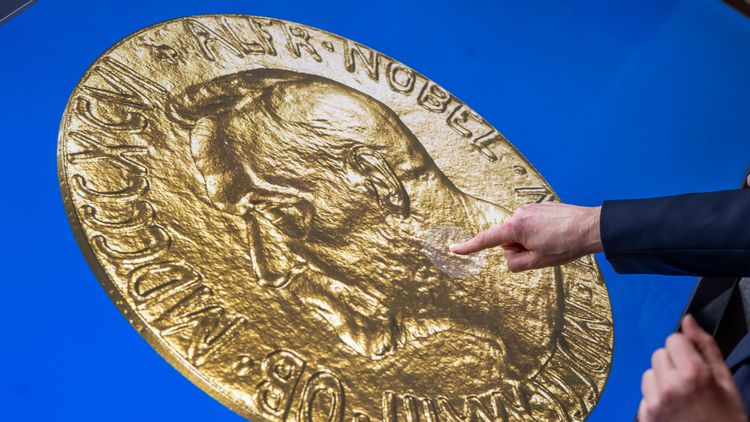
To mark the 90th anniversary of the retrospective awarding of the Nobel Prize to Carl von Ossietzky, the University Library commissioned a three-dimensional scan of the Nobel Prize medal. The results are now available for all to see online. University of Oldenburg / Daniel Schmidt
-
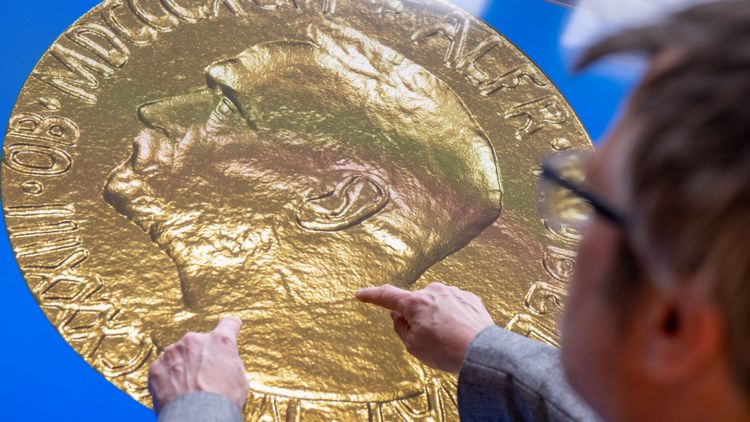
What you can do with your hands on a multi-touch table also works online with a mouse or touchpad: you can freely rotate and zoom in on the medal. University of Oldenburg / Daniel Schmidt
-
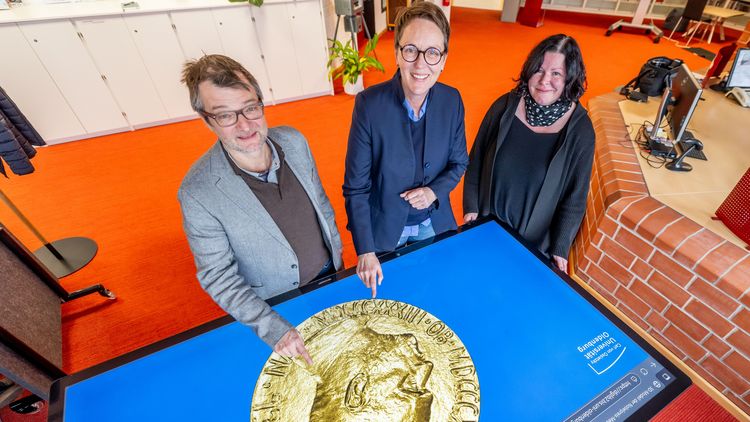
Excited about the 3D model of the Nobel Prize medal (from left): Dr Gunnar Zimmermann, Head of the University Archives; Heike Andermann, Director of the University Library; Alexandra Otten, University Library staff member. University of Oldenburg / Daniel Schmidt
Nobel Prize in 3D
Ninety years have passed since Carl von Ossietzky, after whom the university is named, was awarded the Nobel Peace Prize. The University Library is displaying an innovative 3D scan of his Nobel Prize medal on its website to mark the occasion.
“Pro pace et fraternitate gentium” (“For the peace and brotherhood of men”) – these words, along with three figures embracing each other, are engraved on one side of the gold medal, a 3D scan of which glows on the screen of the multitouch table in the University Library’s Learning Lab. The other side features a portrait of the prize’s founder, Alfred Nobel. But the most interesting feature is almost hidden: the words “Prix Nobel de la Paix 1935 – Carl von Ossietzky”, written in French and inscribed on the medal’s edge. The scan is a digital version of the Nobel Prize medal awarded to Carl von Ossietzky, the German journalist and pacifist after whom the University of Oldenburg was named. The original, designed by Norwegian sculptor Gustav Vigeland, weighing around 200 grams and made of 23-carat gold, is kept in a high-security vault in the University Library.
“December 10 marks the 90th anniversary of Carl von Ossietzky winning the 1935 Nobel Peace Prize, which was awarded to him retroactively in 1936,” explains Alexandra Otten, a historian and member of staff at the University Library. “We want to use the anniversary to draw the attention especially of newer members of the university to our namesake, his life story and the Nobel Prize he was awarded – the three-dimensional scan of the medal plays a key role here.”
A complex procedure with many advantages
The scanning procedure was highly complex. Using two different methods – photogrammetry and classic 3D scanning – three experts spent several hours in a room at the University Library, taking photographs of the medal from every angle under a canvas tent. Once the images had been assembled, a zoomable and rotatable digital model was created, and can now be seen on the University Library’s website. “The medal is very valuable, so for security reasons we rarely put it on public display,” Otten explains. In addition, both the medal and the accompanying Nobel certificate must be protected from wear and tear. “The scan is therefore a wonderful way for us to make the medal and the Nobel Peace Prize known to a wider audience,” she says.
Ossietzky was not allowed to receive the medal in person
Carl von Ossietzky himself never got to hold the medal or the certificate in his own hands. The Nazi regime in Germany refused to allow him to travel to Norway to receive the prize at the prize-giving ceremony in 1936. Just a year and a half later, in May 1938, Ossietzky died of tuberculosis, severely weakened after years of torture and abuse at the hands of the Gestapo in a Nazi concentration camp. By that time, the Nobel Committee had entrusted the medal and certificate to Ossietzky’s daughter Rosalinde after she emigrated to Sweden. Later on, Rosalinde not only campaigned for her father’s rehabilitation but also supported the university’s request to be named after Carl von Ossietzky. When Rosalinde died in 2000, she bequeathed a large part of the Ossietzky family estate to the university, including the Nobel Prize certificate and medal.
About Carl von Ossietzky
Carl von Ossietzky (1889-1938) was a journalist, a passionate democrat and pacifist, and a staunch defender of the Weimar Republic. He recognised the dangers of National Socialism early on. He was arrested shortly after Hitler came to power in 1933 and imprisoned in the Esterwegen concentration camp. After an intensive campaign by his friends and allies, the Norwegian Nobel Committee awarded him the Nobel Peace Prize in 1936. However, Ossietzky, who was interned in a Berlin hospital at the time and guarded by the Gestapo, was not allowed to receive the prize in person. He died in 1938 from the effects of his imprisonment.
When the University of Oldenburg was founded in 1973, the founding committee proposed naming the university after Carl von Ossietzky as a symbol of its social commitment. After almost 20 years of controversy, the Lower Saxony state parliament finally gave the green light for the university to bear the official name Carl von Ossietzky Universität Oldenburg in 1991.


Topics
- Astronomy
- Biology
- Botanical garden
- Chemistry
- Computing Science
- Cooperations
- Covid
- Culture
- Dutch Studies
- Early Career
- Economics
- Educational Sciences
- Energy
- Energy Research
- Environmental Sciences
- Equal opportunities
- German Studies
- Graduate academy
- Health Services Research
- Higher Education Policy
- History
- Human Medicine
- International affairs
- Marine Sciences
- Material Culture
- Medical ethics
- Medical Physics and Acoustics
- Music
- Neuroscience
- People
- Philosophy
- Physics
- Presidential Board
- Psychology
- Research
- Slavic Studies
- Social Sciences
- Special Needs Education
- Sport Science
- Study Affairs
- Sustainability
- Teacher Education
- Theology
- Transfer
- University Medicine
- Ukraine
- Wind Physics