
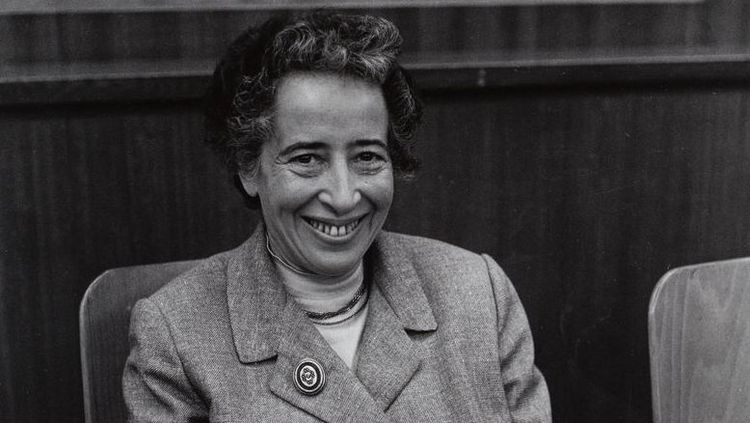
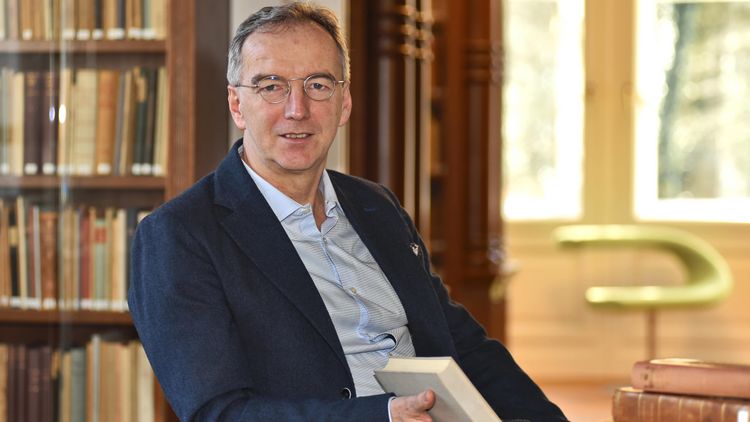


The world-renowned philosopher Hannah Arendt died fifty years ago today. In this essay, Oldenburg philosopher Matthias Bormuth examines Arendt’s views on independent thinking as a prerequisite for democracy.
Born in Germany to a Jewish family, Hannah Arendt (1906–1975) is known throughout the world as a leading thinker on democracy and human freedom. However, when she began her career in the Weimar Republic, studying under Martin Heidegger and Karl Jaspers, Arendt was apolitical. During her time as a student in the university towns of Marburg and Heidelberg she explored existential questions that had little bearing on public life with passion and erudition. But her thinking and views remained private, confined to a close circle of family and friends, and her doctoral thesis, Love and Saint Augustine, is a testament to this.
It was not until 1933, while living in Berlin, that the young intellectual developed political awareness. She had been doing historical research for her book Rahel Varnhagen: The life of a Jewish woman, and suddenly experienced first-hand what it was like to be a social outsider. She finished the book deeply disillusioned, living in exile in Paris after fleeing Nazi Germany: “Rahel had remained a Jew and a pariah. [...] She hailed young Heine with enthusiasm and great friendship – ‘only galley slaves know one another’.”
Her experiences of totalitarianism found expression in a historically reflected thinking which, with reference to Rahel Varnhagen, she described as a way to confront the harsh reality: “All that remained for her to do was to […] verbalise whatever happened.” It was in this spirit that she penned her most famous work, The Origins of Totalitarianism, after the Second World War had ended and she had emigrated to the United States. Precisely in her sociological perception of social oppression, Arendt retained a philosophical view of the inner life of the individual, which she considered a prerequisite and integral component of all political life: “For to destroy individuality is to destroy spontaneity.”
Arendt kept coming back to Socrates
The wondrous inner world of which Hannah Arendt writes grants freedom – the freedom of spontaneous thought and actions that run counter to the expectations of the external world. This idea, which Ahrendt found reflected in the works of the Enlightenment and above all Kantian thought, has its origins in antiquity. Consequently, Arendt kept coming back to Socrates, who had drawn the affluent youth of democratic Athens into critical discussions that questioned established truths. But because Socrates maintained that there was no such thing as fixed truth and engaged in ironic debates that challenged traditional certainties, Hannah Arendt believed that his mission had always been doomed to fail, and contrasted him with Plato, Socrates’ most talented student, who, horrified by the fate of his teacher (who was forced to kill himself by poison), embarked on a quest for a more exclusive philosophical vision based on higher concepts. Plato’s goal as a philosopher had been to set “absolute standards” for life in the public sphere, that is, to recommend himself as a statesman by presenting a “vision” of ideas and knowledge.
For Arendt as a modern philosopher, this approach was not an option. She adhered to the Socratic method which sought to produce a wide range of opinions through open discussion. Only in this way could the independence of the individual be preserved while at the same time promoting co-existence in a democratic world, she argued, while underlining that in addition to the inner dialogue that individuals conduct with themselves this form of political freedom requires social dialogue: “The faculty of speech and the fact of human plurality correspond to each other, not only in the sense that I use words for communication with those with whom I am together in the world, but in the even more relevant sense that speaking with myself I live together with myself,” she wrote. Her review of ancient philosophy thus culminates in a statement that applies to every modern community: “Men not only exist in the plural as do all earthly beings, but have an indication of this plurality within themselves.”
A critical appraisal of totalitarian and autocratic regimes
This conviction forms the basis of the political philosopher’s examination of totalitarian and autocratic regimes. For such regimes, individual or collective spaces in which spontaneous conversations take place are undesirable. An autocratic regime will instead assert seemingly unambiguous and absolute interpretations of reality that do not permit alternative views and use violent means to exclude or even eliminate those who think differently. The result, according to Arendt, is a dramatic disengagement from reality: “The total explanation of the past, the total knowledge of the present and the reliable prediction of the future,” give those in power the advantage of being able to act “independently of all experience”.
In opposition to this Arendt advocates a model of meaningful freedom. However, plurality of one’s own life and public life requires considerable intellectual labour on the part of the individual if it is not to end in the empty arbitrariness of mere opinions. This is why, according to Arendt, human freedom, if it is to have real meaning, is always bound to the obligation of Socratic reflection, or what Kant referred to as “thinking for oneself”. Living a philosophical life requires strength.
Arendt's comparison of revolutions
In the 1960s, as an expression of her gratitude to American democracy, Arendt expanded on her concept of political freedom from a different perspective in her book On Revolution. The book focuses on the idea of small councils and communes and takes a sceptical view of large parties and opinion-forming entities like mass media, which Arendt argues have always had a dreadful impact in the United States. She was fascinated by the founding fathers and at the same time fully aware that the recurring danger of tyrannical and dictatorial leaders requires a complex system to maintain the separation of powers.
Nevertheless, compared to the revolutions in France and Russia, Arendt deemed the revolution by which the American state was founded to be the more successful model. The French Revolution, she argued, had fuelled fears about the freedom gained by the councils among state functionaries, giving the latter an excuse to resort to partisan coercion and state violence. In the case of the Russian Revolution and the founding of the Soviet Union, Arendt highlights how those in power initially professed their commitment to the council system, only to eradicate it and create a centralised one-party dictatorship once the new state had been established.
The “banality of evil” and a global controversy
Arendt continued to pursue her political leitmotif of liberal spontaneity during the crisis provoked by the Vietnam War. She was deeply impressed by the American resistance movement that emerged around 1970 against the US government's deceitful policies. In her essay Civil Disobedience, she evokes Henry David Thoreau and her ancient Greek role model Socrates, and contrasts the latter’s encouragement of public discussion and critical thinking with a collective “thoughtlessness”, the nefarious effects of which she had previously illustrated as a political journalist in her work Eichmann in Jerusalem: A Report on the Banality of Evil, a book that sparked a global controversy.
Irrespective of whether Arendt is correct in all her judgements, it can be said that her contentious reflections on guilt and responsibility strike at the very core of the matter. Stressing the importance of independent thinking as advocated during the Enlightenment, she once stated: “Nobody has the right to obey, according to Kant.” Consequently, to come closer to the historical truth which none of us can ever fully grasp, it must be possible to express even sensitive opinions in conversation. Only courageous reflection can prevent people from becoming willing accomplices to social manipulation, she admonished.
Arendt reiterated the importance of being able to spontaneously oppose perceived constraints in the context of the Vietnam War, but noted that this form of civil courage is seldom observed: “Although we know that human beings are capable of thinking – of having intercourse with themselves – we do not know how many indulge in this rather profitless enterprise; all we can say is that the habit of thinking, of reflecting on what one is doing, is independent of the individual’s social, educational, or intellectual standing.” The courage for such defiant freedom arises spontaneously, often in precarious situations in which traditional truths are no longer tenable: “Good men become manifest only in emergencies, when they suddenly appear, as if from nowhere, in all social strata,” she observed.
A passion for spontaneous action
Hannah Arendt’s political thinking is most evident in her passion for spontaneous action. For Arendt, democracy begins with the individual, who is given the internal and external space to reflect on life in all its irrevocable ambiguity both on their own and with others. In some cases, such reflection may lead to rebellious resistance, without producing a partisan revolution which does not necessarily lead to clear advances.
This Socratic trait in her thinking was also central to her final work, The Life of the Mind, which was unfinished at the time of her death in December 1975. Here she quotes the Roman politician Cato, an opponent of the dictator Caesar, who, like Socrates, regarded internal dialogue as a prerequisite for political life: “Never is he more active than when he does nothing, never is he less alone than when he is by himself.” Thus, for Hannah Arendt, political thinking means creating personal spaces for reflection, free of societal controls and based on trust in the individual’s capacity for spontaneous thought. And such rebellious independent thinking requires a democratic community, so that after personal contemplation people can come together to exchange views.
Meaningful reflection can only develop in the context of a dialogue that challenges the traditional concepts and ideas presented to the individual on the cultural stages of society. In this sense Hannah Arendt was a teacher in the Socratic tradition, using her books, her lectures and above all her seminars to bring people together. In his eulogy to Arendt, Jerome Kohn, her last assistant, recalled her classes at the New School for Social Research in Manhattan as follows: “We now found ourselves in a space of equality, where no one commanded and no one obeyed, a space where one’s own opinion counted as much as any other, at least as long as one remained convinced of it, as long as one was not persuaded by a different opinion. In other words, we now saw freedom in a way we had not before, we felt free and equal, which in Hannah Arendt’s terminology meant that we were appearing in public, and that we were engaging in politics, of all things, where freedom and equality have rarely if ever co-existed in a state of stability.”
An essay by Prof. Dr Matthias Bormuth