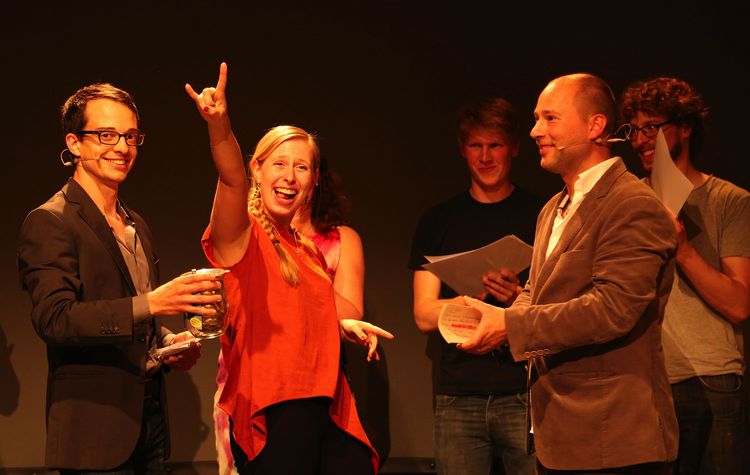
Einen unterhaltsamen und zugleich lehrreichen Abend bescherten Studierende und Nachwuchswissenschaftler von der Universität Oldenburg am Montag rund 150 Zuschauern in der Exerzierhalle des Oldenburgischen Staatstheaters. Vor ausverkauftem Haus traten sie beim 6. Science Slam der Universität gegeneinander an. Das Publikum stimmte über die Sieger ab – nach ihrem wissenschaftlichen Gehalt und dem Unterhaltungswert. Drei „Slammer“ konnten sich über Preise freuen: Bianca Brüggen, Maurits Halbach und Oliver Richters.
Der Science Slam ist eine in Deutschland noch recht junge Form des wissenschaftlichen Wettbewerbs, in dem insbesondere Nachwuchswissenschaftler ihre Forschungsergebnisse in zehnminütigen Kurzvorträgen populärwissenschaftlich präsentieren. So ging es am Montagabend um die Frage, ob Fische ein Drei-Sekunden-Gedächtnis haben und um einen Cartoon, der die Unterscheidung zwischen Natur und Gesellschaft zeichnerisch verdeutlicht. Darüber hinaus erfuhren die Zuschauer, was ein besonders empfindliches Lichtmikroskop über die Netzhaut verraten kann, warum das Modell des Wirtschaftskreislaufs mit physikalischen Gesetzen in Konflikt steht und wie man die Bindung zwischen Pastoren und Kirchenmitgliedern künftig stärken könnte. Die Vielfalt der Themen spiegelt die breitgefächerten und interdisziplinären Forschungsfelder an der Universität Oldenburg wider.
Die Gewinner im Überblick:
1. Platz: Bianca Brüggen (Promovendin, Arbeitsgruppe Neurosensorik am Department für Neurowissenschaften): „Super Mario Bros. Stehen sie auf derselben Seite?“, 500 Euro, gestiftet von der Universitätsgesellschaft Oldenburg (UGO)
2. Platz: Maurits Halbach (Student, Arbeitsgruppe Biodiversität und Evolution der Tiere am Institut für Biologie und Umweltwissenschaften): „ClownfischZirkus“, 150 Euro und ein Fachzeitschriften-Abonnement, gestiftet von der Graduiertenakademie und dem Spektrum Wissenschaftsverlag
3. Platz: Oliver Richters (Promovend, Institut für Volkswirtschaftslehre am Department für Wirtschafts- und Rechtswissenschaften): „Das Perpetuum Mobile in Wissenschaft und Praxis“, Fachzeitschriften-Abonnement, gestiftet vom Spektrum Wissenschaftsverlag
Organisatoren der Veranstaltung sind das Forschungszentrum Neurosensorik, das Oldenburgische Staatstheater, die Graduiertenakademie der Universität Oldenburg, die Graduiertenschulen für Geistes- und Gesellschaftswissenschaften (3GO) und für Naturwissenschaft und Technik (Oltech) und das DFG-Graduiertenkolleg Sensorybio.