
The University of Oldenburg contributes to environmental protection and species conservation in many ways. Making its campuses more nature-friendly is also on the agenda, with numerous projects already underway and many green plans for the future.
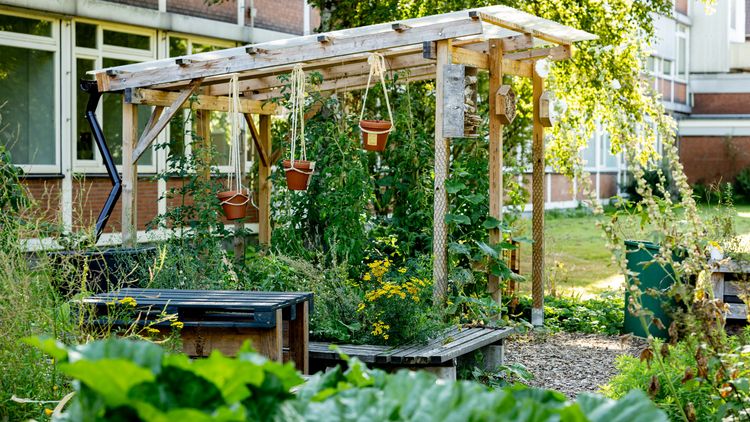
Wildflowers grow freely between Buildings A10 and A7, attracting bees, wasps and butterflies with their colourful blooms. Rosemary, chives and mint thrive in a herb spiral bed, while insects crawl between the cracks and crevices and warm themselves in the sun. A small pond entices mosquitoes and blackbirds. This area was already a green space before flowers and herbs grew here, recalls Anna Sarah Krämer, the university’s climate protection manager. But it mainly consisted of grass that was mowed on a regular basis.
The more structurally diverse an area is, the better it is from an ecological perspective
Anna Sarah Krämer; climate protection manager
A lot has happened on this small patch of the university campus over the past three years. The Student Council (AStA) has constructed the Campus Garden, and right next to it, educationalist Professor Dr. Ines Oldenburg and her students have created the Campus Field. Garden design and vegetable growing come together here to promote biodiversity. And nature also benefits. “The more structurally diverse an area is, the better it is from an ecological perspective,” explains Krämer, who is the university’s contact person for all matters relating to climate protection and sustainability. It is a declared goal of the university to make its campus locations more biodiverse in the long term, in line with the climate protection concept that was adopted in 2022.
For a greener campus
The university has set itself the ambitious goal of becoming climate neutral by 2030. A number of large-scale projects feature on the agenda, from making buildings more energy-efficient by installing PV systems and solar modules to reducing emissions from daily transportation. But there are also smaller areas of action, such as reconceptualising the university campus as a habitat for people, flora and fauna alike. “Ecological projects have the advantage that they can be implemented relatively quickly and cost-effectively compared to other climate protection measures,” explains Krämer. The university’s location is already relatively green – situated on the city of Oldenburg’s outskirts, with the Haarenniederung nature reserve on its doorstep, an abundance of old trees at the Wechloy campus, and extensive lawns between buildings. Nevertheless, there is still room for improvement.
To boost biodiversity and improve the microclimate, in November 2024 a group of employees and students planted trees on a patch of land covering around 180 square metres just a few metres away from the Campus Garden. The result: a walkable Tiny Forest. Around 450 seedlings belonging to 23 different tree species now grow here, including apple, cherry, pear and currant, as well as willow, maple and beech.
Just a few steps away, behind Building A1 and not far from the lecture hall centre, at the end of last year a team led by Professor Dr. Dirk Albach of the Institute of Biology and Environmental Sciences created a new pond. The addition of this small body of water has improved rainwater retention, and it is now home to numerous amphibians and small creatures. In a similar project implemented on the Wechloy campus in 2024, a team led by Wolfgang zur Brügge from the university’s facility management office cleared a rainwater retention basin behind Building W32 to promote its biotope character. And in the courtyard of Building A5, Krämer herself, in collaboration with student representatives from the Sustainability Economics and Management (SEM) programme, built and planted several raised garden beds.
Scientific data is also playing a role in the university’s ecological projects. For example, the data from a breeding bird monitoring system shows which species are found and breed on the campus grounds, how often, and at which locations. A group of students launched the project in spring 2024, with help from the Migration Ecology research team led by Professor Dr. Heiko Schmaljohann. They will continue to gather the data every spring at both the Haarentor and Wechloy sites. Twenty-two breeding species have been identified so far, including jackdaws, wood pigeons, great tits and wrens. Seventeen more have been observed searching for food on campus. “We can use the results as input for further bird protection measures,” says Krämer.
Plans for insect nesting sites
“We receive a great deal of support from the university for the changes we initiate with our measures,” says Krämer, who relies on collaborative formats wherever possible. Further projects are currently in the planning stage. The Presidential Board has allocated to each of the university’s six faculties a sustainability budget of 10,000 euros per year for the years 2025 and 2026. Students and doctoral candidates from the School of Mathematics and Science are using the funds for three projects scheduled for completion by autumn 2026, reports Dr Andreas Hiemstra, Coordinator for Studying and Teaching. The first, located at Wechloy campus, is a sandarium – a large, specially designed sandy area in a sunny location that serves as a nesting and living space for ground-nesting wild bees. In the second project, a heat traffic light that indicates when it’s time to turn on the heating in seminar rooms is in development. In the third project, a special container is being designed for use in future rubbish collection campaigns on the university grounds.
The University of Oldenburg is also part of an international initiative aimed at making campuses more nature friendly. In December 2022, it became a founding member of the continuously expanding global network Nature Positive Universities, which was launched by the United Nations Environment Programme and the University of Oxford and now encompasses more than 500 universities. The initiative aims to promote effective measures in the field of biodiversity and nature conservation and offers an additional platform for the exchange of information about ongoing ecological projects at universities across the globe, on subjects such as how to measure and monitor success in a simple and accessible way. “It's not so easy to measure our results by methodological standards,” says Krämer, “But compared to other universities, we've already come a long way.”
Many hurdles to clear
A number of factors must be taken into consideration whenever employees or students propose an ecological project for the university grounds. “The outdoor areas serve many different purposes and interests,” Krämer explains. Fire safety assembly points and fire brigade access roads are off limits for projects that involve a lot of plants or ponds. Safety always comes first on campus. For example, although dead wood is a good habitat for animals and plants, old and diseased trees cannot be left standing because falling branches could pose a threat to passers-by.
To advance the ecological redesign of the campus, the climate protection concept also envisages a cross-departmental utilisation concept for all locations. “This will make it possible to identify additional areas for ecological projects and coordinate them more effectively,” says Krämer. “We can help to improve the quality of life and sense of wellbeing on our campus. And perhaps our campus can even serve to inspire students, employees and people from outside the university to design their own surroundings with ecological aspects in mind.”