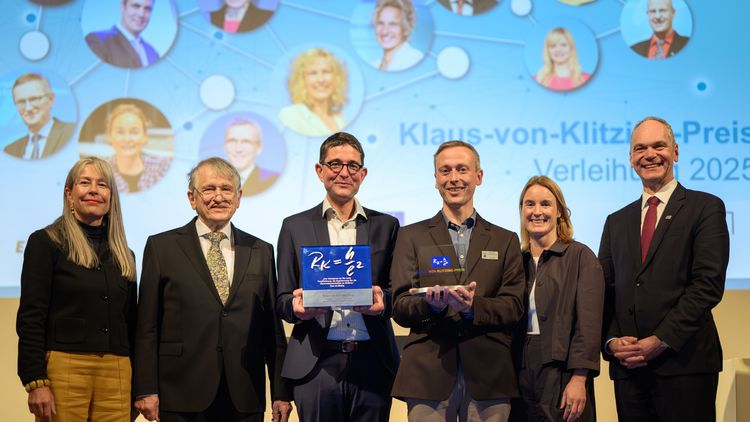
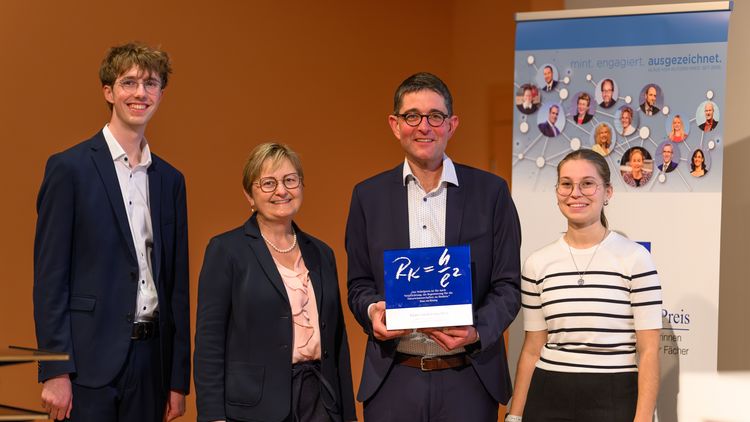
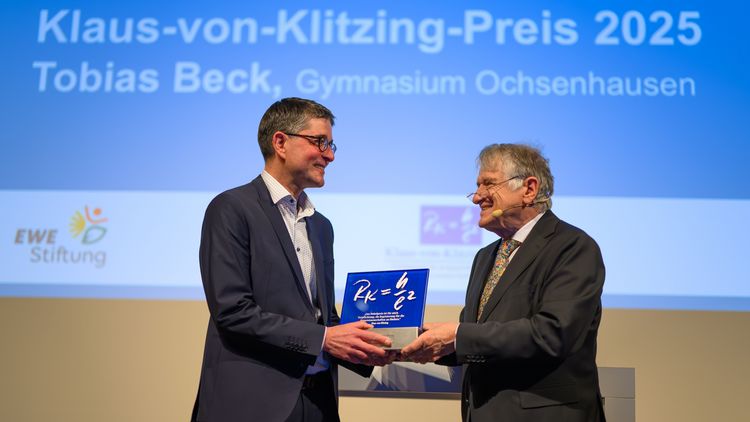


This year's Klaus von Klitzing Prize goes to Tobias Beck and thus to Upper Swabia. The award, worth €20,000, was presented on 18 November during a ceremony in Oldenburg by its namesake and Nobel Prize winner Klaus von Klitzing. Sebastian Schneemelcher from Wittmund was delighted to receive the special prize for primary school teachers.
Building a sky lantern out of a bin bag, a piece of wire and some methylated spirits, then flying it in the classroom: what sounds like a forbidden prank is actually a normal lesson for Tobias Beck. The physics, maths and technology teacher knows exactly how to get his students excited about STEM subjects – thanks in part to his many years of theatre experience and appearances on the science show ‘Die Physikanten’. The former journalist and career changer now puts his acting talent to good use at a secondary school in Ochsenhausen, Baden-Württemberg. There, he may occasionally dance around the classroom with a water canister in his hand to demonstrate an experiment. But his commitment does not end in the classroom: Beck also promotes STEM subjects outside of school. For this commitment, he has now been awarded the Klaus von Klitzing Prize 2025 at the EWE Forum Alte Fleiwa in Oldenburg.
Tobias Beck had previously successfully prevailed against 38 competitors from all over Germany. The University of Oldenburg and the EWE Foundation have jointly awarded the Klaus von Klitzing Prize, worth 20,000 euros, since 2005. It honours outstanding commitment in the STEM subjects of mathematics, computer science, natural sciences and technology. In addition to Nobel Prize winner in physics Prof. Dr. Klaus von Klitzing, the jury also includes representatives from the University of Oldenburg, the Oldenburg Chamber of Industry and Commerce, the EWE Foundation, the Wesermarsch Economic Development Agency and the headmistress of the Graf-Anton-Günther-Schule, Nicole Voigtländer-Kunze.
The jury was particularly impressed by Beck's approach to inquiry-based learning. For his favourite field, experimentation, he prefers to use everyday household items such as cooking pots and plastic bottles. The experiments can often be carried out by the pupils themselves.
Maintaining interest in STEM beyond puberty
Tobias Beck wants above all to awaken emotions in children and young people – this makes them much more engaged. He is particularly keen to encourage younger pupils, as children in the fifth and sixth grades are still especially curious. This curiosity often wanes during puberty. In order to make targeted use of this early enthusiasm and carry it over into the higher grades in the long term, he introduced the school subject ‘N-FOX’ (natural science research in Ochsenhausen). Here, children can become researchers themselves, carry out various experiments and find out for themselves how everyday processes work.
He also contributes his knowledge outside of school. In 2014, Beck took over as director of the Schülerforschungszentrum Südwürttemberg e. V., a non-profit institution in the South Württemberg region that aims to promote and inspire young talent in STEM subjects. To date, over 200 teams of school students have been formed there to take part in the nationwide ‘Jugend forscht’ competition. Beck has personally supervised 100 of these teams. School students who have won the competition under his guidance have even achieved international success. For example, they took first place at the Stockholm Junior Water Prize 2024 in Sweden.
At Ochsenhausen Grammar School, he also coordinates Erasmus student exchange programmes with Turkey, the Netherlands, Czechia, Italy and France. In workshops and training courses, he passes on his passion for lively experiments to teachers from all over Germany.
‘With his humorous and practical teaching style, Tobias Beck succeeds in inspiring pupils of all grades to take an interest in STEM subjects,’ explained University President Prof. Dr. Ralph Bruder at the award ceremony. ‘Through his method of inquiry-based learning, he teaches important fundamentals of scientific work at an early stage. His successes at “Jugend forscht” and his work at the Student Research Centre have made a decisive contribution to establishing a sustainable and viable STEM education structure in Baden-Württemberg.’
Special prize for primary school teachers goes to Wittmund
For the second time, the EWE Foundation awarded a special prize worth €2,500 to dedicated primary school teachers in north-west Germany. It went to Sebastian Schneemelcher from Wittmund. The teacher impressed the jury with, among other things, a ‘maker space’ for self-directed technical learning. 3D printing, creative break activities and a partnership with the Wittmunder Wald e.V. nature conservation farm are further examples of his above-average commitment.
Klaus von Klitzing, who spent his early school years in Oldenburg, is, among other things, director of the Max Planck Institute for Solid State Research in Stuttgart and a member of the International Solvay Institute. He is also a member of the jury for the Wittgenstein Prize, which is awarded by the Austrian Research Council. In 1980, he discovered a new quantum effect for which he received the Nobel Prize in Physics in 1985. The Von Klitzing constant, named after him, has had a significant influence on modern semiconductor development and precision measurement technology. In 2006, he received an honorary doctorate from the University of Oldenburg.