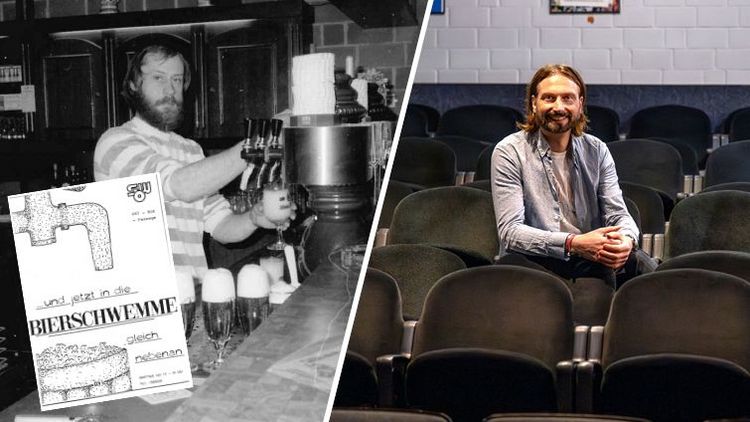


The Unikum is turning 40. Where once there was a pub called Bierschwemme offering bowling, cabaret and cheese skewers there is now a theatre offering a wide range of cultural events on its two stages – by students and for students.
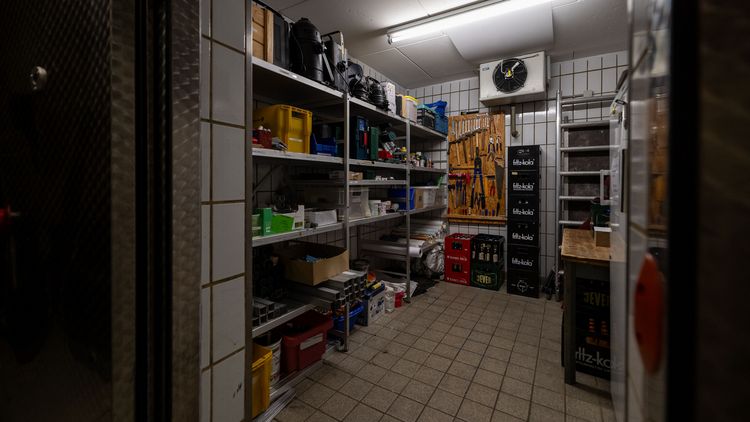
Jürgen Boese pushes a heavy silver-coloured sliding door aside to reveal a room with walls covered in white tiles and an old, yellowing cooling unit standing proudly against one of them. It looks like a cold storage room for a catering business. And indeed, chips, currywurst, cheese skewers and meatballs were once stored here, in what is now the backstage area of the Unikum theatre. But that was a long time ago. Today the room is filled with things for putting on a show: spotlights, tools, cable reels, clothes rails with costumes, masks and wigs.
Now a venue for cultural events such as plays, comedy shows and cinema, back in the 1980s the location was used by a pub called Bierschwemme (or “pub” in English) which lured people to the campus in the evenings and had its own bowling alley. And the Student Services Cultural Office (Kulturbüro des Studierendenwerks) where Boese is now Cultural Advisor was once a snack bar. From his desk, he can still see what used to be the service hatch through which fried food was passed to be served to guests. On the tiles on the other side of the wall you can see the marks left by an extractor hood and grease splatters from times long past.
The first cultural events and pub nights in the 1980s
Right now, people are more interested than ever in participating in or attending cultural events here."
Jürgen Boese; Cultural Advisor at the Student Services Cultural Office
Originally, there were plans to move a bank branch into the premises below the university cafeteria, next to the canteen’s forecourt, but when that didn’t work out the Studierendenwerk (Student Services) decided to open its own event space here in 1985. The goal was to provide a stage for cabaret productions and student creatives. Then Gerhard “Gille” Ritzmann, a “trained teacher with a passion for culture,” as the NWZ newspaper describes him in a 2024 report on the history of the Unikum, opened a campus pub called Bierschwemme next door. It was Ritzmann who organised the first readings in Bierschwemme and served guests draft beer and meatballs made in the university canteen.
Boese, who studied educational science with a focus on culture at the University of Oldenburg, took over Ritzmann’s position in 2013. By that time Bierschwemme had long since closed its doors. “It wasn’t worthwhile to keep it going anymore,” says Boese. It was attracting ever fewer young students, especially during semester breaks. By the early 1990s it was clear that something had to change. Craftsmen and caretakers employed by the university were charged with renovating the premises and upgrading the technology. The Studierendenwerk established the permanent position of Cultural Advisor, which was filled by Gille. In 1992, the new Unikum opened its doors.
Theatre, cinema, comedy: increasingly diverse since the 1990s
Today, the two stages are firmly established as a venue for productions by various student groups, as well as guest performances. According to the annual report by the Studierendenwerk, 5,474 people attended events organised by the Cultural Office and the Oldenburg University Theatre (OUT) in 2024/25 alone. It was only during the Covid pandemic and after the switch to bachelor's and master's degrees that audience numbers dipped noticeably. But each time the Unikum was able to quickly recover. “Right now, people are more interested than ever in participating in or attending cultural events here,” Boese observes with satisfaction.
The OUT, the main user of the Unikum premises, brings theatre and cabaret to the stage. Students sign up for the theatre workshop to learn the basics of directing, design and acting. They also write and stage their own plays. The Cultural Office also organises its own productions, with a programme that includes the SpontanOL improv theatre festival, a short film competition, band contests and slams. The students of Unikino Gegenlicht, the second most frequent user of the Unikum premises, present a selection of complex, multi-layered films and organise film evenings – popcorn included.
Boese’s Cultural Office functions as a point of contact and advisory service, organising the allocation of rooms as well as providing technical support and know-how. It also brings cultural figures from outside the Unikum to the venue. “We recruit a mixture of established cabaret artists and newcomers whose performances attract young target groups,” Boese explains. This year, for example, the well-known German satirist Florian Hacke will be giving a performance to mark the Unikum’s 40th anniversary. Indeed, many artists who performed at the Unikum at the beginning of their careers went on to become famous: entertainer Harald Schmidt, cabaret artist Volker Pispers, comedians Till Reiners and Moritz Neumeier, the magician duo Siegfried & Joy, and satirist Sarah Bosetti, to name a few.
Plans for the future
Boese naturally wants to maintain the high standards that have now been achieved. But this is no easy task, he explains: “Launching a new project doesn’t take long, but establishing a new series of events for the long term is a real challenge given the constantly changing student body.” He dreams of turning the entrance area into a proper foyer. So far, an old wooden table at the entrance has doubled as the ticket office, and guests take their jackets with them to their seats. Asked about his goals for the future, Boese is emphatic: “Even more diversity, collaboration and exchange, also in the intercultural domain!” As ways to achieve this, he can imagine adding new formats to the programme or intensive networking with other venues for collaborative projects.
However, certain things from the past are to be left just as they are. In addition to the cold storage rooms, the Oldenburg Cabaret Days format which has been running for 30 years will remain intact. The policy of keeping drinks prices low for performances will also continue. And on festive occasions such as this year’s Unikum anniversary party, cheese skewers, potato salad and meatballs are back on the menu. “But with a vegan option, of course,” Boese comments reassuringly.