

Recognition portfolio
Initial consultation
Online consultation hour in stud.IP in the PLAR community forum.
You must be logged in to stud.IP to use the link.
Recognition portfolio
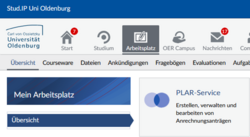
Here you will find an overview of the PLAR recognition portfolio.
All processing takes place in stud.IP. After you have taken part in the personal consultation with the PLAR-Service, the PLAR service button will be activated on your workstation.
Recognition form
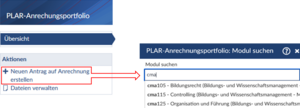
Explanatory statement
Please introduce yourself briefly (max. 500 words). Describe in your own words why you are submitting the application. Please refer to the skills you have acquired to date.
You should consider the following points when explaining your application:

Cover letter
The explanatory statement is your cover letter and therefore your most "personal" contact with the recognition matters specialist of a subject who will decide on your application. Take the opportunity to introduce yourself to them.


Curriculum vitae
In particular, your CV should contain precise details of your training, further education and, if applicable, professional activities.
You should consider the following points when prepairing your CV:

Skills
The aim of your CV is to show the skills you have acquired based on your career stages with as few gaps as possible.

Higher education entrance qualification
Which higher education entrance qualification do you have: a genereal or a subject-specific one?
However, information on your primary school attendance does not need to be included in your CV.

Range
Do you practise a hobby professionally or do you do voluntary work? You can list skills from all areas of life on your CV.
Good to know:
You only need to create your CV in the first module you recognize. As soon as you create new application for further modules, the data you have stored will be displayed automatically. You should therefore only add further applications after you have created your CV, as it is not possible to read out the data retrospectively.
Recognition synopsis
The purpose of the recognition synopsis is to demonstrate that you have already achieved the competence objectives of the module for which you are applying for recognition through skills and abilities acquired outside the university. The competence objective description of the module stored in stud.IP is automatically displayed.
Under "equivalent skills and abilities", you should describe in your own words what you can do. Refer to the content of the module's competence objectives, but do not copy them word for word. Under "Learning context", indicate where you have learnt or applied this. To do this, link the relevant stages from your CV.
You can create up to 15 entries in the recognition synopsis to describe your skills. Assign corresponding evidence to each entry that clearly shows that you have the skills and abilities described in the respective entry. If necessary, refer to specific pages in the supporting documents or highlight the relevant paragraphs. You can provide a maximum of two pieces of authentic evidence (individual certificates and curricula) and two references/certificates per entry.

Evidence
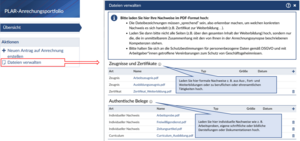
You only need to upload your documents once to stud.IP and can then link them as often as you like in the portfolio.
Within the scope of the recognition portfolio, a distinction is made between two types of evidence:
- Certificates and diplomas (= formal evidence)
- Authentic evidence and curricula (= non-formal evidence)

Formal certificates
- from education, training and further education
- for professional or voluntary activities

Authentic evidence
Each person has individual authentic evidence. This means that they can be very different - the following list therefore only contains examples:

work samples
- own publications (scientific articles, monographs)
- work reports
- Expert optinions (prepared by you)
- Written or pictorial representations of your procedures:
Notes, work plans, visualisations and presentations (graphics, illustrations, videos of drafts and results)


Curricula are excerpts from the educational programmes you have completed: overviews of learning content, learning objectives, learning processes
The diplomas and certificates do not have to be notarised.
If it is not clear from which context the certificates originate, please add appropriate explanations.
Please adhere to the protection regulations for personal data in accordance with the GDPR and agreements made with employers to protect business secrets.
Submission of the recognition portfolio
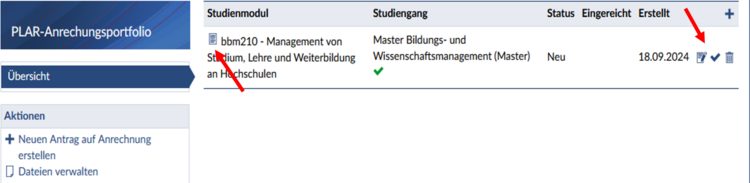
You can see the portfolio you have created in the overview list under the status "New".
You can continue to edit your portfolio at any time. 
When everything is complete, submit your portfolio to the PLAR-Service. 
Tip:
For more information on the module (e.g. content, literature, links), you can view the complete module description. 
Notes at the end

By submitting the recognition portfolio, you confirm that:
- all documents and evidence submitted relate to your own biography.
- all representations in the recognition synopses were created by you personally.


- You can only submit an application for recognition if you have not yet registered for the corresponding module examination (or if it is no longer possible to deregister). It is also not possible to submit a recognition application if you have already attempted an examination.
- As long as your recognition application has not yet been decided, you should continue to attend the module courses for which you have applied for recognition and, if necessary, register for module examinations in order not to miss the registration deadline.
