


How should we design incentives and price signals so that decentralised resources (like home batteries or rooftop PV) actually support the energy transition and decrease the burden on future energy systems?
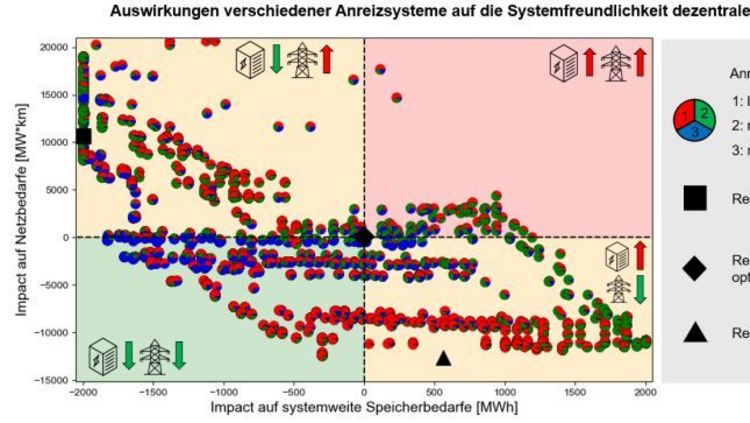
Decentralised assets optimize their operation based on price signals. Depending on how these signals are set, they can either ease the pressure on the system and reduce the need for new infrastructure or do the opposite and drive additional grid and storage expansion.
The new article by Karoline Brucke, Sunke Schlüters, Jan Buschmann, Dr. Benedikt Hanke, Dr. Carsten Agert and Dr. Karsten von Maydell, published in Applied Energy, shows:
- There is a trade-off between grid expansion and storage expansion: incentives and prices need to reflect both the overall situation in the power system and local bottlenecks.
- In wind-heavy regions, dynamic, location-specific information on grid usage is key to getting “system-friendly” behaviour from decentralised actors.
- In solar-dominated regions, price signals that focus more on the national energy balance work better.
- It is possible to find robust price structures that strike a good balance between grid and storage needs in regions with different local electricity mix
Our team extends the concept of “system friendliness” and develops indicators that show, for each node and line in the system, whether decentralised actors increase or reduce the need for additional grid and storage capacity. Using data for a future German energy system, they use hyper-parameter optimisation to test many different compositions of price signals that combine local and system-wide information.
The key message: well-designed, local and dynamic grid fees in combination with global electricity prices can steer decentralised behaviour in a way that benefits the whole system and helps avoid unnecessary and costly grid and storage expansion.
Interested in the details, methods and full set of results?
Read the full article here: https://s.dlr.de/ENeLx
What role do you think local, dynamic network tariffs should play in practice?